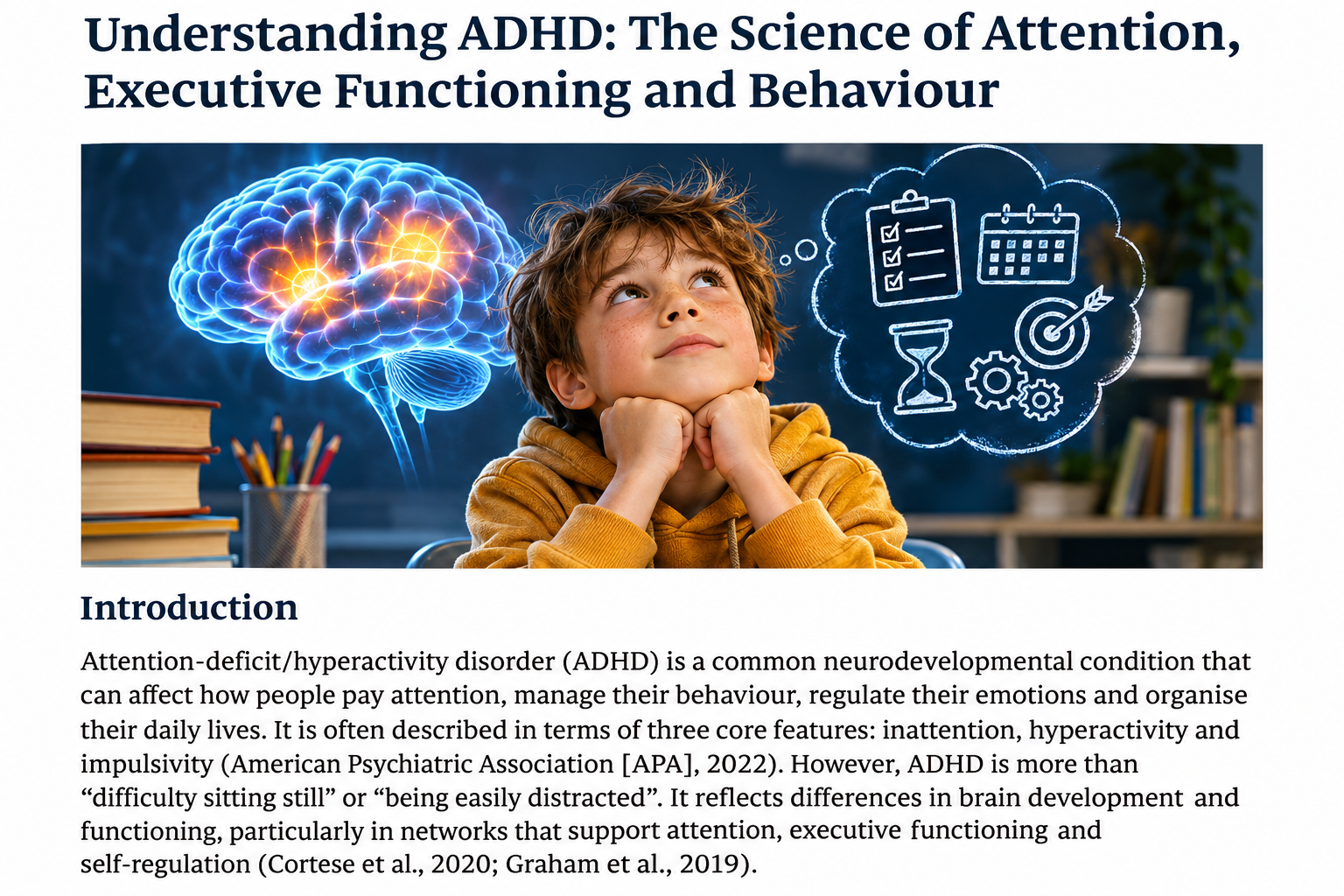
What Is ADHD?
Attention-Deficit/Hyperactivity Disorder (ADHD) is a neurodevelopmental condition characterised by persistent patterns of inattention and/or hyperactivity-impulsivity that interfere with functioning or development. Although commonly identified during childhood, ADHD can continue into adolescence and adulthood (American Psychiatric Association, 2022).
ADHD is not simply a matter of being distracted, restless or disorganised. Everyone experiences these behaviours occasionally. The distinction lies in their persistence, developmental appropriateness, impact across settings and degree of interference with daily functioning.
ADHD is generally described through three clinical presentations:
- Predominantly inattentive presentation: Difficulties sustaining attention, organising activities, following instructions, remembering responsibilities and completing tasks.
- Predominantly hyperactive-impulsive presentation: Excessive movement, restlessness, interrupting, difficulty waiting and acting without sufficient consideration of consequences.
- Combined presentation: Clinically significant symptoms of both inattention and hyperactivity-impulsivity.
Presentations may change as individuals develop. A child who displays pronounced physical hyperactivity may become an adult who experiences internal restlessness, impatience or difficulty switching off mentally.
The Neuroscience of ADHD
Scientific research indicates that ADHD is associated with differences in brain development, neural connectivity and the regulation of cognitive processes.
Neuroimaging studies have identified group-level differences involving several interconnected brain systems, particularly those supporting attention, response inhibition, reward processing and executive control (Cortese et al., 2012; Hoogman et al., 2017).
The Prefrontal Cortex
The prefrontal cortex contributes to planning, decision-making, working memory, inhibition and goal-directed behaviour.
These abilities help individuals resist distractions, organise tasks and consider consequences before acting.
Research suggests that some individuals with ADHD experience difficulties in the effective coordination of these functions. However, ADHD cannot be attributed to a single abnormal brain region, and brain scans are not currently diagnostic tests for the condition.
The Basal Ganglia
The basal ganglia participate in motor control, learning, motivation and the selection of actions.
Research has identified differences in certain subcortical structures among groups of people with ADHD, although findings vary according to age, methodology and individual characteristics (Hoogman et al., 2017).
Brain Networks and Attention
Attention depends on communication among multiple neural networks.
The default mode network, which is involved in internally directed thought, interacts with networks supporting externally focused attention and cognitive control.
Researchers have investigated whether differences in the coordination of these networks contribute to attentional lapses in ADHD. Findings suggest that network regulation may be relevant, although the mechanisms remain under investigation.
Importantly, neuroscience describes statistical patterns across research groups. It does not establish that every person with ADHD has the same neurological profile.
Executive Functioning: The Brain's Management System
Executive functions are higher-order cognitive processes that enable people to regulate their thoughts and actions in pursuit of goals.
They include working memory, inhibitory control, cognitive flexibility, planning and organisation.
Barkley (1997) proposed an influential account linking ADHD to difficulties in behavioural inhibition and related executive processes. Subsequent research has shown that executive-function difficulties are common in ADHD but are not universal or unique to the condition.
Consider a student preparing for an examination.
The student understands the material and genuinely intends to study. However, beginning the task, estimating the required time, organising notes and resisting distractions may prove difficult.
The resulting problem is not necessarily a lack of knowledge or willingness. It may involve difficulty translating intentions into sustained, organised behaviour.
Similarly, an adult may be highly capable professionally yet repeatedly miss appointments, underestimate deadlines or struggle with administrative responsibilities.
These difficulties can produce frustration when others interpret them as carelessness.
ADHD and Working Memory
Working memory enables individuals to hold and manipulate information over short periods.
For example, remembering a sequence of verbal instructions while carrying them out requires working memory.
Research has identified working-memory weaknesses in some individuals with ADHD, although performance varies substantially (Martinussen et al., 2005).
In educational settings, these difficulties may become apparent when children are expected to remember several instructions simultaneously.
A child might successfully complete the first instruction but forget the remaining steps.
Useful strategies include presenting instructions in manageable stages, providing written reminders and checking comprehension without creating embarrassment.
Attention, Motivation and Reward
One of the apparent contradictions of ADHD is that an individual may struggle to concentrate on routine activities while remaining deeply absorbed in an interesting task.
This is sometimes described informally as hyperfocus.
Although experiences of intense task engagement are reported by some people with ADHD, hyperfocus is not an official diagnostic criterion.
Research has examined how motivation, reinforcement and reward processing influence ADHD-related behaviour (Luman et al., 2010).
Tasks involving immediate feedback, novelty or personal interest may be easier to sustain than tasks involving delayed rewards.
For example, a person may spend hours solving a fascinating technical problem but struggle to complete a brief administrative form.
The difference does not necessarily indicate that the person is choosing to be uncooperative. The motivational and cognitive demands of the tasks differ.
ADHD in Children
ADHD may influence academic performance, classroom participation, social relationships and emotional wellbeing.
Common signs include difficulty completing assignments, losing materials, forgetting instructions, interrupting conversations and struggling to remain seated when expected.
However, not all children with ADHD are visibly hyperactive.
Some are quiet, inattentive and easily overlooked.
A child who appears to be daydreaming may be experiencing significant difficulty maintaining attention, even without disruptive behaviour.
This distinction is important because children with predominantly inattentive symptoms may receive less immediate attention than those displaying conspicuous hyperactivity.
Educational assessment should consider the child's developmental history, learning environment, cognitive profile and possible co-occurring conditions.
ADHD in Adults
Adult ADHD may affect employment, relationships, financial organisation, household responsibilities and emotional wellbeing.
Some adults describe lifelong difficulties that were never formally investigated during childhood.
Symptoms may become more apparent when increasing responsibilities place greater demands on independent organisation.
For example, someone who performed well at school within a highly structured environment may experience difficulties at university or in employment when required to manage competing deadlines independently.
Adult presentations may involve internal restlessness rather than obvious physical hyperactivity.
A comprehensive assessment should establish whether the relevant symptoms began during development, occur in more than one setting and cause meaningful impairment.
ADHD, Emotional Regulation and Self-Esteem
Although emotional dysregulation is not a core diagnostic criterion for ADHD, difficulties managing emotional responses are frequently reported and studied.
Some individuals experience intense frustration, impatience or difficulty recovering from upsetting situations.
Repeated criticism can also affect self-esteem.
A child who frequently hears that they are lazy, careless or disruptive may begin to internalise those descriptions.
Over time, negative experiences may contribute to anxiety, avoidance or reduced confidence.
Supportive approaches should distinguish between the individual and the behaviour, while recognising that ADHD does not eliminate personal responsibility or the value of developing coping strategies.
ADHD and Other Learning Differences
ADHD may co-occur with dyslexia, autism, developmental coordination disorder, anxiety and other conditions.
ADHD and dyslexia are distinct.
Dyslexia primarily involves difficulties associated with accurate or fluent word reading and spelling, whereas ADHD concerns patterns of attention and/or hyperactivity-impulsivity.
Nevertheless, the two conditions may occur together, potentially increasing the complexity of learning difficulties.
A child experiencing both reading difficulties and impaired sustained attention may require support addressing each area rather than assuming that one diagnosis explains every challenge.
This is one reason comprehensive assessment is valuable.
How Is ADHD Assessed?
ADHD assessment is a clinical process rather than the interpretation of a single questionnaire or cognitive test.
According to the National Institute for Health and Care Excellence (NICE, 2018), diagnosis should be undertaken by an appropriately qualified specialist following a full clinical and psychosocial assessment.
Relevant evidence may include developmental and educational history, clinical interviews, observations, information from different settings and standardised rating scales.
Psychometric assessments can provide useful supplementary information about cognitive abilities, attention, executive functioning and associated learning needs.
However, no single psychometric score, computerised attention test or brain scan can independently establish an ADHD diagnosis.
Assessment should also consider alternative explanations and co-occurring difficulties, including sleep problems, anxiety, trauma-related symptoms and learning disorders.
Evidence-Based Support and Intervention
Effective support depends on the individual's age, needs, circumstances and preferences.
For children, strategies may involve parent or caregiver support, classroom adjustments, predictable routines and behavioural interventions.
For adults, approaches may include structured psychological interventions, organisational strategies, environmental adjustments and, where appropriate, medication prescribed and monitored by a qualified clinician.
Practical supports can include:
- Breaking complex tasks into smaller steps.
- Using calendars, reminders and visual schedules.
- Reducing unnecessary distractions.
- Providing clear, concise instructions.
- Establishing consistent routines.
- Allowing appropriate movement breaks.
- Using external organisational systems rather than relying entirely on memory.
NICE (2018) provides evidence-based guidance on recognition, diagnosis and management, including medication and non-pharmacological support.
Interventions should be individually tailored and reviewed for effectiveness.
Recognising Strengths Without Stereotyping
Discussions of ADHD increasingly recognise that individuals may demonstrate creativity, enthusiasm, adaptability and intense engagement with personally meaningful activities.
However, these qualities should not be presented as universal characteristics of ADHD or as guaranteed advantages arising from the condition.
People with ADHD differ in their abilities, personalities, experiences and support needs.
A strengths-based approach identifies an individual's actual capabilities while addressing the difficulties that interfere with everyday functioning.
The objective is neither to romanticise ADHD nor to define individuals entirely through their challenges.
Conclusion
ADHD is a complex neurodevelopmental condition involving interactions among attention, executive functioning, motivation, behaviour and environmental demands.
Research has advanced our understanding of its neurological and psychological characteristics, but considerable individual variation remains.
Early recognition, appropriate clinical assessment and tailored support can help individuals understand their difficulties and develop effective strategies.
For children and adults alike, the most constructive approach combines scientific understanding with practical intervention, realistic expectations and respect for individual differences.
At Neuro Quest Consulting, we recognise the importance of understanding cognitive, educational and behavioural functioning within the broader context of an individual's development and everyday life. Appropriate psychometric assessment can help clarify learning and cognitive profiles and inform recommendations for support.
References
American Psychiatric Association. (2022). Diagnostic and statistical manual of mental disorders (5th ed., text rev.). https://doi.org/10.1176/appi.books.9780890425787
Barkley, R. A. (1997). Behavioral inhibition, sustained attention, and executive functions: Constructing a unifying theory of ADHD. Psychological Bulletin, 121(1), 65–94. https://doi.org/10.1037/0033-2909.121.1.65
Cortese, S., Kelly, C., Chabernaud, C., Proal, E., Di Martino, A., Milham, M. P., & Castellanos, F. X. (2012). Toward systems neuroscience of ADHD: A meta-analysis of 55 fMRI studies. American Journal of Psychiatry, 169(10), 1038–1055. https://doi.org/10.1176/appi.ajp.2012.11101521
Hoogman, M., Bralten, J., Hibar, D. P., Mennes, M., Zwiers, M. P., Schweren, L. S. J., et al. (2017). Subcortical brain volume differences in participants with attention deficit hyperactivity disorder in children and adults: A cross-sectional mega-analysis. The Lancet Psychiatry, 4(4), 310–319. https://doi.org/10.1016/S2215-0366(17)30049-4
Luman, M., Tripp, G., & Scheres, A. (2010). Identifying the neurobiology of altered reinforcement sensitivity in ADHD: A review and research agenda. Neuroscience & Biobehavioral Reviews, 34(5), 744–754. https://doi.org/10.1016/j.neubiorev.2009.11.021
Martinussen, R., Hayden, J., Hogg-Johnson, S., & Tannock, R. (2005). A meta-analysis of working memory impairments in children with attention-deficit/hyperactivity disorder. Journal of the American Academy of Child & Adolescent Psychiatry, 44(4), 377–384. https://doi.org/10.1097/01.chi.0000153228.72591.73
National Institute for Health and Care Excellence. (2018). Attention deficit hyperactivity disorder: Diagnosis and management (NICE Guideline NG87). https://www.nice.org.uk/guidance/ng87
Editorial note: This article provides general educational information and is not a substitute for individual clinical assessment or diagnosis.