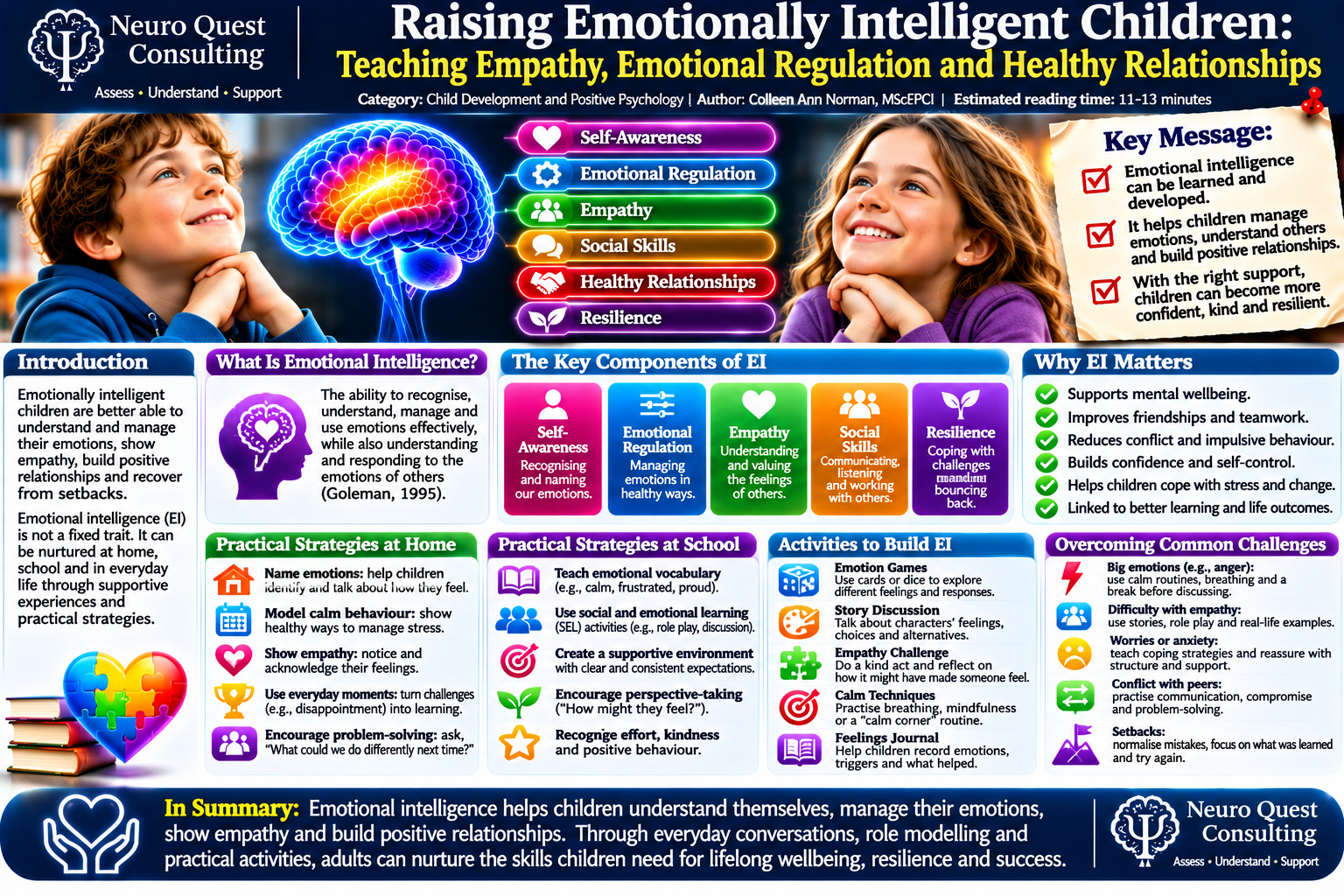
Introduction
A child who recognises that a friend is upset, manages disappointment without aggression or asks for help when overwhelmed is demonstrating important emotional and social abilities.
These skills contribute to relationships, learning and psychological wellbeing.
However, emotional development does not occur automatically or uniformly.
Children learn about emotions through relationships, observation, communication and experience.
Parents and teachers play an important role in helping children recognise feelings, understand different perspectives and develop constructive responses to challenging situations.
The objective is not to eliminate negative emotions.
Rather, it is to help children understand that emotions are normal while learning how to respond to them appropriately.
What Is Emotional Intelligence?
Emotional intelligence is a psychological construct involving the perception, understanding and regulation of emotions.
Salovey and Mayer (1990) introduced an influential conceptualisation of emotional intelligence.
Mayer, Salovey and Caruso (2004) subsequently described an ability-based model involving emotional perception, using emotions to facilitate thinking, understanding emotional information and regulating emotions.
However, emotional intelligence is not a single universally agreed-upon ability.
Different theoretical models and assessment instruments measure somewhat different characteristics.
For children, the practical emphasis is often on emotional awareness, regulation, empathy and social interaction.
Emotional Intelligence and General Intelligence
Emotional intelligence and general cognitive intelligence are related but distinct constructs.
Traditional intelligence assessments commonly examine reasoning, knowledge, working memory and other cognitive abilities.
Emotional intelligence concerns abilities associated with emotional information.
A child may demonstrate advanced mathematical reasoning while struggling to identify or express feelings.
Another child may demonstrate strong interpersonal understanding while finding certain academic tasks difficult.
Neither profile determines the child's overall worth or future success.
Emotional skills should be considered alongside cognitive, developmental and environmental factors.
Emotional Awareness
Emotional awareness involves recognising and identifying one's own emotional experiences.
Young children may initially describe feelings using broad terms such as happy, sad or angry.
As development progresses, they may learn more specific vocabulary, including disappointed, embarrassed, frustrated, anxious or proud.
Developing emotional vocabulary can help children communicate experiences more accurately.
For example, a child who says I feel disappointed because my friend cancelled our plans provides more useful information than simply saying I feel bad.
Adults can support emotional awareness through everyday conversations.
Teaching Children to Name Emotions
Parents can introduce emotional vocabulary during ordinary activities.
For example:
You seem frustrated because the puzzle is difficult.
You look excited about tomorrow's trip.
I wonder whether you felt disappointed when the game ended.
These statements should be offered tentatively rather than assuming adults always know what a child feels.
Children should be encouraged to describe their own experiences.
The objective is to develop understanding, not to impose emotional interpretations.
Understanding Emotional Regulation
Emotional regulation involves processes used to influence emotional experiences and responses.
Gross (1998) developed an influential framework describing different emotion-regulation processes.
These can involve modifying situations, directing attention, changing interpretations or regulating responses.
In childhood, emotional regulation develops gradually.
Younger children often require substantial adult support.
Over time, many children become increasingly capable of managing frustration, disappointment and emotional intensity.
However, development varies across individuals.
Why Children Sometimes Struggle With Strong Emotions
Children may experience intense emotions when tired, overwhelmed, disappointed or unable to communicate their needs.
Developmental differences can also influence regulation.
For example, some children experience difficulties with impulse control or sensory processing.
Others may be responding to stressful circumstances.
A child's emotional reaction should therefore be understood in context.
Adults should avoid assuming that every outburst is deliberate misbehaviour.
Co-Regulation: Why Adults Matter
Before children can consistently regulate emotions independently, they often rely on supportive adults.
This process is commonly described as co-regulation.
For example, a parent may help a distressed child by remaining calm, providing reassurance and supporting problem-solving.
The adult's response can help the child gradually learn effective strategies.
However, co-regulation does not require agreeing with every demand.
Parents can acknowledge emotions while maintaining appropriate boundaries.
For example:
I understand that you are angry, but hitting is not acceptable.
This distinguishes emotional experience from behaviour.
Teaching Healthy Responses to Anger
Anger is a normal emotion.
It may arise when children perceive unfairness, frustration or interference with their goals.
The objective is not to teach children that anger is wrong.
Instead, adults can help them recognise early signs of frustration and identify constructive responses.
Strategies may include taking a break, asking for help or explaining what has happened.
Children should also learn that aggressive behaviour can harm others.
Teaching emotional regulation involves combining understanding with clear behavioural expectations.
Anxiety and Emotional Development
Anxiety is another normal emotional experience.
It can help individuals recognise uncertainty or potential threats.
However, excessive or persistent anxiety may interfere with learning, relationships or everyday activities.
Parents can support children by listening to concerns, providing accurate information and encouraging manageable steps towards appropriate goals.
Repeated reassurance alone may not resolve significant anxiety.
When difficulties persist or substantially affect functioning, professional assessment may be appropriate.
Understanding Empathy
Empathy involves processes associated with understanding or responding to another person's emotional experience.
Researchers often distinguish between cognitive and affective aspects of empathy.
Cognitive empathy concerns understanding another person's perspective or emotional state.
Affective empathy concerns emotional responses to another person's experience.
These processes are related but not identical.
A child may understand that another person is upset without experiencing the same emotion.
Empathy also varies according to context, development and individual characteristics.
Teaching Perspective-Taking
Perspective-taking involves considering how another person might understand a situation.
Parents can encourage this skill through stories, conversations and everyday interactions.
For example:
Why do you think that character became upset?
What might your friend have understood about what happened?
Could there be another explanation?
Such questions encourage children to consider multiple perspectives.
However, adults should avoid suggesting that they can know another person's thoughts with certainty.
Empathy and Kindness
Empathy can contribute to compassionate behaviour, but the relationship is not automatic.
A child may recognise another person's distress yet be unsure how to respond.
Adults can model practical expressions of kindness.
These may include offering assistance, listening or respecting another person's boundaries.
Children should also learn that empathy does not require accepting mistreatment or neglecting their own needs.
Healthy relationships involve consideration for both oneself and others.
Emotional Intelligence and Friendships
Friendships provide opportunities to practise communication, cooperation and conflict resolution.
Children may need support understanding different preferences, negotiating activities or responding to disagreements.
Parents can help by discussing specific situations without immediately assigning blame.
For example:
What happened?
How did you feel?
What might help you resolve the disagreement?
The objective is to develop social problem-solving skills rather than simply instructing children to apologise.
Teaching Conflict Resolution
Conflict is a normal part of relationships.
Children benefit from learning that disagreements can be managed without aggression or humiliation.
A simple conflict-resolution process might involve identifying the problem, listening to each person's perspective and considering possible solutions.
Children can then evaluate which solution is fair and practical.
However, not every conflict should be treated as a disagreement between equally responsible individuals.
Bullying, coercion or intimidation require appropriate adult intervention and safeguarding responses.
Teaching Healthy Boundaries
Healthy relationships involve respect for personal boundaries.
Children should learn that they can express discomfort, decline unwanted physical contact and seek help when someone behaves inappropriately.
They should also learn to respect other people's boundaries.
Parents can model these principles through everyday interactions.
For example, asking permission before hugging a child reinforces the importance of consent.
Boundary education should be developmentally appropriate and consistent with safeguarding guidance.
Emotional Intelligence and Self-Esteem
Emotional awareness and self-esteem are related but distinct.
A child may develop confidence in recognising feelings while still experiencing insecurity in particular situations.
Healthy self-esteem involves recognising personal worth without requiring constant success or approval.
Parents can support self-esteem through acceptance, constructive feedback and opportunities for competence.
Children should understand that experiencing anger, sadness or anxiety does not make them inadequate.
Emotions are part of human experience.
The Role of Parents as Models
Children observe how adults respond to frustration, disagreement and disappointment.
Parents who communicate respectfully and acknowledge mistakes can provide useful examples.
For instance, a parent might say:
I became frustrated earlier and raised my voice. I should have handled that differently.
This demonstrates accountability.
It also shows that emotional regulation involves learning and adjustment rather than perfection.
Adults do not need to display constant calmness.
They do need to take responsibility for their behaviour.
Teaching Emotional Skills Through Stories
Books and stories provide opportunities to explore emotional experiences.
Parents can ask children to consider characters' feelings, motivations and choices.
For example:
Why did the character feel excluded?
What could the other children have done differently?
What might happen if the character asks for help?
These discussions encourage emotional vocabulary and perspective-taking.
They can also introduce complex situations in a relatively safe context.
Using Role-Play
Role-play can help children practise communication and problem-solving.
For example, a parent and child might practise asking to join a game.
Another activity might involve responding to a disagreement about sharing materials.
Role-play should remain supportive and enjoyable.
Children should not be pressured into rehearsing emotionally distressing situations without appropriate consideration of their needs.
Emotion Charts and Visual Supports
Some children benefit from visual tools that help identify emotional experiences.
An emotion chart may include pictures or words representing different feelings.
Children can use the chart to communicate how they feel.
However, visual tools should not replace genuine conversation or become instruments for controlling emotional expression.
The objective is to support communication and understanding.
Helping Children Recognise Physical Signs of Emotion
Emotions can involve bodily sensations.
For example, anxiety may be associated with a racing heartbeat or muscle tension.
Anger may involve changes in breathing or physical agitation.
Children can learn to notice these sensations.
However, physical experiences vary, and similar sensations can have multiple explanations.
Adults should avoid treating bodily signs as definitive evidence of a particular emotion.
Breathing and Relaxation Strategies
Some children find slow breathing or relaxation exercises helpful during periods of stress.
Others prefer movement, quiet spaces or sensory activities.
No single strategy is effective for every child.
Parents can introduce options and encourage children to identify what works.
Relaxation strategies should not be used to dismiss legitimate concerns or avoid addressing difficult environments.
Emotional Intelligence in the Classroom
Schools provide opportunities to develop social and emotional competencies.
These may include recognising emotions, communicating respectfully, cooperating and resolving disagreements.
Social-emotional learning programmes have been evaluated across educational settings.
Durlak et al. (2011) conducted a meta-analysis of school-based social and emotional learning interventions.
The findings indicated improvements in several social, emotional and academic outcomes across the studies examined.
However, programme quality, implementation and context influence effectiveness.
Creating an Emotionally Supportive Classroom
Teachers can support emotional development by establishing clear expectations and respectful communication.
Classroom discussions may help pupils recognise different perspectives.
Cooperative activities can provide opportunities to practise teamwork.
Teachers should also recognise that emotional difficulties may reflect unmet educational, developmental or environmental needs.
Support should be individualised rather than based solely on behavioural appearance.
Emotional Development and ADHD
Some children with ADHD experience difficulties with emotional regulation.
They may respond quickly to frustration or struggle to inhibit immediate reactions.
However, emotional regulation difficulties are not universal among children with ADHD.
Support may involve predictable routines, explicit communication and strategies for managing transitions.
Parents and teachers should consider the child's broader developmental profile.
Emotional Development and Autism
Autistic children experience a full range of emotions.
However, differences in communication, sensory processing or emotional identification may influence how feelings are expressed.
Some autistic individuals experience alexithymia, involving difficulties identifying or describing emotions.
This should not be confused with an absence of empathy.
Support should respect individual communication preferences and avoid requiring particular facial expressions or eye contact as proof of emotional understanding.
Emotional Development and Dyslexia
Children with dyslexia may experience frustration or reduced confidence when literacy tasks are difficult.
However, dyslexia does not inherently imply poor emotional intelligence.
Supportive teaching and appropriate literacy interventions can help reduce unnecessary stress.
Adults should recognise the child's strengths and avoid interpreting reading difficulties as a reflection of overall intelligence.
Emotional Development in Gifted Children
Some high-ability children experience frustration when they encounter unfamiliar challenges.
Others may demonstrate strong emotional insight or sensitivity.
However, giftedness does not automatically produce advanced emotional maturity.
Parents and teachers should maintain developmentally appropriate expectations.
Children need opportunities to make mistakes, manage disappointment and build supportive relationships regardless of intellectual ability.
When Emotional Difficulties Require Professional Support
Children occasionally experience anger, sadness, anxiety and interpersonal conflict.
These experiences are not automatically signs of a psychological disorder.
However, persistent distress, substantial changes in behaviour, significant withdrawal or difficulties affecting daily functioning may warrant professional attention.
Parents can seek advice from a GP, school pastoral team or appropriately qualified mental health professional.
Where there are immediate safety concerns, urgent safeguarding or emergency procedures should be followed.
Practical Activity: The Feelings Journal
Children can keep a simple journal describing emotional experiences.
They might record:
What happened today?
How did I feel?
What helped me?
What might I try next time?
Younger children may prefer drawings or symbols.
The journal should remain a supportive activity rather than a graded assignment.
Practical Activity: The Empathy Detective
Parents can use fictional stories to help children practise perspective-taking.
The child identifies a character's possible feelings and explains which details support that interpretation.
The adult can then ask whether another explanation is possible.
This encourages children to consider evidence rather than assume they know what others feel.
Practical Activity: The Calm Plan
Children can develop a personalised plan for responding to overwhelming emotions.
The plan might include recognising early signs of distress, choosing a helpful strategy and identifying a trusted adult.
For example:
When I notice that I am becoming frustrated, I can ask for a short break.
The plan should be practised during calm periods.
Adults should review whether the strategies remain useful as the child develops.
Practical Activity: The Kindness Project
Children can identify small actions that contribute to supportive relationships.
Examples include helping a classmate, expressing appreciation or including someone in a group activity.
The focus should be on genuine kindness rather than earning rewards for appearing compassionate.
Parents can discuss how kindness also involves respecting boundaries and recognising personal needs.
UK Resources for Parents and Teachers
NHS — Children's Mental Health:
https://www.nhs.uk/mental-health/children-and-young-adults/
Provides information about children's emotional wellbeing and mental health.
YoungMinds:
https://www.youngminds.org.uk/
Offers resources for parents, carers and young people.
Anna Freud:
https://www.annafreud.org/
Provides research-informed resources relating to child and family mental health.
Education Endowment Foundation:
https://educationendowmentfoundation.org.uk/
Provides evidence-informed resources for schools, including social and emotional learning.
NSPCC:
https://www.nspcc.org.uk/
Provides information about safeguarding, healthy relationships and child protection.
Conclusion
Emotional intelligence involves important abilities associated with recognising, understanding and regulating emotional information.
For children, related skills include emotional awareness, empathy, communication and constructive conflict resolution.
These abilities develop through experience, relationships and opportunities for learning.
Parents and teachers can support development by modelling respectful behaviour, encouraging emotional vocabulary and helping children respond constructively to challenges.
However, emotional development should not become another performance standard.
Children need to know that difficult emotions are normal and that personal worth does not depend on remaining calm, agreeable or successful at all times.
At Neuro Quest Consulting, educational, personality and ability assessment can contribute to understanding individual psychological and developmental profiles where appropriate.
Supporting emotional development means recognising the whole child—their cognitive strengths, emotional experiences, relationships and individual needs.
The objective is not to raise children who never experience difficult emotions. It is to help them understand themselves, respect others and develop the skills to navigate life's challenges.
References
Durlak, J. A., Weissberg, R. P., Dymnicki, A. B., Taylor, R. D., & Schellinger, K. B. (2011). The impact of enhancing students' social and emotional learning: A meta-analysis of school-based universal interventions. Child Development, 82(1), 405–432. https://doi.org/10.1111/j.1467-8624.2010.01564.x
Gross, J. J. (1998). The emerging field of emotion regulation: An integrative review. Review of General Psychology, 2(3), 271–299. https://doi.org/10.1037/1089-2680.2.3.271
Mayer, J. D., Salovey, P., & Caruso, D. R. (2004). Emotional intelligence. Psychological Inquiry, 15(3), 197–215. https://doi.org/10.1207/s15327965pli1503_02
Salovey, P., & Mayer, J. D. (1990). Emotional intelligence. Imagination, Cognition and Personality, 9(3), 185–211. https://doi.org/10.2190/DUGG-P24E-52WK-6CDG
Editorial note: This article provides general educational information and does not replace individual psychological or clinical assessment. References and external resources should be verified before publication.