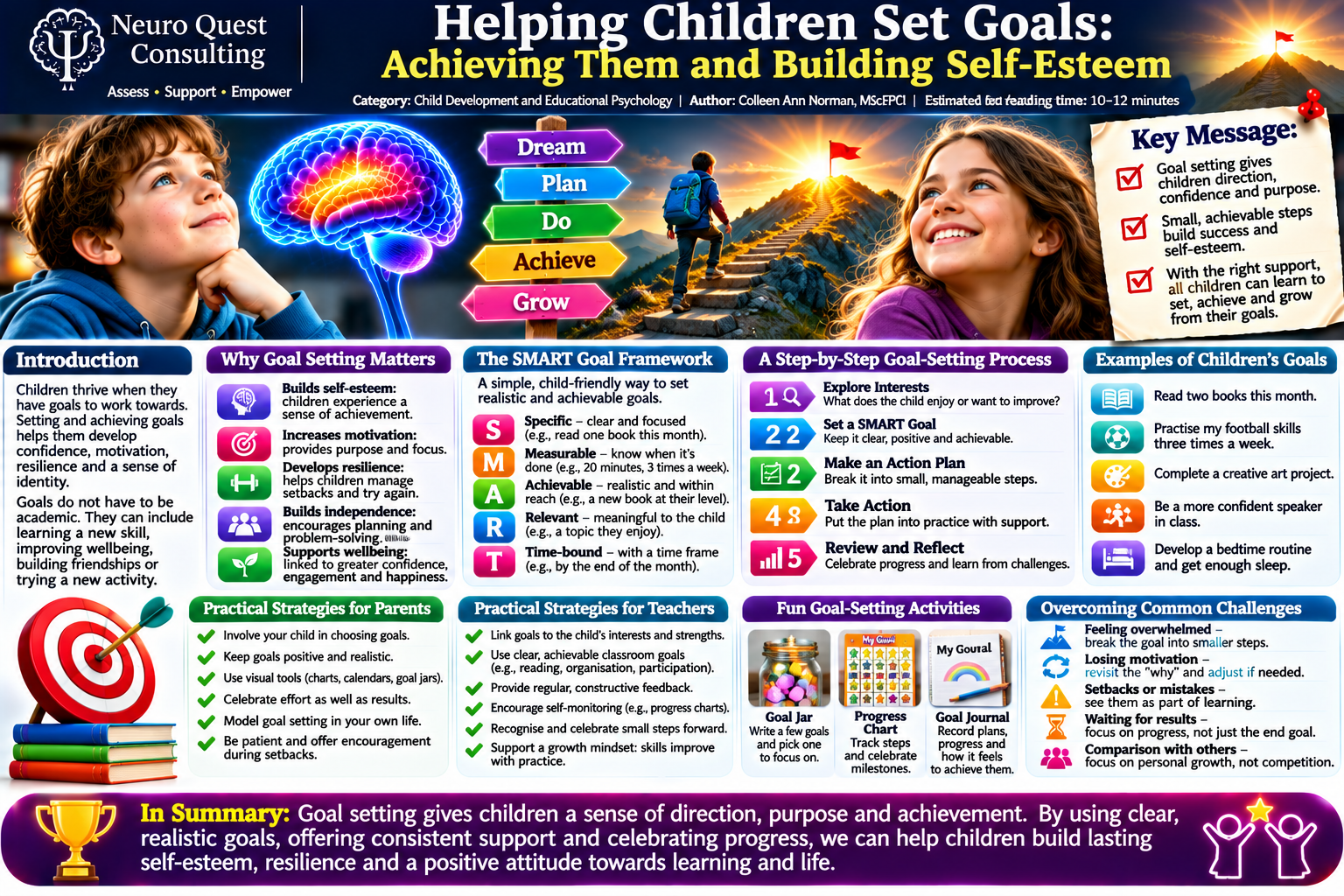
Introduction
Every child experiences moments of success and disappointment.
A child may struggle to learn a new skill, become frustrated with schoolwork or compare their achievements with those of classmates.
How adults respond to these experiences can influence the child's confidence, motivation and willingness to attempt future challenges.
Goal-setting provides a practical way to help children identify what they want to achieve, develop strategies and recognise progress.
However, the objective should not be to create constant pressure to succeed.
Effective goal-setting encourages realistic expectations, personal growth, independence and a healthy sense of competence.
What Is Self-Esteem?
Self-esteem refers broadly to an individual's evaluation of their own worth.
Children develop beliefs about themselves through relationships, experiences, feedback and interpretations of success and failure.
A child with healthy self-esteem can recognise strengths while accepting that difficulties and mistakes are normal.
Healthy self-esteem does not require believing that one is superior to others.
Nor does it mean feeling confident in every situation.
Instead, it involves developing a reasonably stable sense of personal worth that is not entirely dependent on achievement.
Self-Esteem and Self-Efficacy
Self-esteem and self-efficacy are related but distinct psychological concepts.
Self-esteem concerns a person's evaluation of their own worth.
Self-efficacy concerns beliefs about the ability to organise and perform actions required to achieve particular outcomes.
Bandura (1997) identified mastery experiences as an important source of self-efficacy.
For example, a child who successfully learns to ride a bicycle may become more confident about mastering other physical skills.
However, confidence in one activity does not automatically generalise to every area of life.
Parents and teachers can support self-efficacy by providing achievable challenges and opportunities to recognise genuine progress.
Why Goal-Setting Matters
Goals help direct attention and effort towards desired outcomes.
Locke and Latham (2002) demonstrated the importance of goal-setting in motivation and performance across numerous contexts.
Specific, appropriately challenging goals can be more effective than vague instructions such as try harder.
However, research findings from adults and organisational settings should not automatically be applied to children without considering developmental differences.
Children require goals that are understandable, meaningful and suited to their abilities.
Supportive feedback and opportunities for adjustment are also important.
Helping Children Choose Their Own Goals
Children are more likely to engage with goals that reflect their interests and values.
A parent may want a child to improve reading, while the child may be more interested in learning guitar or becoming more confident in sports.
Both educational and personal goals can be valuable.
Adults can help children explore possibilities through questions such as:
What would you like to learn?
What is something you would feel proud of improving?
What would make this activity more enjoyable?
Children should have meaningful involvement in choosing goals whenever developmentally appropriate.
The SMART Goal Framework
SMART goals are commonly described as:
Specific: Clearly identify the intended outcome.
Measurable: Establish how progress will be recognised.
Achievable: Consider the child's current abilities and available support.
Relevant: Ensure the goal matters to the child.
Time-bound: Identify an appropriate period for reviewing progress.
SMART is a practical planning framework rather than a guarantee of success.
For younger children, simpler language may be more useful.
For example, instead of saying I want to become better at reading, a child might choose:
I will read with an adult for ten minutes on four evenings each week for the next month.
This goal identifies a specific activity that can be monitored and adjusted.
Start With Small Goals
Large goals can become overwhelming.
Breaking them into smaller stages allows children to experience progress.
For example, a child who wants to learn to swim may begin by becoming comfortable in the water.
Later goals may involve floating, practising breathing techniques and swimming short distances.
Each stage provides an opportunity to develop skills.
However, adults should avoid turning every small accomplishment into a performance evaluation.
The emphasis should remain on learning and enjoyment.
Create an Action Plan
Once a child identifies a goal, the next step is developing a plan.
An action plan should answer three questions:
What will I do?
When will I do it?
What help or resources will I need?
For example, a child preparing for a school presentation might practise for five minutes after dinner on selected evenings.
A parent could help organise the practice schedule.
The child might also identify which parts of the presentation feel most difficult.
This approach encourages planning and problem-solving.
Using Visual Goal Charts
Visual charts can help children monitor progress.
A reading chart might record completed reading sessions.
A sports chart could record practice activities.
A project checklist might show completed stages.
However, charts should not become sources of shame or punishment.
If a child misses a planned activity, adults can explore the reason and adjust the plan.
The purpose is to make progress visible rather than to demand perfect compliance.
Encouraging a Growth Mindset
Dweck (2006) popularised the distinction between fixed and growth mindsets.
A fixed mindset involves viewing abilities as relatively unchangeable.
A growth mindset emphasises the potential for development through learning, effective strategies and support.
For example, a child who says I cannot do mathematics may benefit from considering which mathematical skills are difficult and what strategies might help.
However, growth mindset interventions have shown variable effects across studies.
Simply telling children to work harder is not sufficient.
Children need appropriate instruction, useful feedback and access to resources.
Praise Effort, Strategy and Progress
Praise can influence how children interpret achievement.
Research by Mueller and Dweck (1998) examined how different forms of praise affected children's responses to setbacks.
The findings suggest that praise focused exclusively on intelligence may create unhelpful performance concerns in some circumstances.
Parents can instead acknowledge effective strategies, persistence and improvement.
For example:
You tried a different method when the first one did not work.
This identifies a specific behaviour that contributed to progress.
However, effort should not be praised indiscriminately when a child needs better instruction or a different strategy.
Learning From Mistakes
Mistakes are a normal part of learning.
Children who believe that mistakes indicate personal inadequacy may avoid challenging activities.
Adults can help by demonstrating that errors provide information.
For example, a child who struggles with a science experiment can be encouraged to consider what happened and what might be changed.
The discussion should focus on evidence, reasoning and alternative approaches.
This teaches problem-solving rather than fear of failure.
Building Resilience
Resilience involves positive adaptation in the context of adversity or significant challenges.
It is influenced by individual characteristics, supportive relationships and environmental resources.
Masten (2001) emphasised the importance of ordinary adaptive systems in resilience.
Children do not become resilient simply by experiencing hardship.
Supportive adults, appropriate opportunities and stable environments are important protective factors.
Goal-setting may contribute to resilience when children learn to adapt plans and recover from manageable setbacks.
The Importance of Autonomy
Self-determination theory identifies autonomy, competence and relatedness as important psychological needs.
Ryan and Deci (2000) examined how these needs relate to motivation and wellbeing.
Children benefit from opportunities to make developmentally appropriate choices.
For example, a parent might allow a child to choose between practising music before or after dinner.
The parent maintains necessary structure while allowing meaningful participation.
Autonomy does not mean removing all boundaries.
It means supporting the child's developing capacity to make decisions.
Goals for Younger Children
Young children generally benefit from simple, concrete goals.
Examples might include putting toys away after play, learning to tie shoelaces or practising a new word.
Goals should be brief and understandable.
Visual reminders may help.
Adults should provide support and avoid expecting levels of planning or self-regulation that exceed the child's developmental abilities.
Goals for School-Age Children
School-age children can begin working towards more complex goals.
Examples include completing a reading project, improving handwriting or developing a sporting skill.
Children may benefit from identifying intermediate steps and reviewing progress weekly.
Parents and teachers can help them distinguish between outcomes they can control and those influenced by external circumstances.
For example, practising regularly is more directly controllable than winning a competition.
Goals for Adolescents
Adolescents may develop goals involving academic achievement, relationships, hobbies or future careers.
At this stage, personal autonomy becomes increasingly important.
Adults can support adolescents by discussing options, identifying resources and helping evaluate potential consequences.
However, goals should not become a means of imposing parental ambitions.
Adolescents benefit from opportunities to explore their own interests and values.
Helping Children With ADHD Set Goals
Children with ADHD may experience difficulties involving planning, attention regulation or task initiation.
Goals may therefore require additional structure.
Shorter time frames, visual reminders and regular check-ins can be useful.
For example, a child may find it easier to complete homework in several planned stages than through one extended session.
However, support should be individualised.
ADHD does not imply that every child has the same organisational difficulties.
Helping Children With Dyslexia Set Goals
Children with dyslexia may benefit from literacy goals that reflect their current skills and appropriate specialist teaching.
For example, a goal might involve practising a particular decoding skill or using assistive technology independently.
Goals should not depend solely on reading speed.
Accuracy, comprehension, confidence and effective strategy use may also be important.
Parents should avoid comparing a child's progress with that of siblings or classmates.
Helping Autistic Children Set Goals
Autistic children may benefit from clear expectations, predictable routines and communication adapted to their preferences.
Goals should reflect the child's interests, sensory needs and developmental profile.
For example, a child may choose to develop a particular hobby, practise an organisational strategy or learn to communicate a support need.
Adults should avoid imposing goals designed solely to make autistic behaviour appear more typical.
The focus should be on wellbeing, autonomy and meaningful participation.
Helping Gifted Children Set Goals
High-ability children may set ambitious goals.
Some enjoy complex projects and advanced learning opportunities.
However, gifted children may also experience frustration when progress is slower than expected.
Parents can help by encouraging challenging but manageable activities.
Goals should include opportunities for exploration rather than focusing exclusively on grades or awards.
Learning to tolerate uncertainty and mistakes is valuable for children at every ability level.
Avoiding Unhealthy Competition
Comparing children with peers can undermine confidence.
A child who constantly hears that another pupil performs better may begin to evaluate personal worth through competition.
Adults can encourage children to compare current performance with their own earlier progress.
For example:
Last month, you could complete two stages independently. Now you can complete four.
This highlights improvement without diminishing others.
Celebrating Achievement
Recognising progress can reinforce motivation.
Celebrations do not need to involve expensive rewards.
A child may appreciate positive feedback, a family activity or an opportunity to demonstrate a new skill.
However, external rewards should not become the sole reason for participating in meaningful activities.
The objective is to help children experience satisfaction in learning and accomplishment.
What Happens When a Child Does Not Achieve a Goal?
Not every goal will be achieved.
Sometimes a task is too difficult, the time frame is unrealistic or circumstances change.
Adults should help children review what happened without assigning blame.
Useful questions include:
Which parts went well?
What was difficult?
What could we change next time?
The child may decide to modify the goal, seek additional support or pursue a different objective.
Adapting a plan can represent effective problem-solving rather than failure.
When Goal-Setting Becomes Stressful
Goal-setting should support wellbeing, not create constant pressure.
Warning signs may include excessive anxiety about performance, avoidance of activities, persistent self-criticism or distress following ordinary mistakes.
When goals are causing substantial emotional difficulties, adults should reconsider expectations.
Children need opportunities for unstructured play, rest and relationships.
If concerns persist or significantly affect functioning, appropriate professional advice may be beneficial.
Practical Activity: The Goal Ladder
The Goal Ladder is a simple activity parents and teachers can use.
Step 1: Choose a goal.
For example: I want to become more confident speaking in class.
Step 2: Identify the first small step.
The child might begin by answering one prepared question.
Step 3: Add intermediate steps.
Later steps could involve contributing to a small-group discussion or presenting a short prepared explanation.
Step 4: Review progress.
Discuss what felt manageable and what support was helpful.
Step 5: Adjust the ladder.
If a step is too difficult, divide it into smaller stages.
The aim is gradual progress without unnecessary pressure.
Practical Activity: The Achievement Journal
Children can keep a simple journal recording achievements and learning experiences.
Entries might include:
Something I learned today.
Something difficult that I tried.
A strategy that helped me.
Something I would like to improve.
The journal should not become another graded assignment.
It is intended to encourage reflection and recognition of progress.
Practical Activity: The Family Goal Project
Families can select a shared goal, such as creating a garden, planning a charity activity or learning a new skill together.
Each family member can contribute according to their abilities.
The project provides opportunities to practise cooperation, planning and problem-solving.
It also demonstrates that adults experience setbacks and must sometimes change their plans.
Children can learn that progress is a shared process rather than an individual competition.
Useful UK Resources
NHS — Children's Mental Health:
https://www.nhs.uk/mental-health/children-and-young-adults/
Provides information about children's mental health and support.
YoungMinds:
https://www.youngminds.org.uk/
Offers resources for young people, parents and carers.
Anna Freud — Mental Health Resources:
https://www.annafreud.org/
Provides information and resources relating to child and family mental health.
Education Endowment Foundation:
https://educationendowmentfoundation.org.uk/
Provides research-informed resources for schools, including approaches to feedback, learning and metacognition.
GOV.UK — Education and Learning:
https://www.gov.uk/browse/education
Provides information about educational services and support in England.
Conclusion
Helping children set and achieve goals is not simply about improving academic performance.
It involves developing self-efficacy, independence, planning skills and a healthy relationship with success and failure.
Children benefit when adults provide realistic challenges, constructive feedback and opportunities to recognise progress.
Healthy self-esteem should not depend entirely on achievement.
A child should understand that personal worth remains intact even when a goal is not reached.
At Neuro Quest Consulting, educational and ability assessment can help identify children's cognitive strengths, learning differences and areas where additional support may be beneficial.
By combining appropriate assessment with supportive goal-setting, parents and educators can help children develop confidence, competence and a positive approach to learning.
The greatest achievement is not teaching children that they must always succeed. It is helping them understand that they can learn, adapt and continue growing.
References
Bandura, A. (1997). Self-efficacy: The exercise of control. W. H. Freeman.
Dweck, C. S. (2006). Mindset: The new psychology of success. Random House.
Locke, E. A., & Latham, G. P. (2002). Building a practically useful theory of goal setting and task motivation: A 35-year odyssey. American Psychologist, 57(9), 705–717. https://doi.org/10.1037/0003-066X.57.9.705
Masten, A. S. (2001). Ordinary magic: Resilience processes in development. American Psychologist, 56(3), 227–238. https://doi.org/10.1037/0003-066X.56.3.227
Mueller, C. M., & Dweck, C. S. (1998). Praise for intelligence can undermine children's motivation and performance. Journal of Personality and Social Psychology, 75(1), 33–52. https://doi.org/10.1037/0022-3514.75.1.33
Ryan, R. M., & Deci, E. L. (2000). Self-determination theory and the facilitation of intrinsic motivation, social development, and well-being. American Psychologist, 55(1), 68–78. https://doi.org/10.1037/0003-066X.55.1.68
Editorial note: This article is intended for educational purposes and does not replace individual psychological assessment or clinical advice. References and external links should be verified before publication.