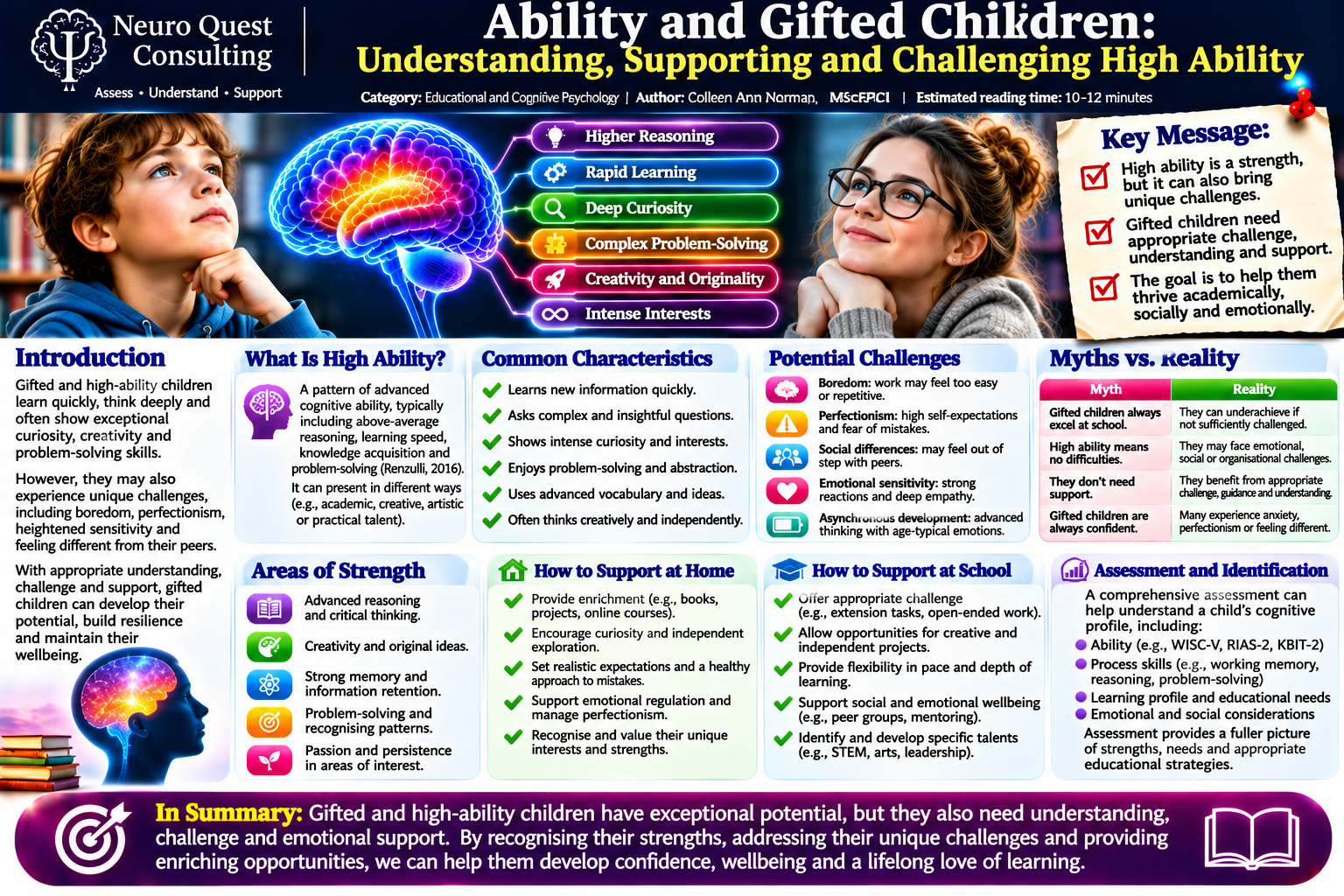
Introduction
A seven-year-old child may demonstrate the reading comprehension of a much older pupil while struggling to organise school materials. Another may solve advanced mathematical problems but become frustrated when asked to repeat skills already mastered.
Such differences illustrate an important principle: high intellectual ability does not necessarily produce uniformly advanced development.
Gifted and high-ability children may demonstrate exceptional reasoning, creativity, curiosity or rapid learning. However, they can also experience educational frustration, social difficulties or emotional challenges.
The educational objective should not simply be to increase the quantity of work assigned to these children.
Instead, parents and educators should provide meaningful intellectual challenge, appropriate support and opportunities for healthy development.
What Is Giftedness?
There is no universally accepted definition of giftedness.
Some approaches emphasise high general intellectual ability, while others recognise exceptional achievement or potential in specific domains.
These domains may include mathematics, language, science, creative thinking, music or other areas.
Renzulli (1978) proposed a model of gifted behaviour involving above-average ability, creativity and task commitment.
This model illustrates that giftedness can involve more than intelligence test performance alone.
Nevertheless, different educational systems and researchers use different identification criteria.
A child may be described as gifted under one framework but not another.
Giftedness and Intelligence
Intelligence tests provide standardised estimates of particular cognitive abilities.
These may include verbal comprehension, fluid reasoning, visual-spatial processing, working memory and processing speed.
Some gifted-identification programmes use intelligence scores as one source of evidence.
However, intelligence is multidimensional, and no single score captures every form of human ability.
A child may demonstrate exceptional verbal reasoning while performing closer to the age-expected range on processing speed tasks.
Consequently, a comprehensive cognitive profile can sometimes provide more useful educational information than a single overall score.
What Does an IQ Score Tell Us?
Intelligence quotient scores compare an individual's performance with that of a standardisation sample.
Many contemporary intelligence scales use a mean of 100 and a standard deviation of 15.
An IQ score of approximately 130 is commonly associated with the upper 2% of the reference population.
However, this is not a universal threshold for giftedness.
Test selection, measurement error, confidence intervals and the child's developmental circumstances all influence interpretation.
A score should therefore be considered alongside educational achievement, observed abilities and other relevant information.
Characteristics of High-Ability Children
Some high-ability children demonstrate rapid learning, advanced vocabulary or unusually sophisticated reasoning.
Others show strong curiosity, originality or sustained interest in particular subjects.
For example, a child may independently investigate astronomy, construct elaborate engineering models or ask detailed questions about historical events.
However, these characteristics are not universal.
Some gifted children are quiet and reserved.
Others may be energetic, socially confident or reluctant to display their abilities.
Identification should not depend on a narrow stereotype of how a gifted child is expected to behave.
Why Gifted Children Sometimes Become Bored
A mismatch between a child's abilities and the level of classroom instruction can contribute to disengagement.
A pupil who has already mastered a concept may find repeated practice insufficiently challenging.
However, boredom does not necessarily establish giftedness.
It can also arise from poor instructional fit, limited interest, emotional difficulties or other circumstances.
Teachers should therefore examine the child's actual knowledge and learning needs.
Appropriate challenge should be based on demonstrated readiness rather than assumptions about intelligence.
Challenge Versus Additional Work
One common educational mistake is giving high-ability pupils more work rather than more challenging work.
For example, a child who understands multiplication may not benefit from completing fifty additional routine problems.
A more meaningful activity might involve mathematical reasoning, patterns, proofs or unfamiliar applications.
Similarly, an advanced reader may benefit from analysing complex themes rather than simply reading a greater number of books.
The aim is to increase intellectual depth, complexity and opportunity for independent thinking.
Curriculum Compacting
Curriculum compacting involves identifying material that a student has already mastered and reducing unnecessary repetition.
The time gained can then be used for enrichment or more advanced learning.
For example, a pupil who demonstrates mastery of a mathematics unit may progress to more demanding concepts.
This approach requires careful assessment of prior knowledge.
It should not result in gaps in essential learning.
When implemented appropriately, curriculum compacting can improve the match between instruction and student readiness.
Acceleration
Academic acceleration allows students to progress through educational material at a faster rate or enter advanced learning opportunities earlier.
Examples include subject-specific acceleration, advanced coursework and, in selected cases, grade skipping.
Steenbergen-Hu et al. (2016) reviewed research on academic acceleration.
Their findings support the potential academic benefits of acceleration for appropriately selected students.
However, decisions should consider academic readiness, social circumstances, emotional wellbeing and individual preferences.
Acceleration should not be assumed to be suitable for every high-ability child.
Enrichment
Enrichment provides opportunities to explore subjects in greater depth or breadth.
Examples include research projects, creative writing, coding, science investigations and advanced reading.
Enrichment can also involve museums, competitions, mentoring or collaboration with individuals who share similar interests.
Effective enrichment should promote reasoning, curiosity and problem-solving.
It should not merely add extracurricular obligations to an already demanding schedule.
Encouraging Critical Thinking
High-ability children may benefit from questions that require explanation, comparison and evaluation.
For example, rather than asking a child to recall historical facts, a teacher might ask:
Why might two historians interpret the same event differently?
Similarly, a science activity could require a child to design an experiment, identify alternative explanations and evaluate evidence.
Such activities encourage intellectual flexibility and deeper understanding.
They also demonstrate that learning involves questioning assumptions rather than simply producing correct answers.
Supporting Creativity
Creativity involves generating ideas that are original and appropriate to a particular context.
High intellectual ability and creativity may overlap, but they are not identical.
Some gifted children demonstrate strong creative abilities.
Others prefer structured or analytical tasks.
Parents and educators can encourage creativity through open-ended projects, experimentation and opportunities to explore different solutions.
Children should be allowed to make mistakes and revise their ideas without excessive pressure.
Perfectionism
Some high-ability children develop demanding personal expectations.
They may become frustrated when they cannot immediately master a new skill.
Others may avoid difficult activities because they fear making mistakes.
However, perfectionism is not inevitable among gifted children.
Research distinguishes between different dimensions of perfectionism, including high personal standards and concerns about mistakes.
Parents can help by recognising effort, persistence and learning rather than focusing exclusively on achievement.
Children benefit from understanding that errors are a normal part of intellectual development.
Emotional Development
Advanced reasoning does not necessarily mean that a child has equally advanced emotional regulation.
For example, a child may discuss sophisticated scientific concepts but respond to disappointment in a developmentally typical manner.
Adults should avoid expecting emotional maturity simply because a child demonstrates high academic ability.
Similarly, emotional sensitivity should not automatically be attributed to giftedness.
Support should reflect the child's actual developmental and psychological needs.
Social Relationships
Some gifted children enjoy friendships with same-age peers.
Others prefer interacting with older children or adults who share their interests.
Social experiences vary considerably.
A child who feels intellectually isolated may benefit from opportunities to meet peers with similar interests.
However, giftedness does not inherently cause social difficulties.
Schools should encourage inclusion and avoid treating advanced ability as evidence that a child is socially different or superior.
Gifted Children and ADHD
High ability and ADHD can co-occur.
A child may demonstrate exceptional reasoning while experiencing difficulties with attention, organisation or impulse control.
Such children are sometimes described as twice exceptional.
High ability may help compensate for some difficulties, potentially delaying recognition.
Conversely, attention difficulties may obscure intellectual strengths.
Assessment should examine both cognitive abilities and functional concerns.
Neither high intelligence nor strong academic achievement rules out ADHD.
Gifted Children and Dyslexia
Some children demonstrate high reasoning abilities alongside specific literacy difficulties.
For example, a child may possess advanced verbal knowledge but struggle with accurate or fluent word reading.
Strong reasoning skills may sometimes compensate for literacy weaknesses.
However, persistent reading and spelling difficulties should not be dismissed because the child is intelligent.
A comprehensive educational assessment can help identify discrepancies between cognitive strengths and literacy performance.
Support should address both advanced learning needs and specific difficulties.
Gifted Children and Autism
Autism and high intellectual ability can also co-occur.
Some autistic children demonstrate advanced abilities in particular academic or cognitive domains.
However, exceptional abilities should not be assumed to characterise autism.
A child may require support with social communication, sensory experiences or everyday functioning while demonstrating substantial academic strengths.
Educational planning should recognise both sets of needs.
The Twice-Exceptional Child
Twice-exceptionality generally refers to the coexistence of high ability and a disability or neurodevelopmental difference.
Examples may include giftedness alongside ADHD, dyslexia or autism.
These profiles can be difficult to identify because strengths and difficulties may partially mask one another.
A child may achieve average grades despite having exceptional reasoning abilities because an unrecognised learning difficulty limits performance.
Alternatively, a child may achieve highly while expending considerable effort to compensate for organisational difficulties.
Assessment should therefore examine the whole cognitive and educational profile.
Why Ability Assessment Matters
Standardised ability assessment can help identify cognitive strengths and areas requiring additional support.
Depending on the referral question, an assessment may examine verbal reasoning, nonverbal reasoning, working memory, processing speed and related abilities.
Results may contribute to educational planning.
However, ability assessment should not be treated as a competition or as a definitive measure of a child's worth.
Test results should be interpreted with appropriate attention to reliability, confidence intervals and relevant contextual factors.
Common Assessment Instruments
Examples of standardised instruments used in cognitive or ability assessment include:
Wechsler Intelligence Scale for Children (WISC): Provides information about several cognitive abilities in children.
Reynolds Intellectual Assessment Scales (RIAS): Assesses aspects of verbal and nonverbal intelligence.
Kaufman Brief Intelligence Test (KBIT): Provides a brief estimate of selected verbal and nonverbal abilities.
The suitability of an instrument depends on the child's age, referral question, language background and other factors.
Different instruments serve different purposes and are not necessarily interchangeable.
Assessment should be conducted and interpreted by appropriately qualified practitioners working within their competence.
How Parents Can Challenge Gifted Children at Home
Parents can support high-ability children by encouraging exploration rather than placing constant emphasis on performance.
Activities may include reading challenging books, visiting museums, conducting science experiments or learning programming.
Children may also enjoy music, art, engineering, languages or independent research projects.
The most effective activities often build on genuine interests.
Parents should allow children to pursue subjects deeply while maintaining time for recreation and social experiences.
Encouraging Independent Projects
Independent projects can help children develop planning, research and problem-solving skills.
For example, a child interested in astronomy might investigate the conditions required for life on other planets.
Another interested in engineering might design and test a model bridge.
Parents can support the process by helping children formulate questions, identify resources and evaluate findings.
The child should retain meaningful ownership of the project.
Teaching Resilience
Children who learn quickly may have relatively limited experience with difficult academic tasks.
When they eventually encounter challenging material, they may become discouraged.
Parents and teachers can help by normalising mistakes and demonstrating how to approach unfamiliar problems.
The emphasis should be on strategy development, persistence and thoughtful reflection.
Learning to manage difficulty is an important part of education, regardless of intellectual ability.
Avoiding Excessive Pressure
High ability should not become an obligation to achieve constantly.
Children need opportunities for play, friendships, rest and activities unrelated to academic performance.
Excessive expectations can create stress and reduce enjoyment of learning.
Parents should distinguish between encouraging a child's interests and imposing goals that the child does not share.
A balanced approach recognises intellectual potential while protecting wellbeing.
How Teachers Can Support High-Ability Pupils
Teachers can support advanced learners through differentiated instruction, flexible grouping, curriculum compacting and enrichment.
Where appropriate, subject acceleration may also be considered.
Classroom tasks should provide opportunities for deeper reasoning rather than simply increasing workload.
Teachers should also monitor the child's emotional and social experiences.
Educational provision should be responsive to the individual rather than determined solely by a gifted label.
Gifted Education in the United Kingdom
Provision for high-ability learners varies across UK schools and educational settings.
Schools may use terms such as more able, high attaining or high potential.
There is no single nationally prescribed IQ threshold for gifted education across the United Kingdom.
Parents can discuss advanced learning needs with teachers, subject leaders or school leadership teams.
Educational planning should focus on appropriate challenge and evidence of learning needs.
Where a child also has a disability or special educational need, relevant statutory support arrangements may apply.
Useful UK Resources
Potential Plus UK:
https://potentialplusuk.org/
Provides information and support relating to high learning potential.
National Association for Gifted Children (NAGC):
https://www.nagc.org/
Offers research-informed resources on gifted education, although primarily focused on the United States.
GOV.UK — Education and Learning:
https://www.gov.uk/browse/education
Provides information about education in England.
British Dyslexia Association:
https://www.bdadyslexia.org.uk/
Provides information about dyslexia and learning differences.
NHS — ADHD:
https://www.nhs.uk/conditions/attention-deficit-hyperactivity-disorder-adhd/
Provides information about ADHD, including assessment and support.
Conclusion
Gifted and high-ability children require more than recognition of their intellectual strengths.
They need educational opportunities that provide appropriate challenge, encourage curiosity and support healthy development.
High ability does not guarantee academic success, and gifted children may experience learning difficulties or neurodevelopmental differences alongside their strengths.
Comprehensive assessment can help identify cognitive profiles and inform individualised educational recommendations.
At Neuro Quest Consulting, ability and educational assessment can contribute to understanding a child's strengths, learning profile and support needs.
The objective is not simply to identify how intelligent a child may be, but to understand how that child learns and how their abilities can be developed appropriately.
Gifted children do not necessarily need more work. They need meaningful opportunities to think, explore, create and grow.
References
Diamond, A. (2013). Executive functions. Annual Review of Psychology, 64, 135–168. https://doi.org/10.1146/annurev-psych-113011-143750
Pfeiffer, S. I. (2015). Essentials of gifted assessment. Wiley.
Renzulli, J. S. (1978). What makes giftedness? Reexamining a definition. Phi Delta Kappan, 60(3), 180–184, 261.
Steenbergen-Hu, S., Moon, S. M., & Cooper, H. (2016). What one hundred years of research says about the effects of ability grouping and acceleration on K–12 students' academic achievement: Findings of two second-order meta-analyses. Review of Educational Research, 86(4), 849–899. https://doi.org/10.3102/0034654316675417
Subotnik, R. F., Olszewski-Kubilius, P., & Worrell, F. C. (2011). Rethinking giftedness and gifted education: A proposed direction forward based on psychological science. Psychological Science in the Public Interest, 12(1), 3–54. https://doi.org/10.1177/1529100611418056
Editorial note: This article is intended for educational purposes. Assessment instruments, references and external resources should be checked for suitability and currency before publication.