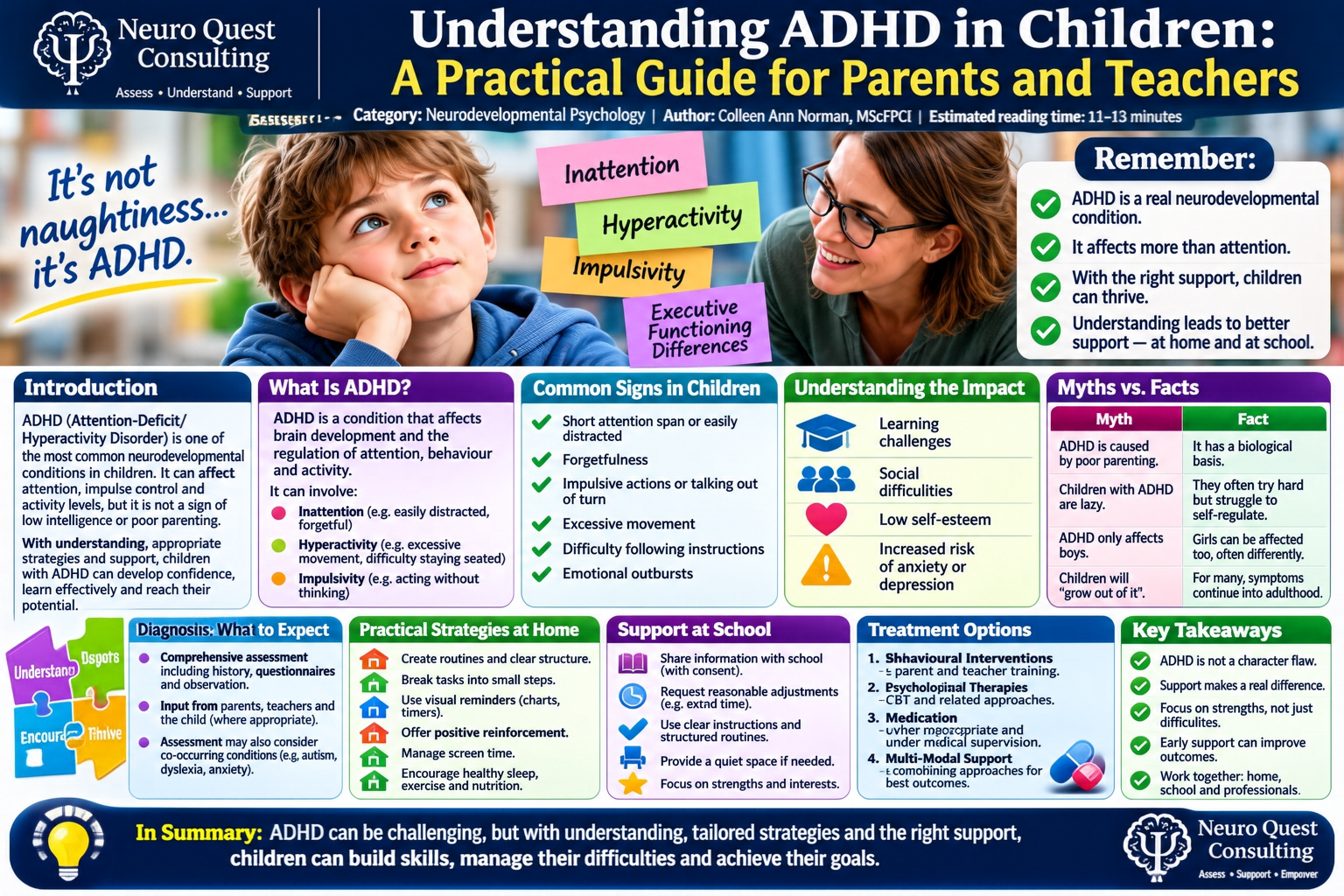
Introduction
A child who struggles to concentrate, frequently forgets instructions or finds it difficult to remain seated may be described as disruptive, careless or unmotivated.
However, these behaviours can sometimes reflect differences in attention regulation, executive functioning and impulse control.
Attention-deficit/hyperactivity disorder (ADHD) is a neurodevelopmental condition that can affect learning, behaviour, emotional regulation and everyday functioning.
ADHD does not indicate low intelligence, poor parenting or a lack of effort.
Understanding how ADHD presents in children can help parents, teachers and professionals provide appropriate support.
What Is ADHD?
ADHD is characterised by persistent patterns of inattention and/or hyperactivity-impulsivity that interfere with functioning or development.
According to the Diagnostic and Statistical Manual of Mental Disorders, Fifth Edition, Text Revision (DSM-5-TR), symptoms must meet specific developmental, duration and functional criteria.
ADHD is not diagnosed simply because a child is energetic, forgetful or occasionally distracted.
The relevant behaviours must be considered in relation to the child's age, developmental level and circumstances.
Symptoms must also occur across more than one setting, although their intensity may vary between environments.
The Three Presentations of ADHD
ADHD is commonly described through three presentations.
Predominantly Inattentive Presentation
Children may demonstrate difficulties sustaining attention, following instructions, organising activities or remembering everyday responsibilities.
For example, a child may understand a lesson but repeatedly lose track of the steps required to complete an assignment.
Some children with predominantly inattentive symptoms are quiet and may not attract attention through disruptive behaviour.
Predominantly Hyperactive-Impulsive Presentation
Children may experience difficulties regulating movement, waiting their turn or inhibiting immediate responses.
They may interrupt conversations, leave their seats frequently or act before considering consequences.
However, high activity levels alone do not establish ADHD.
Combined Presentation
Children with the combined presentation demonstrate sufficient symptoms of both inattention and hyperactivity-impulsivity.
Presentations may change over time as development and circumstances change.
Common Signs of ADHD in Children
Possible signs include difficulty sustaining attention, frequent forgetfulness, losing belongings, struggling to organise schoolwork and becoming distracted during tasks.
Some children demonstrate excessive movement, interrupt others or experience difficulty waiting.
Others may struggle with transitions, task initiation or managing frustration.
However, these characteristics can also occur for reasons unrelated to ADHD.
Sleep difficulties, anxiety, learning disorders, environmental stressors and other factors may influence attention and behaviour.
A comprehensive assessment is therefore essential.
ADHD and the Developing Brain
Research has investigated differences in neural networks associated with attention, behavioural regulation and executive functioning.
These include systems involving prefrontal and subcortical brain regions.
However, ADHD cannot be diagnosed through a routine brain scan.
Neuroscientific findings generally describe statistical differences across research groups rather than a definitive biological signature in every individual.
The diagnosis remains based on developmental history, clinical assessment and evidence of symptoms and impairment.
ADHD and Intelligence
Children with ADHD demonstrate a wide range of intellectual abilities.
Some have exceptional reasoning, creativity or problem-solving strengths.
Others experience additional learning difficulties.
ADHD does not establish a child's intelligence level.
A child may understand complex concepts yet struggle to organise work, complete assignments or manage deadlines.
This distinction is important because academic difficulties may reflect executive functioning demands rather than limited intellectual ability.
ADHD and Executive Functioning
Executive functions help individuals plan, organise, remember instructions and regulate behaviour.
Some children with ADHD experience difficulties in these areas.
For example, a child may understand that homework must be completed but struggle to begin the task.
Another may complete an assignment yet forget to submit it.
These difficulties should not automatically be interpreted as deliberate disobedience.
Practical support can reduce organisational demands and help children develop useful strategies.
ADHD and Emotional Regulation
Some children with ADHD experience difficulties managing frustration, disappointment or emotional intensity.
For example, a child may become upset when an activity is interrupted or when a task feels overwhelming.
However, emotional regulation difficulties are not unique to ADHD.
They may also occur in association with anxiety, autism, sleep difficulties or stressful circumstances.
Parents and teachers should consider the broader context rather than assuming that every emotional response is caused by ADHD.
ADHD in Girls
ADHD can affect both boys and girls.
Some girls demonstrate predominantly inattentive symptoms that may be less noticeable in classroom settings.
Others experience hyperactivity, impulsivity or combined symptoms.
Girls may sometimes develop strategies to conceal difficulties or compensate for organisational challenges.
However, presentation should not be predicted solely from gender.
Assessment must consider the individual child's symptoms, developmental history and functional needs.
ADHD and Co-Occurring Conditions
ADHD may occur alongside other developmental or psychological conditions.
These can include autism, dyslexia, language difficulties, anxiety and other mental health concerns.
The presence of one condition does not automatically exclude another.
For example, a child may have both ADHD and dyslexia.
In such circumstances, difficulties with attention and literacy may require different forms of support.
Comprehensive assessment can help distinguish overlapping symptoms and identify co-occurring needs.
How Is ADHD Diagnosed?
ADHD assessment typically involves gathering information about the child's developmental history, behaviour and functioning.
This may include clinical interviews, parent and teacher reports, standardised questionnaires and relevant educational or medical information.
The assessment should examine whether symptoms are persistent, developmentally inappropriate and associated with impairment.
Other possible explanations should also be considered.
NICE Guideline NG87 provides recommendations for ADHD recognition, diagnosis and management in the United Kingdom.
A diagnosis should be made by an appropriately qualified healthcare professional with relevant training and expertise.
No single questionnaire or cognitive test is sufficient to establish ADHD independently.
What Parents Can Do at Home
Parents can support children with ADHD through predictable routines, clear communication and practical organisational strategies.
The objective is not to eliminate every difficulty but to create an environment that supports learning and independence.
Establish Predictable Routines
Consistent routines can help children anticipate daily activities.
Morning and bedtime schedules may reduce confusion and unnecessary conflict.
Visual timetables can be particularly helpful for some children.
Break Tasks Into Smaller Steps
Large tasks may feel overwhelming.
Breaking homework or household responsibilities into smaller stages can make them easier to begin and complete.
For example, rather than asking a child to tidy an entire bedroom, a parent might begin with one specific activity.
Use Visual Reminders
Checklists, calendars and written instructions can reduce demands on working memory.
Children may benefit from seeing what needs to be completed rather than relying entirely on verbal reminders.
Provide Positive Reinforcement
Specific praise can help children recognise successful strategies and progress.
For example, acknowledging that a child began homework independently may be more informative than offering general praise.
Behavioural approaches should be supportive, proportionate and adapted to developmental needs.
Reduce Unnecessary Distractions
Some children benefit from a quiet homework area with limited competing stimulation.
Others may concentrate better with appropriate movement opportunities.
Environmental adjustments should reflect the child's individual preferences and needs.
Helping Children Manage Homework
Homework can be challenging when tasks require sustained attention, planning and independent organisation.
Parents may find it useful to establish a consistent homework routine.
Short work periods with planned breaks may help some children.
A checklist can clarify which tasks remain unfinished.
Parents should also communicate with teachers when homework demands are consistently causing substantial distress.
The goal is to support learning rather than turn homework into a daily conflict.
Supporting Sleep
Sleep difficulties can worsen attention, emotional regulation and daytime functioning.
Consistent sleep routines may be helpful.
Parents should consider bedtime schedules, evening stimulation and the child's individual sleep needs.
Persistent sleep problems should be discussed with an appropriate healthcare professional.
Sleep difficulties should not automatically be attributed to ADHD because other medical or psychological factors may be relevant.
Supporting Physical Activity
Regular physical activity contributes to general health and wellbeing.
Some children may find movement breaks helpful for concentration and emotional regulation.
However, physical activity is not a substitute for indicated clinical treatment.
Activities should be enjoyable, developmentally appropriate and suited to the child's interests.
ADHD in the Classroom
Children with ADHD may experience difficulties sustaining attention, completing assignments or managing transitions between activities.
However, educational needs vary considerably.
Some pupils require substantial adjustments, while others benefit from relatively simple changes.
Teachers should avoid assuming that all children with ADHD need identical support.
Practical Classroom Strategies
Clear instructions: Provide concise directions and check understanding.
Written reminders: Use visual schedules, task lists and examples.
Task breakdown: Divide complex assignments into manageable stages.
Movement opportunities: Allow appropriate breaks where helpful.
Reduced distractions: Consider seating and environmental adjustments.
Organisational support: Help pupils use planners, folders and checklists.
Positive feedback: Recognise progress, effort and effective strategies.
These approaches should be evaluated according to their impact on the individual pupil.
Working Together: Parents and Teachers
Communication between home and school can improve consistency and support.
Parents may provide useful information about routines, interests and strategies that work at home.
Teachers can describe classroom demands and identify particular learning difficulties.
Where appropriate, the child should also contribute to decisions about support.
A collaborative approach helps avoid conflicting expectations and encourages shared problem-solving.
Special Educational Needs Support in England
Children with ADHD may require special educational needs support if their difficulties affect learning.
Schools should consider appropriate provision according to the child's assessed needs.
Some pupils may benefit from classroom adjustments and targeted support.
Others may require consideration for an Education, Health and Care needs assessment.
An ADHD diagnosis does not automatically guarantee an Education, Health and Care Plan (EHCP).
Eligibility depends on the child's educational needs and the relevant statutory criteria.
Parents can seek information from their school's special educational needs coordinator (SENCO) and local SEND information services.
What Treatments Are Available?
ADHD management may involve environmental adjustments, parent-training programmes, educational support, psychological approaches and medication where clinically indicated.
NICE NG87 provides guidance on treatment according to age, symptoms, impairment and individual circumstances.
For younger children, parent-training and environmental interventions are particularly important.
For children aged five years and over, medication may be considered under the circumstances specified by NICE when symptoms continue to cause significant impairment despite appropriate support.
Medication must be initiated and monitored according to relevant clinical guidance.
Treatment decisions should involve qualified professionals and, where appropriate, the child and family.
Parent-Training Programmes
Parent-training programmes can help families develop practical approaches to managing behaviour and supporting emotional regulation.
These programmes may focus on communication, predictable routines, positive reinforcement and reducing unnecessary conflict.
Participation does not imply that parents caused their child's ADHD.
Rather, the programmes provide evidence-informed strategies for responding to particular developmental and behavioural needs.
Medication and ADHD
ADHD medication may be beneficial for some children.
Commonly used medicines include stimulant and non-stimulant treatments.
The selection of medication depends on clinical assessment, age, medical history and relevant prescribing guidance.
Potential benefits and adverse effects should be discussed with the prescribing clinician.
Parents should not begin, stop or change prescribed medication without appropriate medical advice.
ADHD and Self-Esteem
Repeated criticism or academic difficulties can affect a child's confidence.
Some children begin to believe that they are less capable than their peers.
Parents and teachers can help by recognising strengths and separating the child's identity from particular difficulties.
For example, rather than describing a child as lazy, adults can identify the specific task that is difficult and explore practical solutions.
Supportive communication can contribute to confidence and engagement.
Recognising Strengths
Children with ADHD have varied abilities and interests.
Some demonstrate creativity, curiosity, enthusiasm or strong engagement with preferred activities.
However, these characteristics should not be treated as universal ADHD strengths.
The objective is to recognise the individual child's abilities and provide opportunities to develop them.
A strengths-based approach should complement, not replace, appropriate support for genuine difficulties.
When Should Parents Seek Professional Advice?
Parents may wish to seek advice when attention, activity level or impulsivity difficulties are persistent and substantially affect everyday life.
Relevant concerns may include significant academic difficulties, problems with friendships, emotional distress or challenges across home and school.
A GP can discuss concerns and advise about appropriate NHS pathways.
Schools may also provide educational information and support.
Families should not feel required to establish a diagnosis independently before seeking guidance.
UK Medical and Educational Resources
NHS — ADHD:
https://www.nhs.uk/conditions/attention-deficit-hyperactivity-disorder-adhd/
Provides information about ADHD, assessment and treatment.
NICE — ADHD: Diagnosis and Management (NG87):
https://www.nice.org.uk/guidance/ng87
Provides evidence-based clinical recommendations.
ADHD UK:
https://adhduk.co.uk/
Offers ADHD information, resources and support.
ADDISS — The National Attention Deficit Disorder Information and Support Service:
https://www.addiss.co.uk/
Provides information and resources relating to ADHD.
YoungMinds:
https://www.youngminds.org.uk/
Provides mental health information and support for young people and parents.
GOV.UK — Children with Special Educational Needs:
https://www.gov.uk/children-with-special-educational-needs/overview
Explains educational support and statutory arrangements in England.
Contact — For Families with Disabled Children:
https://contact.org.uk/
Provides information and support for families of children with disabilities and additional needs.
Conclusion
ADHD is a neurodevelopmental condition that can affect attention, behavioural regulation, organisation and everyday functioning.
Children with ADHD are not defined by their difficulties.
With appropriate assessment, educational adjustments, family support and clinical intervention where indicated, many children can develop effective strategies and make meaningful progress.
Understanding the child's individual strengths and needs is essential.
At Neuro Quest Consulting, educational and psychometric assessment emphasises evidence-informed interpretation, individual differences and practical recommendations that support learning and development.
The objective is to help families and educators understand the child more fully and identify appropriate pathways for support.
References
American Psychiatric Association. (2022). Diagnostic and statistical manual of mental disorders (5th ed., text rev.). https://doi.org/10.1176/appi.books.9780890425787
Barkley, R. A. (1997). Behavioral inhibition, sustained attention, and executive functions: Constructing a unifying theory of ADHD. Psychological Bulletin, 121(1), 65–94. https://doi.org/10.1037/0033-2909.121.1.65
Diamond, A. (2013). Executive functions. Annual Review of Psychology, 64, 135–168. https://doi.org/10.1146/annurev-psych-113011-143750
National Institute for Health and Care Excellence. (2018). Attention deficit hyperactivity disorder: Diagnosis and management (NICE Guideline NG87). https://www.nice.org.uk/guidance/ng87
Sonuga-Barke, E. J. S., Brandeis, D., Cortese, S., Daley, D., Ferrin, M., Holtmann, M., Stevenson, J., Danckaerts, M., van der Oord, S., Döpfner, M., Dittmann, R. W., Simonoff, E., Zuddas, A., Banaschewski, T., Buitelaar, J., Coghill, D., Hollis, C., Konofal, E., Lecendreux, M., Wong, I. C. K., & Sergeant, J. (2013). Nonpharmacological interventions for ADHD: Systematic review and meta-analyses of randomized controlled trials of dietary and psychological treatments. American Journal of Psychiatry, 170(3), 275–289. https://doi.org/10.1176/appi.ajp.2012.12070991
Editorial note: This article provides general educational information rather than individual medical advice. Clinical recommendations and external resource links should be checked against current guidance before publication.