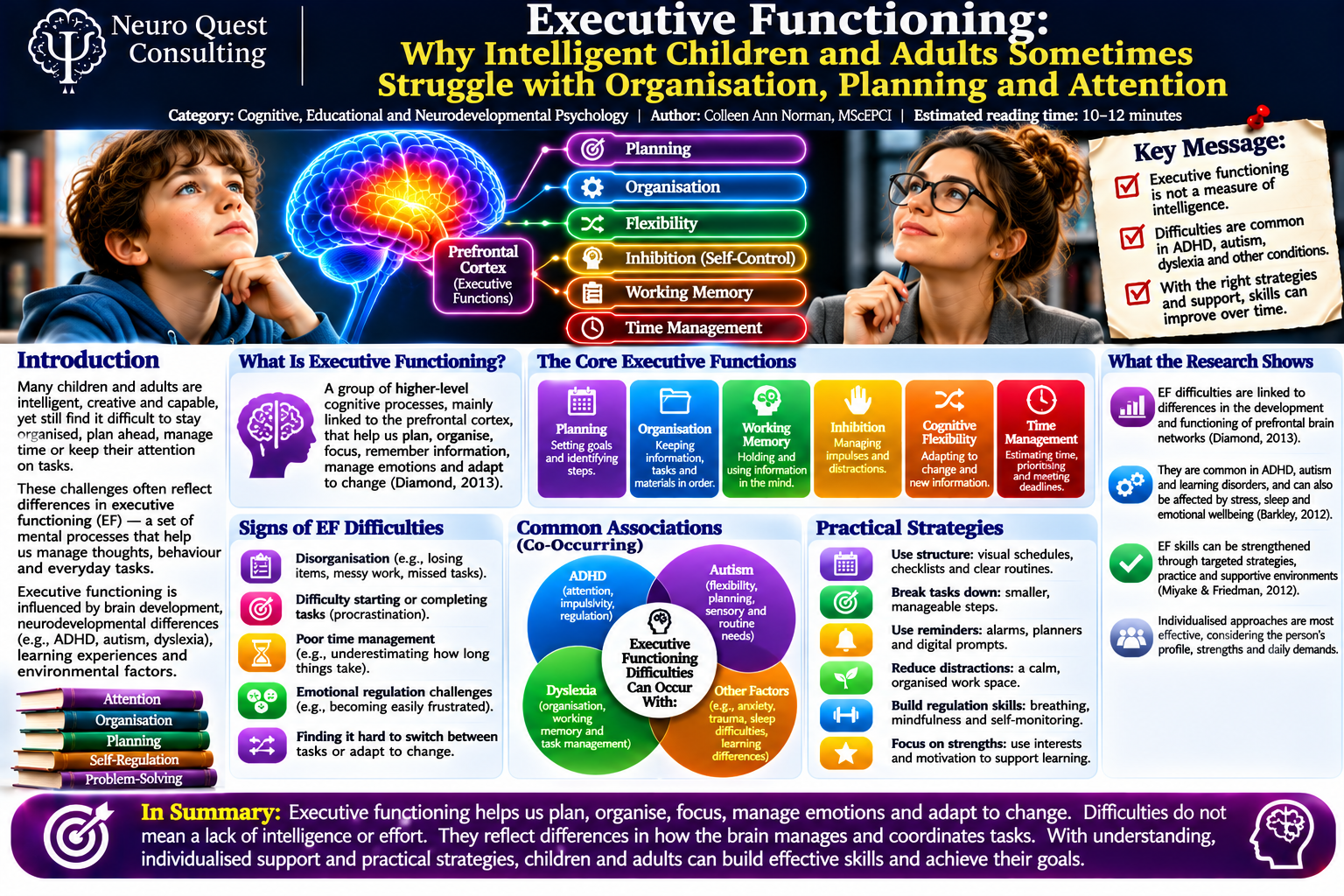
Introduction
A child may demonstrate exceptional reasoning abilities yet repeatedly forget to bring completed homework to school. An adult may be highly knowledgeable in their profession but struggle to organise appointments, begin complex tasks or manage competing deadlines.
Such difficulties are often misunderstood as laziness, carelessness or insufficient motivation.
However, the underlying explanation may involve executive functioning.
Executive functions are cognitive processes that support goal-directed behaviour, including planning, working memory, inhibitory control and cognitive flexibility.
These processes help individuals organise information, regulate responses, adapt to changing circumstances and complete tasks requiring several steps.
Understanding executive functioning is important in educational psychology, neuropsychology and the assessment of neurodevelopmental conditions.
What Is Executive Functioning?
Executive functioning refers to a collection of higher-order cognitive processes involved in managing thoughts and actions.
Diamond (2013) identified three core executive functions:
- Inhibitory control: The ability to regulate automatic responses, resist distractions and manage impulses.
- Working memory: The ability to hold and manipulate information temporarily.
- Cognitive flexibility: The ability to shift perspectives, adjust strategies and respond to changing demands.
More complex abilities, such as planning, reasoning and problem-solving, draw upon these foundational processes.
Executive functioning is not a single ability.
An individual may demonstrate strong working memory while experiencing difficulties with planning or inhibition.
Consequently, assessment should consider the person's pattern of strengths and difficulties rather than assuming that all executive functions operate at the same level.
The Role of the Prefrontal Cortex
Executive functioning is strongly associated with networks involving the prefrontal cortex.
The prefrontal cortex contributes to decision-making, behavioural regulation and the coordination of goal-directed activities.
However, executive functions depend on distributed brain networks rather than one isolated region.
Neuroscientific research has examined how prefrontal and other cortical and subcortical systems contribute to cognitive control.
Miller and Cohen (2001) proposed an influential theory describing the integrative role of prefrontal cortex in cognitive control.
Nevertheless, executive functioning difficulties cannot be diagnosed from a simple brain image.
Psychological assessment requires behavioural, developmental and contextual information.
Working Memory
Working memory allows individuals to hold information temporarily while using it.
For example, a student solving a mathematical problem may need to remember intermediate calculations.
An adult following verbal directions may need to retain several instructions while completing each step.
Working memory difficulties can affect reading comprehension, mathematical reasoning and everyday organisation.
A person may understand an instruction when it is given but lose track of the information before completing the task.
This does not necessarily indicate poor intelligence or unwillingness to cooperate.
Practical support may include written instructions, visual reminders and breaking complex information into manageable steps.
Inhibitory Control
Inhibitory control involves regulating impulses, resisting distractions and suppressing responses that interfere with current goals.
For example, a student may need to ignore surrounding conversations while completing an examination.
An adult may need to resist checking messages while working on a demanding report.
Inhibitory control also contributes to behavioural regulation.
However, impulsive behaviour can arise for several reasons, including emotional distress, environmental demands and developmental differences.
A single instance of impulsivity does not establish an executive functioning disorder.
Cognitive Flexibility
Cognitive flexibility involves adapting thoughts and behaviour when circumstances change.
For example, a student may need to use a different strategy when a mathematical method does not work.
An employee may need to reorganise priorities after an unexpected deadline change.
Some individuals find such transitions difficult.
They may become frustrated when routines change or struggle to move between competing tasks.
However, a preference for predictability does not automatically indicate impairment.
The relevant consideration is whether difficulties adapting interfere with the person's goals or everyday functioning.
Planning and Organisation
Planning involves identifying goals, selecting appropriate actions and organising steps towards completion.
Organisation involves arranging information, materials and activities in a useful way.
These skills are closely related but not identical.
For example, a child may understand that a school project requires research, writing and presentation but struggle to determine when each stage should be completed.
An adult may understand professional responsibilities but experience difficulty coordinating several projects simultaneously.
Support may involve calendars, checklists, task sequencing and explicit planning strategies.
Task Initiation
Task initiation refers to beginning an activity when it needs to be completed.
Some individuals experience difficulty starting tasks even when they understand their importance.
This may occur when an activity is complex, insufficiently structured or emotionally demanding.
Task initiation difficulties should not automatically be interpreted as laziness.
However, they are not unique to executive functioning differences.
Anxiety, depression, fatigue, perfectionism and environmental circumstances may also contribute.
Assessment should consider alternative explanations.
Time Management
Time management involves estimating duration, prioritising activities and monitoring progress.
Some people consistently underestimate how long tasks will take.
Others struggle to recognise when they need to begin preparing for an appointment or deadline.
These difficulties can create frustration in education and employment.
Practical strategies may include visual timers, reminders, intermediate deadlines and realistic scheduling.
However, the effectiveness of strategies varies.
Individuals may benefit from experimenting with different approaches rather than relying on one universal system.
Executive Functioning and Intelligence
One of the most important distinctions is that executive functioning and intelligence are not identical.
Intelligence assessments may examine abilities such as verbal reasoning, visual-spatial processing, fluid reasoning and working memory.
Executive functioning concerns the regulation and coordination of goal-directed behaviour.
An individual may demonstrate strong reasoning abilities while struggling with organisation or self-regulation.
Conversely, a person with modest performance on certain cognitive tests may demonstrate effective everyday planning and organisation.
Therefore, high intelligence does not rule out executive functioning difficulties.
Executive Functioning and ADHD
ADHD is associated with difficulties involving attention regulation, impulsivity and, in some cases, executive functioning.
Barkley (1997) proposed an influential theoretical model linking behavioural inhibition and executive functioning in ADHD.
However, ADHD is heterogeneous.
Not every person with ADHD demonstrates the same executive functioning profile.
Furthermore, executive functioning difficulties are not exclusive to ADHD.
A diagnosis requires consideration of developmental history, symptoms, functional impairment and relevant diagnostic criteria.
Executive functioning tests alone cannot establish ADHD.
Executive Functioning and Autism
Autistic individuals may experience differences in cognitive flexibility, planning or other executive processes.
However, research findings vary considerably.
Some autistic people demonstrate significant difficulties with transitions or complex organisation.
Others show strong planning abilities in familiar or preferred activities.
Sensory demands, communication differences and environmental expectations may also influence performance.
Consequently, executive functioning should be assessed in relation to the individual's broader developmental profile.
Executive Functioning and Dyslexia
Dyslexia primarily involves difficulties with accurate and fluent word reading and spelling.
However, some individuals with dyslexia also experience difficulties involving working memory, organisation or aspects of attention.
These characteristics are not universal.
A person may have dyslexia without substantial executive functioning difficulties.
Similarly, executive functioning difficulties do not establish dyslexia.
Educational assessment should distinguish literacy-specific difficulties from broader cognitive and organisational factors.
Executive Functioning and Anxiety
Anxiety can interfere with attention, working memory and decision-making.
For example, a student experiencing examination anxiety may struggle to concentrate despite understanding the material.
An adult facing substantial stress may find it difficult to organise priorities.
These effects can resemble executive functioning difficulties.
However, their underlying mechanisms and appropriate interventions may differ.
A comprehensive assessment should consider emotional wellbeing alongside cognitive functioning.
Sleep and Cognitive Performance
Sleep contributes to attention, learning and cognitive regulation.
Insufficient or disrupted sleep may impair executive functioning.
For example, a sleep-deprived individual may experience increased distractibility, slower responses or difficulty managing complex tasks.
Such difficulties may be temporary rather than evidence of a longstanding neurodevelopmental condition.
Sleep patterns are therefore relevant when interpreting cognitive assessment results.
Executive Functioning in Childhood
Executive functions develop throughout childhood and adolescence.
Younger children typically require greater external support to organise activities and regulate behaviour.
As development progresses, many individuals become increasingly capable of independent planning and self-monitoring.
However, developmental trajectories vary.
Some children benefit from additional scaffolding, including predictable routines, visual reminders and explicit instruction.
Expectations should be appropriate to the child's developmental level rather than based solely on chronological age.
Executive Functioning in Adolescence
Adolescence often brings increasing demands for independent organisation.
Students may need to manage several subjects, assignments and extracurricular activities.
These demands can reveal difficulties that were less apparent during earlier schooling.
For example, a student who performed well when teachers closely supervised homework may struggle when expected to manage deadlines independently.
Support may involve teaching planning strategies, using digital calendars and gradually increasing responsibility.
The objective is to build independence without removing necessary support prematurely.
Executive Functioning in Adults
Executive functioning remains important throughout adulthood.
Workplace responsibilities may require prioritisation, decision-making, time management and adapting to unexpected changes.
Some adults develop effective compensatory strategies.
Others experience persistent difficulties that affect employment, relationships or daily activities.
A person may also notice changes in executive functioning during periods of stress, illness or disrupted sleep.
When difficulties are new, progressive or substantially different from previous functioning, appropriate medical evaluation may be warranted.
How Is Executive Functioning Assessed?
Executive functioning assessment may involve several sources of information.
These can include clinical interviews, developmental history, standardised cognitive tasks, behavioural rating scales and observations of everyday functioning.
Examples of relevant measures include the Behaviour Rating Inventory of Executive Function, Second Edition (BRIEF2), and selected neuropsychological tests.
However, laboratory-based tasks and everyday behaviour ratings do not always measure identical aspects of functioning.
Toplak et al. (2013) reviewed the relationship between performance-based measures and ratings of executive functioning.
Their findings highlight the importance of interpreting different assessment methods carefully.
No single score provides a complete account of executive functioning.
Why Everyday Functioning Matters
An individual may perform adequately on a structured cognitive task yet struggle with organisation in everyday life.
Testing environments often provide clear instructions, reduced distractions and externally imposed structure.
Real-world situations may require independent planning, motivation and management of competing demands.
Consequently, assessment should consider both standardised performance and functional difficulties.
Information from teachers, parents, employers or the individual may provide useful context when appropriately obtained.
Strategies for Supporting Executive Functioning
Practical strategies can help reduce unnecessary cognitive demands.
Use visual schedules: Written plans and calendars can make expectations easier to monitor.
Break tasks into smaller steps: Complex activities may become more manageable when divided into specific actions.
Establish routines: Predictable systems can reduce the need for repeated planning.
Use reminders: Alarms and digital notifications can support prospective memory.
Reduce distractions: Environmental adjustments may improve concentration.
Provide clear instructions: Concise, structured information can reduce working memory demands.
Review progress: Regular check-ins can help individuals identify difficulties and adjust strategies.
These approaches should be adapted to individual needs.
Can Executive Functions Improve?
Executive functioning develops with experience and may respond to particular forms of training or environmental support.
However, claims that a specific programme can dramatically improve all executive functions should be treated cautiously.
Diamond and Ling (2016) reviewed evidence concerning interventions intended to improve executive functions.
The effectiveness of interventions depends on the skills targeted, the population and whether improvements transfer to everyday activities.
Practising a particular cognitive task may improve performance on that task without necessarily producing broad improvements in daily functioning.
Practical interventions should therefore focus on meaningful goals and measurable outcomes.
Supporting Children at Home
Parents can help children develop organisational skills by providing structure and gradually encouraging independence.
For example, a morning checklist may help a child remember school materials.
A homework schedule may make large assignments less overwhelming.
Parents can also model planning by discussing how activities are organised.
However, support should not become excessive monitoring or criticism.
The objective is to teach useful strategies while respecting the child's developmental needs.
Supporting Students at School
Teachers can support executive functioning through clear instructions, predictable routines and accessible learning materials.
Some pupils benefit from written task sequences or additional time to organise their responses.
Others may require support with transitions, planning or managing long-term assignments.
Educational adjustments should be based on assessed needs.
Where difficulties substantially affect learning, schools may consider appropriate special educational needs support.
Supporting Adults at Work
Workplace strategies may include written instructions, prioritised task lists and regular planning meetings.
Some individuals benefit from quieter working environments or flexibility in organising tasks.
Others may prefer digital project-management systems or structured deadlines.
In the United Kingdom, employees with qualifying disabilities may be entitled to reasonable adjustments under the Equality Act 2010.
The suitability of adjustments depends on individual circumstances and relevant legal requirements.
When Should Someone Seek Assessment?
Assessment may be appropriate when organisational, attentional or self-regulation difficulties are persistent and significantly affect education, employment or everyday life.
A comprehensive evaluation can help clarify whether difficulties are associated with ADHD, learning disorders, emotional factors, sleep problems or other circumstances.
The assessment should identify both strengths and areas requiring support.
Its purpose is not simply to assign a label.
It should provide information that can guide practical recommendations and appropriate intervention.
UK Resources
NHS — ADHD: https://www.nhs.uk/conditions/attention-deficit-hyperactivity-disorder-adhd/
NHS — Autism: https://www.nhs.uk/conditions/autism/
British Dyslexia Association: https://www.bdadyslexia.org.uk/
GOV.UK — Special Educational Needs: https://www.gov.uk/children-with-special-educational-needs/overview
Equality Act 2010: https://www.legislation.gov.uk/ukpga/2010/15/contents
These resources provide information about relevant conditions, educational support and legal protections.
Conclusion
Executive functioning is fundamental to learning, organisation, decision-making and everyday independence.
Difficulties with planning, attention, working memory or self-regulation do not necessarily reflect low intelligence or insufficient effort.
Such difficulties may arise in association with neurodevelopmental conditions, emotional distress, sleep disruption or other factors.
Comprehensive assessment should consider the individual's cognitive profile, developmental history and everyday functioning.
At Neuro Quest Consulting, educational and cognitive assessment emphasises understanding individual strengths and difficulties through evidence-informed psychometric methods.
Recognising executive functioning differences can help children and adults develop practical strategies, access appropriate support and work towards meaningful personal goals.
References
Barkley, R. A. (1997). Behavioral inhibition, sustained attention, and executive functions: Constructing a unifying theory of ADHD. Psychological Bulletin, 121(1), 65–94. https://doi.org/10.1037/0033-2909.121.1.65
Diamond, A. (2013). Executive functions. Annual Review of Psychology, 64, 135–168. https://doi.org/10.1146/annurev-psych-113011-143750
Diamond, A., & Ling, D. S. (2016). Conclusions about interventions, programs, and approaches for improving executive functions that appear justified and those that, despite much hype, do not. Developmental Cognitive Neuroscience, 18, 34–48. https://doi.org/10.1016/j.dcn.2015.11.005
Gioia, G. A., Isquith, P. K., Guy, S. C., & Kenworthy, L. (2015). Behavior Rating Inventory of Executive Function, Second Edition (BRIEF2). PAR.
Miller, E. K., & Cohen, J. D. (2001). An integrative theory of prefrontal cortex function. Annual Review of Neuroscience, 24, 167–202. https://doi.org/10.1146/annurev.neuro.24.1.167
Toplak, M. E., West, R. F., & Stanovich, K. E. (2013). Practitioner review: Do performance-based measures and ratings of executive function assess the same construct? Journal of Child Psychology and Psychiatry, 54(2), 131–143. https://doi.org/10.1111/jcpp.12001
Editorial note: This article is intended for educational purposes and does not constitute a diagnosis or individual assessment. References and resource links should receive final verification before publication.