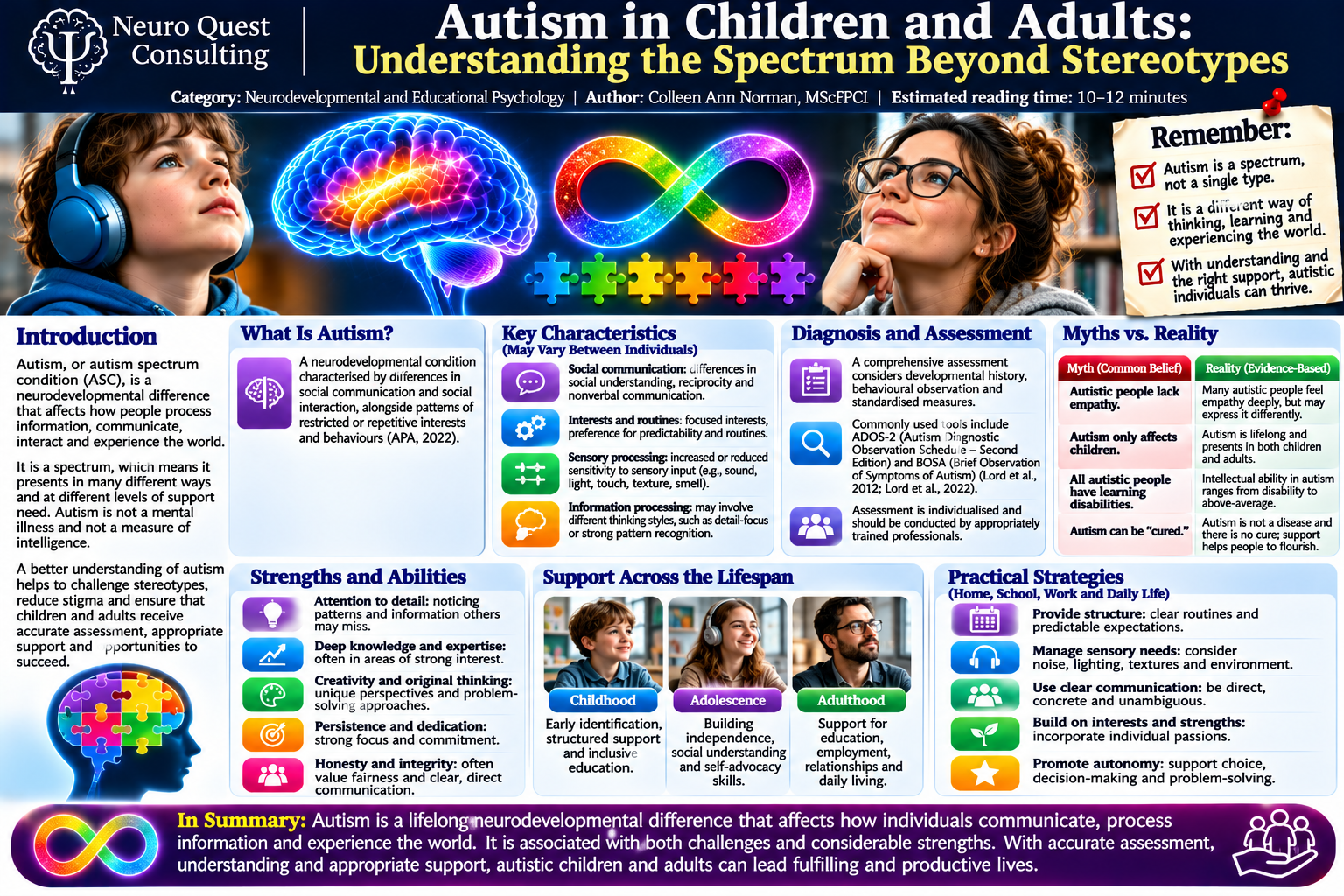
Editorial note: The supplied Article 15 file begins mid-sentence; its opening text needs to be restored before publication.
ition characterised by differences in social communication and interaction, alongside restricted or repetitive patterns of behaviour, interests or activities. Sensory differences are also recognised within contemporary diagnostic frameworks (American Psychiatric Association, 2022).
Autism is lifelong, but its presentation and the support an individual requires can change over time.
Understanding autism involves recognising individual differences rather than assuming that everyone shares the same abilities, difficulties or developmental pathway.
What Is Autism Spectrum Disorder?
Autism spectrum disorder (ASD) is the diagnostic term used in the Diagnostic and Statistical Manual of Mental Disorders, Fifth Edition, Text Revision (DSM-5-TR).
The diagnosis involves two broad domains:
- Persistent differences or difficulties in social communication and social interaction.
- Restricted or repetitive patterns of behaviour, interests or activities.
Diagnostic criteria also require that characteristics are present during the developmental period and are associated with clinically significant functional difficulties.
These characteristics cannot be better explained solely by intellectual disability or global developmental delay.
Many autistic people and advocacy organisations prefer identity-first language, such as autistic person, while others prefer person with autism.
Respecting individual preferences is an important part of person-centred practice.
Why Is Autism Called a Spectrum?
The word spectrum is sometimes misunderstood as indicating a single line from mild to severe autism.
In reality, autistic characteristics vary across several dimensions.
An individual may demonstrate strong language abilities while experiencing substantial sensory sensitivities.
Another person may require support with communication but demonstrate strengths in visual learning or specific interests.
Support needs may also differ according to environment and circumstances.
For example, someone who functions comfortably in a predictable setting may experience significant difficulties in a noisy or socially demanding environment.
The spectrum therefore reflects variation in developmental profiles and support needs rather than a simple ranking of individuals.
Social Communication Differences
Autistic people may communicate and interpret social information differently from non-autistic people.
Some experience difficulties interpreting implied meanings, indirect language or rapidly changing social expectations.
Others may prefer direct, explicit communication.
Differences can also involve conversational timing, eye contact, gestures and the interpretation of facial expressions.
However, reduced eye contact should not automatically be interpreted as lack of interest, dishonesty or emotional detachment.
Communication differences are influenced by individual preferences, sensory experiences, culture and context.
The Double Empathy Problem
Traditional explanations of autism have often focused on difficulties autistic individuals may experience understanding non-autistic communication.
Milton (2012) proposed the double empathy problem, suggesting that misunderstandings can arise in both directions when people with different social experiences and communication styles interact.
This perspective challenges the assumption that communication difficulties reside exclusively within the autistic individual.
For example, a non-autistic person may misinterpret an autistic person's direct communication as rudeness.
The autistic person may find indirect or ambiguous language confusing.
Both individuals may benefit from clearer communication and mutual understanding.
The double empathy problem remains an active area of research, but it provides a useful perspective on interpersonal differences.
Restricted and Repetitive Behaviours
Autism may involve repetitive movements, repeated speech, strong preferences for routines or highly focused interests.
These characteristics vary considerably.
Some individuals engage in repetitive movements, sometimes called stimming, that help regulate sensory or emotional experiences.
Others prefer predictable routines because unexpected changes create uncertainty or distress.
Focused interests may provide enjoyment, expertise, motivation and opportunities for social connection.
Such characteristics should not automatically be viewed as problems requiring elimination.
The relevant consideration is whether a behaviour creates harm, distress or meaningful interference with the individual's wellbeing or goals.
Sensory Processing Differences
Sensory experiences are an important aspect of autism for many individuals.
Some autistic people experience heightened sensitivity to sounds, lighting, textures, smells or physical contact.
Others may seek particular sensory experiences.
For example, a child may find the noise of a school dining hall overwhelming.
An adult may experience difficulty concentrating in an open-plan office because of competing sounds and visual stimulation.
Sensory responses vary across individuals and situations.
Practical adjustments may include quieter environments, predictable routines, appropriate lighting and access to sensory supports.
Autism in Early Childhood
Autistic characteristics may become apparent during early childhood.
Possible signs include differences in social communication, play, sensory responses or patterns of behaviour.
Some children may demonstrate delayed spoken language.
Others develop language within expected ranges but experience difficulties with reciprocal conversation or interpreting social expectations.
A child may show intense interest in particular subjects or experience distress when routines change.
However, individual signs are not sufficient to establish a diagnosis.
Developmental differences should be evaluated through an appropriate assessment process.
Autism in School-Age Children
Educational environments can create particular challenges for autistic pupils.
Classrooms involve complex social expectations, sensory stimulation and frequent transitions between activities.
Some children may struggle with group work, unstructured social situations or changes to established routines.
Others may perform well academically but experience substantial anxiety or exhaustion from managing the school environment.
Support should be based on individual needs rather than assumptions about diagnostic labels.
Relevant adjustments may include clear instructions, predictable schedules, sensory accommodations and opportunities for structured communication.
Autism in Adolescence
Adolescence introduces additional social, emotional and developmental demands.
Peer relationships become increasingly complex, while educational expectations often require greater independence.
Some autistic adolescents experience difficulties navigating social expectations or managing competing responsibilities.
Others develop strong friendships through shared interests and supportive environments.
Mental health should also be considered.
Autistic adolescents may experience anxiety, depression or other difficulties, but these conditions should not be regarded as inevitable consequences of autism.
Appropriate support should address the individual's circumstances and preferences.
Autism in Adults
Autism does not disappear when someone reaches adulthood.
Some individuals receive a diagnosis during childhood, while others are identified much later.
Adults may seek assessment after recognising longstanding patterns in communication, sensory experiences, routines or relationships.
Others may explore autism after a family member receives a diagnosis.
A later diagnosis can provide an explanatory framework for experiences that previously seemed difficult to understand.
However, an autism diagnosis does not explain every aspect of an individual's personality or life history.
Assessment should consider developmental evidence, current functioning and possible alternative explanations.
Autism in Women and Girls
Historically, autism research and diagnostic practices have included substantial numbers of male participants.
Researchers have examined whether some autistic girls and women demonstrate presentations that are less readily recognised by conventional expectations.
For example, some individuals may develop strategies for imitating social behaviour or concealing difficulties.
This is sometimes described as camouflaging or masking.
Hull et al. (2017) examined social camouflaging in autistic adults.
However, masking is not exclusive to women, and not every autistic person engages in it.
Assessment should avoid relying on gender stereotypes and instead consider the individual's developmental and behavioural profile.
Autism and Intelligence
Autism occurs across a wide range of intellectual abilities.
Some autistic individuals have intellectual disabilities.
Others demonstrate average or above-average cognitive abilities.
Exceptional abilities in particular areas occur in some individuals but should not be assumed.
Likewise, communication differences should not automatically be interpreted as evidence of reduced intelligence.
Appropriate cognitive assessment may help identify strengths and support needs, particularly when educational planning is required.
However, intelligence testing alone cannot diagnose autism.
Autism and ADHD
Autism and attention-deficit/hyperactivity disorder (ADHD) can co-occur.
Both conditions may involve differences in attention, executive functioning, sensory experiences or emotional regulation.
However, they have distinct diagnostic characteristics.
ADHD primarily involves persistent patterns of inattention and/or hyperactivity-impulsivity.
Autism involves differences in social communication and interaction alongside restricted or repetitive patterns of behaviour or interests.
A comprehensive assessment may need to investigate both conditions.
Identifying one does not automatically exclude the other.
Autism and Dyslexia
Autism and dyslexia are distinct neurodevelopmental conditions.
Dyslexia primarily affects the development of accurate and fluent word reading and spelling.
Autism primarily involves differences in social communication and restricted or repetitive patterns of behaviour or interests.
Some autistic individuals also experience dyslexia or other learning difficulties.
Others demonstrate strong decoding skills but may require support with particular aspects of reading comprehension.
Assessment should distinguish among literacy, language, attention and broader developmental factors.
Understanding Emotional Experiences
One persistent misconception is that autistic people do not experience empathy or meaningful emotional connections.
This is inaccurate.
Autistic individuals experience a wide range of emotions and may form deep, supportive relationships.
Differences may arise in recognising, communicating or interpreting emotional information.
Some individuals also experience alexithymia, which involves difficulty identifying or describing emotions.
However, alexithymia is not universal among autistic people.
Emotional functioning should be understood individually rather than inferred from a diagnostic label.
What Is an Autism Assessment?
Autism assessment involves gathering evidence about developmental history, social communication, behaviour and current functioning.
The precise process depends on age, referral question and relevant professional guidelines.
Assessment may include developmental interviews, clinical observation, information from parents or other informants, and examination of relevant educational or clinical records.
Standardised instruments may contribute to the assessment.
However, no single questionnaire or observation score should be treated as sufficient to establish an autism diagnosis independently.
A diagnostic conclusion requires integration of the available evidence by appropriately qualified professionals.
The ADOS-2
The Autism Diagnostic Observation Schedule, Second Edition (ADOS-2), is a standardised, semi-structured observational assessment.
It provides opportunities to observe aspects of social communication, interaction and behaviour relevant to autism.
Different modules are available according to the individual's language and developmental level.
The ADOS-2 can provide valuable information as part of a comprehensive assessment.
However, it should not be interpreted as a standalone diagnostic test.
Results must be considered alongside developmental history, clinical information and other relevant evidence.
The BOSA
The Brief Observation of Symptoms of Autism (BOSA) is an observational approach developed to provide structured opportunities to observe autism-related behaviours under particular assessment circumstances.
It emerged partly in response to practical challenges affecting conventional assessment procedures during the COVID-19 pandemic.
The BOSA involves structured interactions that can be reviewed by appropriately trained professionals.
However, its evidence base and intended applications differ from those of the ADOS-2.
It should not be described as an interchangeable replacement for a comprehensive diagnostic assessment.
The selection of an observational method should reflect current guidance, available evidence and professional competence.
Why Comprehensive Assessment Matters
Autism shares certain features with other developmental or psychological presentations.
For example, social anxiety, language difficulties, ADHD and other conditions may influence communication or social participation.
Some individuals may experience more than one condition.
A comprehensive assessment therefore considers differential diagnoses and co-occurring difficulties.
It should also identify strengths, preferences and support needs.
The purpose is not merely to determine whether diagnostic criteria are met but to develop a useful understanding of the individual's functioning.
Supporting Autistic Children at Home
Parents can support autistic children by developing predictable routines, communicating clearly and recognising sensory needs.
Visual schedules may help some children understand daily activities.
Preparing children for changes can reduce uncertainty.
Parents may also find it useful to identify situations that create sensory overload and make reasonable adjustments.
Support should respect the child's communication style and individual preferences.
Strategies should be adapted collaboratively rather than applied rigidly to every autistic child.
Supporting Autistic Children at School
Schools can support autistic pupils through appropriate educational adjustments.
These may include clear instructions, predictable transitions, reduced unnecessary sensory demands and access to suitable learning materials.
Some children benefit from visual information or additional processing time.
Others may require support with social communication, emotional regulation or organisational demands.
In England, schools may provide SEN support, and some children may require consideration for an Education, Health and Care Plan (EHCP).
Educational provision should be based on assessed needs.
Supporting Autistic Adults
Autistic adults may benefit from adjustments in employment, education and healthcare.
Examples include clear written communication, predictable expectations, sensory accommodations and flexibility in how information is exchanged.
However, not every autistic adult requires the same adjustments.
Support should be individualised and developed with the person's involvement.
Respecting autonomy and personal preferences is essential.
Mental Health and Autism
Autistic individuals may experience co-occurring mental health difficulties.
Anxiety and depression are important considerations in clinical practice.
However, autism itself should not be equated with a mental illness.
Mental health assessment should recognise differences in communication and emotional expression.
Professionals should avoid attributing every difficulty to autism when additional assessment or treatment may be appropriate.
Access to suitable psychological support can be important for wellbeing.
The Neurodiversity Perspective
The neurodiversity perspective recognises neurological and cognitive variation as part of human diversity.
It encourages consideration of how environments may create barriers for individuals whose needs differ from prevailing expectations.
However, recognising neurodiversity does not mean denying that some autistic individuals experience substantial disability or require significant support.
A balanced approach acknowledges both individual strengths and genuine support needs.
Autistic people should be involved in decisions affecting their lives wherever possible.
Common Myths About Autism
Myth: All autistic people have exceptional intellectual abilities.
Reality: Intellectual abilities vary widely.
Myth: Autistic people do not experience empathy.
Reality: Emotional experiences and expressions differ among individuals; autism does not imply an absence of empathy.
Myth: Autism only affects children.
Reality: Autism is lifelong.
Myth: Every autistic person avoids social relationships.
Reality: Social preferences and relationship experiences vary considerably.
Myth: Autism can be diagnosed using one questionnaire.
Reality: Comprehensive assessment requires multiple sources of information and appropriate clinical judgment.
UK Educational and Medical Resources
Families and adults seeking information can consult established UK resources.
NHS — Autism: https://www.nhs.uk/conditions/autism/
NICE — Autism in Under 19s: Recognition, Referral and Diagnosis: https://www.nice.org.uk/guidance/cg128
NICE — Autism in Adults: Diagnosis and Management: https://www.nice.org.uk/guidance/cg142
National Autistic Society: https://www.autism.org.uk/
GOV.UK — Children with Special Educational Needs: https://www.gov.uk/children-with-special-educational-needs/overview
These resources can help individuals understand assessment pathways, educational support and available services.
Conclusion
Autism is a diverse neurodevelopmental condition that influences communication, behaviour, sensory experiences and everyday functioning in different ways.
No single stereotype adequately represents autistic children or adults.
Some individuals require substantial support, while others experience relatively few difficulties in supportive environments.
Comprehensive assessment should consider developmental history, observed behaviour, individual strengths, functional needs and possible co-occurring conditions.
At Neuro Quest Consulting, autism-related assessment is approached through evidence-informed psychometric and observational methods, including ADOS-2 and BOSA where appropriate to the referral and professional scope.
The objective is to improve understanding, inform practical recommendations and support individuals and families in making informed decisions.
References
American Psychiatric Association. (2022). Diagnostic and statistical manual of mental disorders (5th ed., text rev.). https://doi.org/10.1176/appi.books.9780890425787
Hull, L., Petrides, K. V., Allison, C., Smith, P., Baron-Cohen, S., Lai, M.-C., & Mandy, W. (2017). “Putting on my best normal”: Social camouflaging in adults with autism spectrum conditions. Journal of Autism and Developmental Disorders, 47, 2519–2534. https://doi.org/10.1007/s10803-017-3166-5
Lord, C., Rutter, M., DiLavore, P. C., Risi, S., Gotham, K., & Bishop, S. L. (2012). Autism Diagnostic Observation Schedule, Second Edition (ADOS-2). Western Psychological Services.
Milton, D. E. M. (2012). On the ontological status of autism: The ‘double empathy problem’. Disability & Society, 27(6), 883–887. https://doi.org/10.1080/09687599.2012.710008
National Institute for Health and Care Excellence. (2011). Autism spectrum disorder in under 19s: Recognition, referral and diagnosis (Clinical Guideline CG128). https://www.nice.org.uk/guidance/cg128
National Institute for Health and Care Excellence. (2012). Autism spectrum disorder in adults: Diagnosis and management (Clinical Guideline CG142). https://www.nice.org.uk/guidance/cg142
Editorial note: This article is intended for general educational purposes. Autism diagnosis requires appropriately qualified professionals and comprehensive assessment. The references, external links and any descriptions of assessment services should receive final verification before publication.