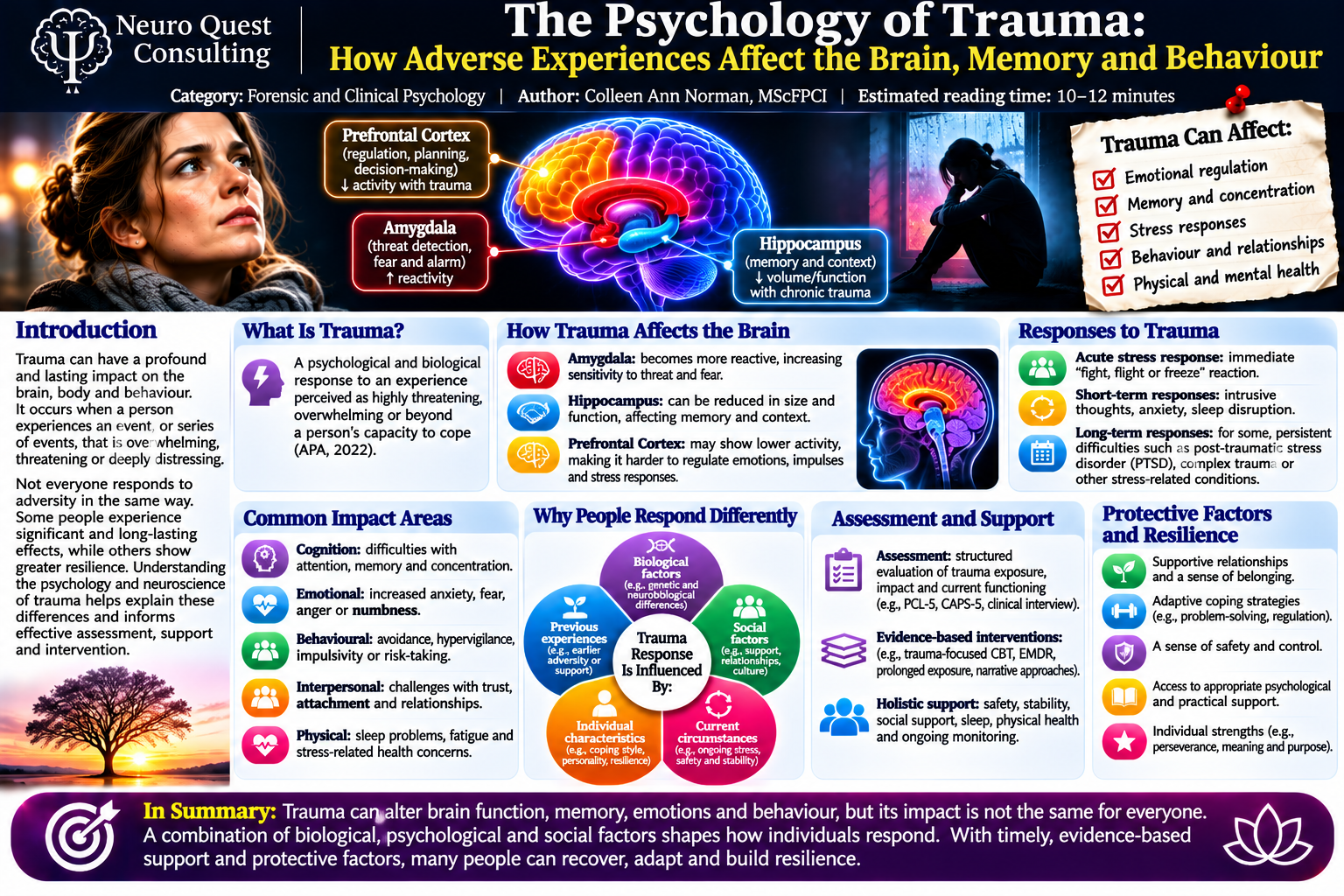
Introduction
Why do people respond differently to traumatic experiences? Why might one individual develop persistent psychological difficulties following a frightening event while another gradually recovers?
Trauma research has investigated these questions through psychology, neuroscience and developmental science.
Potentially traumatic experiences may include interpersonal violence, serious accidents, abuse, threatening events and other circumstances involving actual or perceived danger.
However, exposure to adversity does not inevitably result in a psychological disorder.
Some individuals experience substantial distress that gradually diminishes. Others develop persistent difficulties affecting emotional regulation, memory, relationships or everyday functioning.
Understanding these differences requires examining biological, psychological, social and contextual factors rather than assuming that everyone follows the same developmental pathway.
What Is Psychological Trauma?
The word trauma is used in several ways.
In everyday language, it may describe experiences that are profoundly distressing or overwhelming.
In clinical psychology, definitions depend on the particular condition and diagnostic framework.
For example, post-traumatic stress disorder (PTSD) has specific diagnostic requirements concerning exposure, symptoms, duration and impairment.
Not every distressing event meets the diagnostic exposure criteria for PTSD, and not everyone exposed to a qualifying event develops the disorder.
This distinction is important because psychological suffering can be significant even when a person does not meet criteria for a particular diagnosis.
Assessment should therefore consider the nature of the experience, its meaning to the individual and its consequences for functioning.
The Human Stress Response
When people encounter a perceived threat, the body activates systems involved in responding to danger.
The sympathetic nervous system contributes to changes such as increased heart rate and heightened physiological arousal.
The hypothalamic–pituitary–adrenal (HPA) axis helps regulate hormonal responses to stress, including cortisol release.
These systems can be adaptive.
They help individuals respond to demanding circumstances and mobilise resources when necessary.
However, prolonged or repeated stress may be associated with difficulties regulating physiological and emotional responses.
The effects vary according to factors such as developmental stage, stressor characteristics, previous experiences and available support.
Stress responses should not automatically be interpreted as evidence of permanent neurological damage.
How Trauma May Affect the Brain
Neuroscientific research has investigated associations between traumatic stress and brain systems involved in emotional processing, memory and behavioural regulation.
Three regions frequently examined are the amygdala, hippocampus and prefrontal cortex.
However, these regions function within interconnected networks.
Psychological responses cannot be reduced to activity in a single brain structure.
The Amygdala
The amygdala contributes to processing emotionally significant information, including potential threats.
Some neuroimaging studies of PTSD have identified increased amygdala responses during particular emotional tasks.
However, findings vary according to the population, task and research design.
Heightened amygdala activity is not a universal marker of trauma exposure.
Nor can an individual be diagnosed with PTSD on the basis of amygdala activation alone.
The Hippocampus
The hippocampus contributes to memory formation and contextual processing.
Research has identified associations between PTSD and differences in hippocampal structure or functioning in some populations.
However, interpreting these findings is complicated.
Some differences may precede trauma exposure, while others may be associated with subsequent experiences or additional factors.
Consequently, a group-level association does not establish that trauma caused a particular individual's hippocampus to change.
The Prefrontal Cortex
Prefrontal regions contribute to executive functioning, decision-making and the regulation of emotional responses.
Research has examined differences in prefrontal activity during tasks involving emotional processing among individuals with PTSD.
However, these findings should not be simplified into the claim that trauma permanently disables rational thinking.
Brain functioning is dynamic and influenced by numerous psychological and physiological processes.
Trauma and Memory
Memory is one of the most frequently discussed areas of trauma research.
Some people recall traumatic experiences vividly, particularly details that were central to the event.
Others experience incomplete, fragmented or inconsistent recollections.
These patterns may be influenced by attention, emotional arousal, the passage of time and subsequent experiences.
Importantly, there is no single memory pattern that establishes whether an event occurred.
A vivid memory is not necessarily accurate in every detail.
Similarly, gaps or inconsistencies do not automatically indicate deception.
Forensic and clinical professionals should avoid using memory characteristics alone to determine the truthfulness of an account.
Intrusive Memories
Some individuals experience unwanted recollections of traumatic events.
These may involve distressing images, thoughts, sensations or nightmares.
In PTSD, intrusive symptoms form part of a broader diagnostic pattern.
However, intrusive memories can also occur following stressful experiences without developing into PTSD.
The frequency, intensity and functional impact of symptoms are important considerations during assessment.
Treatment may help individuals reduce distress and develop more adaptive responses to trauma-related reminders.
Avoidance and Emotional Regulation
Avoidance is a common response to distressing experiences.
A person may avoid particular locations, conversations, memories or situations associated with an event.
In the short term, avoidance can reduce emotional discomfort.
However, persistent avoidance may sometimes interfere with recovery by limiting opportunities to process experiences or regain confidence.
Emotional regulation difficulties may also occur.
Some individuals experience heightened irritability, anxiety or emotional reactivity.
Others report emotional numbness or detachment.
These responses are not unique to trauma and should be evaluated within the broader clinical context.
Hypervigilance and Threat Perception
Hypervigilance involves heightened monitoring for potential danger.
Following threatening experiences, some individuals become particularly attentive to environmental cues that might signal risk.
This response may be understandable in circumstances where danger has been experienced.
However, persistent threat monitoring can become exhausting and interfere with sleep, concentration and ordinary activities.
Assessment should distinguish between excessive threat perception and situations in which genuine safety concerns remain.
A person's circumstances should not be dismissed simply because they have experienced trauma.
Why Do Individuals Respond Differently?
One of the central questions in trauma research concerns individual differences in outcomes.
Two people may experience similar events yet demonstrate substantially different psychological responses.
Several interacting influences may contribute.
Developmental history: Earlier experiences can influence coping patterns, expectations and available resources.
Individual characteristics: Temperament, cognitive processes and psychological functioning may affect responses.
Social support: Supportive relationships can contribute to recovery and wellbeing.
Event characteristics: Severity, duration, interpersonal context and repeated exposure may influence outcomes.
Subsequent circumstances: Continuing adversity, access to support and changes in safety may affect recovery.
These influences do not operate independently.
Their interactions can produce different outcomes across individuals and over time.
The Importance of Personal Meaning
Traumatic experiences are not interpreted identically by everyone.
An event may be experienced as threatening, humiliating, unjust, disempowering or profoundly disruptive to personal identity.
Cognitive appraisal theories emphasise that the interpretation of an experience can influence emotional responses and subsequent coping.
Ehlers and Clark (2000) proposed a cognitive model of PTSD highlighting the importance of how individuals process trauma-related information and perceive continuing threat.
However, personal meaning is only one component of a complex process.
It should not be used to suggest that people cause their own symptoms through their interpretations.
Psychological formulation must consider actual circumstances, biological responses and environmental influences alongside cognitive appraisal.
Trauma and Childhood Development
Childhood adversity can influence development through multiple pathways.
Research has examined associations between adverse childhood experiences and later physical and psychological health outcomes.
Felitti et al. (1998) reported relationships between cumulative categories of childhood adversity and several adult health-related outcomes.
However, such findings are statistical associations and do not determine an individual child's future.
Children exposed to adversity may demonstrate different developmental trajectories.
Supportive relationships, appropriate intervention and improved circumstances can make important contributions to wellbeing.
Assessment should therefore consider both difficulties and protective factors.
Trauma and Interpersonal Relationships
Traumatic experiences may influence trust, attachment, communication and interpersonal expectations.
Some individuals become cautious about forming close relationships.
Others may experience heightened sensitivity to perceived rejection or difficulties managing conflict.
However, these responses are not universal.
Many trauma-exposed individuals maintain stable, supportive relationships.
It is also important to avoid assuming that relationship difficulties necessarily originate in trauma.
Psychological assessment should consider alternative explanations and the individual's current circumstances.
Trauma and Behaviour
Trauma-related distress may influence concentration, sleep, emotional regulation and decision-making.
In some circumstances, individuals may demonstrate avoidance, withdrawal or increased irritability.
However, trauma does not inevitably cause aggression, criminal behaviour or violence.
Most people exposed to trauma do not become violent.
Forensic assessment should therefore distinguish between trauma history and the specific factors relevant to an individual's behaviour.
A traumatic experience may contribute to psychological formulation without providing a complete explanation for harmful conduct.
Trauma in Forensic Psychology
Trauma may be relevant to forensic assessment in several ways.
Individuals involved in criminal justice systems may have experienced substantial adversity.
Trauma-related symptoms may influence interviewing, memory, emotional functioning and engagement with services.
However, practitioners must avoid assuming that every individual has experienced trauma or that trauma explains all behaviour.
Assessment should consider the referral question, available evidence and the individual's functioning.
Trauma-informed practice seeks to recognise potential vulnerabilities while maintaining appropriate professional boundaries and evidential standards.
What Is Trauma-Informed Practice?
Trauma-informed practice involves recognising that adverse experiences may influence how people engage with services and institutions.
Common principles include safety, trustworthiness, collaboration, empowerment and sensitivity to individual circumstances.
In educational settings, this may involve predictable routines and supportive communication.
In healthcare, it may involve explaining procedures clearly and respecting patient choice.
In criminal justice settings, it may involve adapting communication and reducing unnecessary distress while maintaining procedural fairness.
Trauma-informed practice does not mean assuming that all behaviour results from trauma.
Nor does it replace evidence-based clinical assessment or treatment.
How Is Trauma Assessed?
Assessment depends on the referral question.
A qualified clinician may examine the nature of relevant experiences, current symptoms, duration, functional impairment and possible alternative explanations.
Structured clinical interviews and validated questionnaires may contribute to assessment.
For PTSD, instruments such as the Clinician-Administered PTSD Scale for DSM-5 (CAPS-5) and PTSD Checklist for DSM-5 (PCL-5) are commonly discussed in clinical research and practice.
However, questionnaires are not substitutes for comprehensive clinical judgment.
The selection and interpretation of measures must reflect professional competence and the assessment context.
Evidence-Based Treatments
Effective psychological treatments are available for many people experiencing trauma-related difficulties.
The National Institute for Health and Care Excellence (NICE) recommends specific psychological interventions for PTSD according to age, symptoms and clinical circumstances.
These include trauma-focused cognitive behavioural therapy and eye movement desensitisation and reprocessing (EMDR) for appropriate groups.
Treatment decisions should be made through individual clinical assessment.
Not everyone exposed to trauma requires specialist therapy.
Some individuals recover with appropriate practical and social support.
Others may benefit from structured psychological intervention.
Trauma-Focused Cognitive Behavioural Therapy
Trauma-focused CBT involves psychological techniques designed to address distressing trauma-related memories, beliefs, avoidance and associated symptoms.
Treatment may include carefully supported processing of traumatic experiences and the development of more adaptive coping strategies.
The precise approach depends on the treatment model and individual needs.
Trauma-focused CBT has substantial research support for PTSD.
However, treatment should be delivered by appropriately trained professionals and adapted to the person's circumstances.
Eye Movement Desensitisation and Reprocessing
EMDR is a structured psychological therapy used in the treatment of PTSD.
It involves recalling aspects of traumatic experiences while engaging in bilateral stimulation, commonly through guided eye movements.
Research supports EMDR as an effective treatment for PTSD in appropriate circumstances.
However, debates remain concerning the mechanisms through which its components contribute to treatment effects.
Clinical recommendations should follow relevant guidelines and individual assessment.
Resilience and Recovery
Resilience refers broadly to positive adaptation in the context of adversity.
It does not mean that a person experiences no distress.
Nor should resilience be interpreted as a fixed personality trait possessed by some individuals and absent in others.
Bonanno (2004) examined patterns of resilience following potentially traumatic events and highlighted the diversity of psychological responses.
Recovery may involve changes in symptoms, improved functioning, supportive relationships and renewed engagement with meaningful activities.
Different people may require different forms of assistance.
Importantly, recovery is not always linear.
Temporary increases in distress do not necessarily mean that progress has been lost.
Post-Traumatic Growth
Some individuals report positive psychological changes following highly challenging experiences.
These may include changes in priorities, relationships or perceptions of personal strength.
Tedeschi and Calhoun (2004) discussed the concept of post-traumatic growth.
However, growth should not be treated as an expected or required response to adversity.
People do not need to identify positive consequences in order for their experiences or recovery to be considered valid.
Furthermore, self-reported growth does not always correspond directly to objectively measured psychological change.
The concept should therefore be discussed sensitively and without imposing expectations.
When Should Someone Seek Professional Support?
Professional support may be appropriate when distress persists, interferes with daily functioning or creates significant difficulties with sleep, relationships, work or education.
Individuals experiencing intrusive memories, severe avoidance, persistent anxiety or other concerning symptoms may benefit from assessment.
In the United Kingdom, a GP can provide advice about NHS mental health services and referral pathways.
Relevant information is available through:
NHS Mental Health Services: https://www.nhs.uk/mental-health/
NICE PTSD Guideline NG116: https://www.nice.org.uk/guidance/ng116
Mind: https://www.mind.org.uk/
Support should be tailored to the individual's needs, preferences and circumstances.
Conclusion
Trauma can influence psychological and physiological functioning, including emotional regulation, memory, stress responses and interpersonal experiences.
However, the effects of adversity are not uniform.
Some individuals develop persistent psychological difficulties, while others demonstrate recovery or resilience.
Neuroscientific findings have contributed to understanding trauma-related processes, but they do not establish a universal brain signature or inevitable developmental outcome.
Effective psychological assessment requires attention to the individual's experiences, interpretations, circumstances, symptoms and protective resources.
At Neuro Quest Consulting, evidence-informed psychological assessment recognises the importance of individual differences and the limitations of simplistic explanations of human behaviour.
Understanding trauma requires scientific care, sensitivity and recognition that similar experiences can lead to very different psychological outcomes.
References
American Psychiatric Association. (2022). Diagnostic and statistical manual of mental disorders (5th ed., text rev.). https://doi.org/10.1176/appi.books.9780890425787
Bonanno, G. A. (2004). Loss, trauma, and human resilience: Have we underestimated the human capacity to thrive after extremely aversive events? American Psychologist, 59(1), 20–28. https://doi.org/10.1037/0003-066X.59.1.20
Ehlers, A., & Clark, D. M. (2000). A cognitive model of posttraumatic stress disorder. Behaviour Research and Therapy, 38(4), 319–345. https://doi.org/10.1016/S0005-7967(99)00123-0
Felitti, V. J., Anda, R. F., Nordenberg, D., Williamson, D. F., Spitz, A. M., Edwards, V., Koss, M. P., & Marks, J. S. (1998). Relationship of childhood abuse and household dysfunction to many of the leading causes of death in adults: The Adverse Childhood Experiences (ACE) Study. American Journal of Preventive Medicine, 14(4), 245–258. https://doi.org/10.1016/S0749-3797(98)00017-8
National Institute for Health and Care Excellence. (2018). Post-traumatic stress disorder (NICE Guideline NG116). https://www.nice.org.uk/guidance/ng116
Tedeschi, R. G., & Calhoun, L. G. (2004). Posttraumatic growth: Conceptual foundations and empirical evidence. Psychological Inquiry, 15(1), 1–18. https://doi.org/10.1207/s15327965pli1501_01
Editorial note: This article provides general educational information rather than individual clinical advice. References and external resource links should receive final verification before publication. The accompanying infographic should also be reviewed to ensure its simplified brain diagrams are not mistaken for universal biological findings.