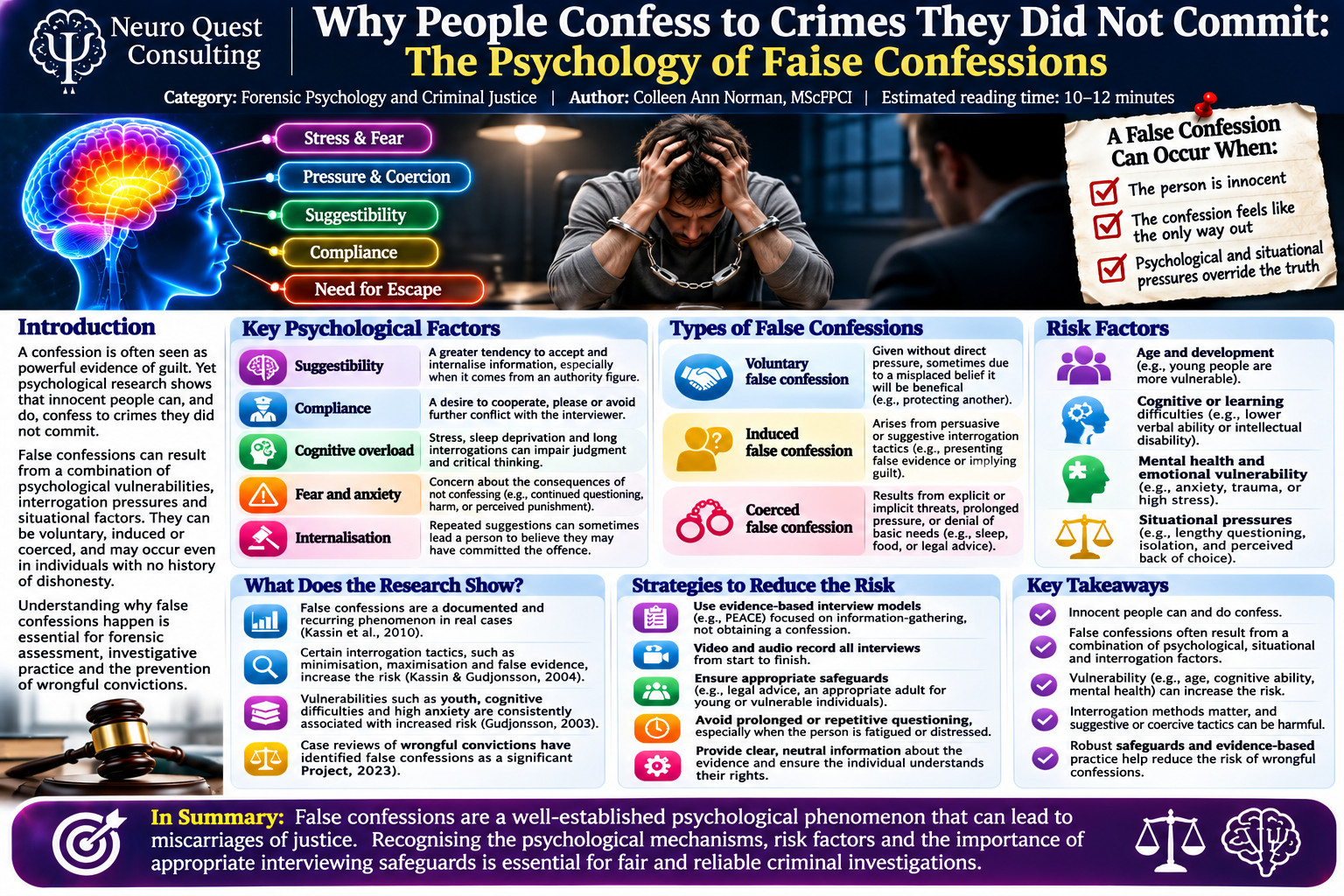
Introduction
Confessions are among the most persuasive forms of evidence presented in criminal investigations. When an individual admits responsibility for an offence, investigators, juries and members of the public may assume that the admission reflects genuine guilt.
Yet psychological research and documented miscarriages of justice demonstrate that innocent individuals sometimes confess to crimes they did not commit.
This phenomenon challenges common assumptions about human behaviour.
Why would someone accept responsibility for an offence they know they did not commit? Why might a person provide detailed information about a crime in which they had no involvement? And how can investigators distinguish a reliable confession from one produced through psychological pressure or suggestion?
False confessions arise through complex interactions involving individual vulnerability, situational circumstances, interviewing practices and psychological processes.
Understanding these factors is essential for forensic psychology, criminal investigation and the administration of justice.
What Is a False Confession?
A false confession occurs when an individual admits responsibility for an offence they did not commit.
Such admissions may be made voluntarily or arise in circumstances involving pressure, coercion or psychological influence.
False confessions should be distinguished from ordinary inaccuracies in witness statements.
A person who falsely confesses may provide an explicit admission of criminal responsibility, sometimes accompanied by a narrative describing the alleged offence.
Importantly, the presence of detailed information does not automatically establish that a confession is accurate.
Details may have been obtained from investigators, media coverage, other individuals or previous exposure to information about the case.
Researchers have identified several psychological pathways through which false confessions may occur (Kassin et al., 2010).
Three Types of False Confessions
Kassin and Wrightsman (1985) proposed an influential classification distinguishing three broad categories.
Voluntary False Confessions
Voluntary false confessions occur without direct pressure from investigators.
Possible motivations include seeking attention, protecting another person, feelings of guilt unrelated to the offence or difficulties distinguishing reality from imagination in particular clinical circumstances.
Some individuals may falsely claim responsibility for highly publicised crimes.
The motivations vary considerably and should not be assumed without evidence.
Compliant False Confessions
Compliant false confessions occur when individuals knowingly admit to something they did not do because they believe the admission will produce an immediate benefit or prevent an undesirable consequence.
For example, someone may confess to end an exhausting interview, avoid further confrontation or obtain a promised opportunity to leave.
The individual may recognise that the confession is false but perceive continued denial as more difficult or threatening.
Internalised False Confessions
Internalised false confessions involve circumstances in which an individual comes to doubt their own memory or develops a belief that they may have committed the offence.
This process may involve suggestion, misleading information or uncertainty about memory.
However, internalisation should not be assumed merely because someone confesses after questioning.
Determining whether an individual genuinely believed a false account requires careful evaluation.
The Psychology of Compliance
Compliance involves changing behaviour in response to requests, expectations or pressure from others.
In an investigative interview, the interviewer occupies a position of authority.
Some individuals may experience a strong desire to cooperate, avoid disagreement or satisfy perceived expectations.
Compliance can be particularly relevant when the interviewee believes that continued denial will prolong an unpleasant situation.
A person may therefore make an admission to obtain immediate relief without adequately considering the long-term consequences.
Gudjonsson (2003) examined the psychological characteristics and processes associated with interrogative suggestibility and compliance.
These concepts are important because individuals differ in how they respond to authority and interpersonal pressure.
Interrogative Suggestibility
Suggestibility refers to the extent to which a person's responses may be influenced by information, expectations or feedback.
In investigative settings, suggestibility may become relevant when interviewers repeatedly introduce particular details or challenge an individual's account.
Some people may begin to question their recollection after repeated assertions that their memory is incorrect.
Others may incorporate suggested information into their responses.
However, suggestibility is not synonymous with dishonesty, and a person with elevated suggestibility is not necessarily incapable of providing accurate evidence.
Assessment requires consideration of the individual's characteristics and the circumstances of questioning.
The Role of Stress and Anxiety
Criminal investigations can create substantial psychological stress.
An individual may experience fear, uncertainty, shame or concern about the consequences of being suspected.
Stress may influence attention, decision-making and the ability to evaluate alternatives.
However, stress does not affect every person in the same way.
Some individuals remain relatively composed, while others experience considerable difficulty managing the situation.
A prolonged or highly confrontational interview may increase the perceived urgency of escaping the immediate circumstances.
This can create conditions in which short-term relief becomes more psychologically salient than long-term consequences.
Sleep Deprivation and Fatigue
Fatigue can impair cognitive functioning, including attention, working memory and decision-making.
Research has demonstrated that sleep deprivation can influence the likelihood of false admissions in experimental settings.
Frenda et al. (2016) found that sleep-deprived participants were more likely to sign a false statement concerning a prohibited action in a laboratory task.
However, laboratory findings should not be treated as direct estimates of false-confession rates in real criminal investigations.
The research nevertheless supports the importance of considering fatigue and sleep deprivation during questioning.
False Evidence and Psychological Pressure
One controversial interviewing practice involves presenting a suspect with fabricated or misleading evidence.
For example, an interviewer may falsely claim that forensic evidence establishes the person's involvement.
Such claims may alter how a suspect evaluates their situation.
Some individuals may believe that denial is futile, even when they know they are innocent.
Others may begin questioning their own memory.
Kassin and Kiechel (1996) demonstrated in an experimental paradigm that false evidence could increase the likelihood of participants accepting responsibility for an action they had not committed.
The experiment did not replicate the full seriousness of a criminal investigation, but it illustrated a psychological mechanism relevant to false admissions.
Minimisation and Maximisation
Researchers have examined interviewing techniques that influence a suspect's perception of the consequences of confessing or denying involvement.
Minimisation may involve presenting the alleged conduct as understandable, excusable or less serious.
Maximisation may involve emphasising the seriousness of the accusation or suggesting that evidence of guilt is overwhelming.
These techniques may influence decision-making, particularly when individuals interpret them as implying consequences for cooperation or resistance.
However, the effects depend on the specific technique, context and individual.
Kassin et al. (2010) recommended safeguards designed to reduce the risk of false confessions and improve investigative reliability.
Why Innocent People May Believe Confession Will Help
People generally assume that innocent suspects will continue denying responsibility.
However, innocence can sometimes contribute to unexpected decisions.
An innocent individual may believe that the truth will inevitably emerge.
They may therefore underestimate the consequences of making an inaccurate admission or agreeing with an investigator's account.
Some individuals may also assume that cooperation will demonstrate their innocence.
This illustrates why investigative procedures should not rely on the assumption that innocent people will always protect themselves effectively during questioning.
Children and Adolescents
Children and adolescents may face particular vulnerabilities during investigative interviews.
Developmental differences can influence understanding of rights, appreciation of long-term consequences and responses to authority.
Younger individuals may be especially concerned with satisfying adults or escaping immediate pressure.
However, vulnerability varies substantially among individuals.
Age alone does not determine whether a confession is reliable.
Appropriate safeguards are necessary to ensure that young suspects understand the process and receive the protections required by law.
Intellectual and Learning Disabilities
Some individuals with intellectual disabilities or communication difficulties may experience challenges understanding complex questions, legal terminology or the consequences of particular responses.
They may also be more susceptible to certain forms of suggestion or compliance.
However, a diagnosis or learning difficulty does not automatically establish unreliability.
Assessment should focus on the person's actual comprehension, communication abilities and support needs.
Interviewing procedures should be adapted where appropriate, and relevant legal safeguards must be observed.
Mental Health and Psychological Vulnerability
Mental health difficulties may influence an individual's experience of police questioning.
For example, acute distress, confusion or particular psychiatric symptoms may affect comprehension or decision-making.
However, most people with mental health conditions do not make false confessions.
The presence of a diagnosis is not sufficient to establish vulnerability in a specific interview.
A careful evaluation considers the person's functioning at the relevant time, the nature of questioning and any available corroborating evidence.
The Importance of Confession Contamination
A confession may contain details that appear to demonstrate knowledge of the offence.
However, investigators must consider whether the suspect independently supplied those details.
Confession contamination occurs when crime-related information is introduced into the interview and subsequently appears in the suspect's account.
For example, an investigator might reveal the location of an object before the suspect mentions it.
If the suspect later repeats that information, it should not automatically be treated as independently generated knowledge.
This is one reason complete interview recordings are valuable.
They allow investigators, courts and experts to examine how information entered the conversation.
False Confessions and Wrongful Convictions
False confessions have contributed to documented wrongful convictions.
Their consequences can be severe because an admission may influence how investigators interpret other evidence.
Once a confession has been obtained, investigators may become more confident in a particular theory of the case.
This can increase the risk of confirmation bias.
Contradictory evidence may receive insufficient attention, while ambiguous findings may be interpreted as supporting guilt.
Kassin et al. (2010) discussed the importance of recognising how confession evidence can affect subsequent investigative and legal decisions.
How Can Investigators Reduce the Risk?
Evidence-based interviewing practices can help reduce avoidable risks.
Important safeguards include:
- Recording interviews in full, where legally and operationally appropriate.
- Avoiding coercion and misleading claims about evidence.
- Providing appropriate legal and procedural protections.
- Considering age, communication needs and psychological vulnerability.
- Allowing appropriate breaks and addressing fatigue.
- Using open-ended, information-gathering questions.
- Testing admissions against independently established evidence.
- Documenting how crime-related details were obtained.
These measures help protect both suspects and the reliability of criminal investigations.
The PEACE Interviewing Framework
In England and Wales, investigative interviewing is commonly informed by the PEACE framework.
PEACE stands for:
Planning and Preparation
Engage and Explain
Account, Clarification and Challenge
Closure
Evaluation
The framework emphasises structured, ethical and information-gathering approaches to interviewing.
Its objective is to obtain accurate and relevant information rather than secure a confession at any cost.
The effectiveness of any interviewing framework depends on training, implementation and adherence to appropriate safeguards.
The Role of Forensic Psychologists
Forensic psychologists may contribute to cases involving disputed confessions by examining psychological factors relevant to reliability.
Potential considerations include:
- The individual's cognitive and communication abilities.
- Relevant psychological vulnerabilities.
- Suggestibility and compliance.
- The conditions and duration of questioning.
- The presence of misleading information or pressure.
- The development of the confession narrative.
- The relationship between the confession and independent evidence.
However, psychological assessment cannot automatically establish whether a confession is true or false.
Experts must distinguish between evidence of vulnerability and conclusions about what occurred in a particular case.
The ultimate determination of criminal responsibility remains a legal matter.
Why Independent Evidence Matters
A confession should be evaluated alongside the broader evidential record.
Investigators should examine whether the account is consistent with independently verified facts.
They should also consider whether the suspect could have obtained relevant information from other sources.
A confession containing accurate details may be compelling, but the origin of those details matters.
Likewise, inconsistencies may require investigation rather than immediate assumptions about guilt or innocence.
The central objective is to evaluate the reliability of the evidence through a fair and transparent process.
Conclusion
False confessions demonstrate that human behaviour under investigative pressure can be more complex than common assumptions suggest.
Innocent individuals may confess because of compliance, suggestibility, fatigue, psychological distress, misleading information or perceived short-term benefits.
These mechanisms do not affect everyone equally, and no single factor establishes that a confession is false.
Scientific research supports careful interviewing, appropriate safeguards and independent evaluation of confession evidence.
At Neuro Quest Consulting, forensic psychology emphasises evidence-based reasoning, recognition of psychological vulnerability and the importance of distinguishing behavioural observations from unsupported conclusions.
Understanding false confessions is essential for protecting the integrity of criminal investigations and reducing the risk of miscarriages of justice.
References
Frenda, S. J., Berkowitz, S. R., Loftus, E. F., & Fenn, K. M. (2016). Sleep deprivation and false confessions. Proceedings of the National Academy of Sciences, 113(8), 2047–2050. https://doi.org/10.1073/pnas.1521518113
Gudjonsson, G. H. (2003). The psychology of interrogations and confessions: A handbook. Wiley.
Kassin, S. M., & Kiechel, K. L. (1996). The social psychology of false confessions: Compliance, internalization, and confabulation. Psychological Science, 7(3), 125–128. https://doi.org/10.1111/j.1467-9280.1996.tb00344.x
Kassin, S. M., & Wrightsman, L. S. (1985). Confession evidence. In S. M. Kassin & L. S. Wrightsman (Eds.), The psychology of evidence and trial procedure (pp. 67–94). Sage.
Kassin, S. M., Drizin, S. A., Grisso, T., Gudjonsson, G. H., Leo, R. A., & Redlich, A. D. (2010). Police-induced confessions: Risk factors and recommendations. Law and Human Behavior, 34(1), 3–38. https://doi.org/10.1007/s10979-009-9188-6
Editorial note: This article is intended for educational purposes and does not constitute an expert opinion about any particular confession or criminal investigation. References should be checked before publication.