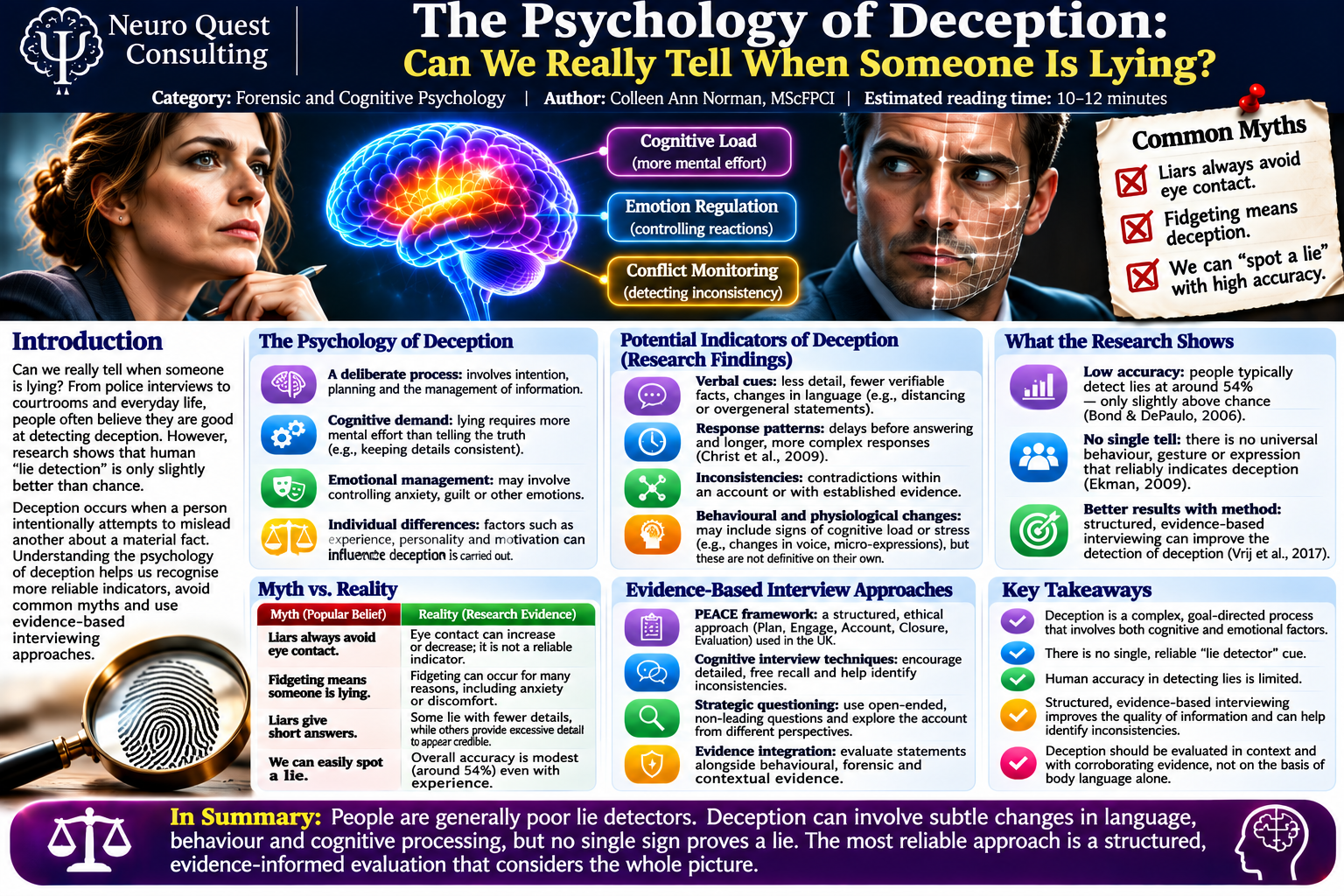
Introduction
Can a person recognise a liar by observing their facial expressions? Does avoiding eye contact indicate deception? Can an experienced investigator reliably determine whether someone is telling the truth simply by watching their behaviour?
These questions have fascinated psychologists, investigators and the public for decades.
Television programmes frequently portray deception detection as an almost intuitive skill. Investigators observe a fleeting expression, notice a change in posture or identify an unusual response and immediately conclude that someone is lying.
Scientific research presents a considerably more complicated picture.
People who lie do not necessarily display obvious signs of nervousness. Conversely, truthful individuals may appear anxious, hesitant or uncomfortable, particularly when questioned about serious or emotionally significant events.
Understanding deception therefore requires examining cognition, motivation, emotional responses and the limitations of behavioural interpretation.
What Is Deception?
Deception generally involves intentionally creating or maintaining a false belief in another person.
This may occur through direct false statements, selective omission of information or misleading communication.
However, not every inaccurate statement constitutes deception.
A person may provide incorrect information because of memory errors, misunderstanding, confusion or mistaken beliefs.
The distinction between intentional deception and unintentional inaccuracy is particularly important in forensic psychology.
A witness who sincerely remembers an event incorrectly is not necessarily lying.
Similarly, an individual who hesitates before answering may be attempting to recall information rather than inventing an explanation.
Determining whether deception has occurred requires evidence concerning the statement and its context, not merely an impression of the speaker's behaviour.
Why Do People Lie?
People may deceive others for numerous reasons.
Some lies are intended to obtain personal advantage.
Others involve avoiding embarrassment, protecting privacy, escaping punishment or attempting to prevent interpersonal conflict.
In criminal investigations, a suspect may lie to conceal involvement in an offence.
However, innocent individuals may also provide misleading information about unrelated matters because they fear suspicion or wish to avoid disclosing private information.
The motivation behind a particular statement cannot be established solely by observing how it is delivered.
Researchers therefore examine deception as a goal-directed behaviour influenced by social, cognitive and situational factors.
The Myth of Eye Contact
One of the most persistent beliefs about deception is that liars avoid eye contact.
In reality, eye contact is not a reliable universal indicator of dishonesty.
Some people avoid eye contact because of anxiety, cultural expectations, neurodevelopmental differences or discomfort.
Others may deliberately maintain eye contact because they believe it conveys credibility.
Research reviewing nonverbal indicators of deception has found that many popular behavioural cues are weak or inconsistent (DePaulo et al., 2003).
Consequently, investigators should not interpret reduced eye contact as proof that someone is lying.
Does Fidgeting Indicate Dishonesty?
Fidgeting, changes in posture and restless movements are frequently associated with lying in popular culture.
However, these behaviours can arise for many reasons.
A truthful person may fidget because they are frightened, uncomfortable or experiencing physical discomfort.
An individual providing a deceptive account may remain relatively still.
Moreover, attempts to control behaviour during an interview can influence movement patterns.
The absence or presence of fidgeting therefore provides little reliable evidence of deception when considered in isolation.
Facial Expressions and Microexpressions
Microexpressions are brief facial movements sometimes discussed in relation to concealed emotions.
Popular accounts occasionally suggest that trained observers can identify deception by detecting these expressions.
However, the scientific evidence does not support treating microexpressions as a dependable method of determining whether a statement is true or false.
An expression of fear, anger or discomfort does not establish why the emotion occurred.
A person may be frightened because they are guilty, because they are innocent but under suspicion, or because the interview itself is distressing.
Emotion and deception are not equivalent.
Facial behaviour should therefore be interpreted cautiously and within context.
How Accurate Are People at Detecting Lies?
Bond and DePaulo (2006) conducted a large meta-analysis examining the accuracy of deception judgments.
Across the studies reviewed, average accuracy was approximately 54%.
This was only modestly above the 50% level expected by chance in balanced truth-versus-lie tasks.
The findings challenge the assumption that people generally possess strong intuitive lie-detection abilities.
However, the estimate should not be treated as a universal accuracy rate for every setting.
Performance varies according to the task, available information, type of deception and methods used.
The important conclusion is that confidence in one's ability to recognise lies does not necessarily correspond to actual accuracy.
Are Professionals Better at Detecting Deception?
Police officers, investigators and other professionals may have substantial experience interviewing people.
However, experience alone does not guarantee superior deception-detection accuracy.
Research suggests that professional groups do not consistently demonstrate dramatic advantages over nonprofessionals in judging deception from behaviour.
This does not mean investigative expertise is unimportant.
Experienced investigators may be skilled at obtaining information, evaluating inconsistencies and identifying evidence requiring further examination.
These skills differ from the ability to identify deception through intuition or body language.
Effective investigative interviewing depends on methodical information gathering rather than assumptions about personal lie-detection talent.
The Cognitive Demands of Lying
Some researchers propose that lying can involve additional cognitive demands.
A person providing a deceptive account may need to construct information, monitor what has already been said and consider whether the account is plausible.
They may also attempt to regulate their behaviour and anticipate questions.
However, lying is not always more cognitively demanding than telling the truth.
A rehearsed lie may be relatively easy to deliver.
Conversely, a truthful person recalling a complex event may experience considerable difficulty organising information.
Cognitive-load approaches therefore require careful application and cannot establish deception through response difficulty alone.
Verbal Indicators of Deception
Researchers have investigated whether truthful and deceptive accounts differ in their verbal characteristics.
Potentially relevant features include detail, specificity, plausibility and the presence of information that can be independently checked.
However, there is no single verbal indicator that reliably identifies every lie.
Some deceptive accounts are elaborate and detailed.
Some truthful accounts are brief, fragmented or incomplete.
Differences may also reflect memory, language ability, interview conditions or cultural communication styles.
Verbal analysis is most useful when integrated with independent evidence and appropriately validated methods.
The Importance of Verifiable Details
One research approach examines whether interviewees provide details that investigators can independently verify.
For example, a person may describe visiting a particular location at a specific time.
The account might be examined against available records, witnesses or other evidence.
The presence of verifiable information can assist investigation, but it does not automatically establish that every aspect of an account is accurate.
Likewise, an inability to provide independently verifiable details does not prove deception.
Some truthful experiences occur without witnesses or documentary records.
The value lies in testing claims against evidence rather than relying on behavioural impressions.
Strategic Interviewing
Evidence-informed investigative interviewing may involve asking questions designed to obtain detailed accounts and examine their consistency with independently established information.
One approach is the Strategic Use of Evidence technique.
This involves carefully considering when and how relevant evidence is disclosed during an interview.
Hartwig et al. (2006) examined the potential value of strategically using evidence when interviewing suspects.
The objective is not to manipulate individuals into confessing but to evaluate explanations and identify discrepancies that warrant further investigation.
Such approaches require appropriate training, ethical safeguards and careful interpretation.
The PEACE Interviewing Framework
In England and Wales, the PEACE framework provides a structured approach to investigative interviewing.
PEACE stands for:
Planning and Preparation
Engage and Explain
Account, Clarification and Challenge
Closure
Evaluation
The framework emphasises information gathering, careful questioning and the evaluation of evidence.
Rather than assuming that an interviewer can recognise deception through body language, the approach encourages systematic examination of the account.
The quality of implementation depends on training and adherence to appropriate professional standards.
The Polygraph: Can Machines Detect Lies?
The polygraph measures physiological responses such as changes in respiration, cardiovascular activity and skin conductance.
These responses may be associated with emotional arousal or other physiological processes.
However, a polygraph does not directly measure deception.
Anxiety, fear, attention and other factors can influence physiological responses.
The National Research Council (2003) reviewed the scientific evidence concerning polygraph testing and identified important limitations, particularly in screening contexts.
Polygraph results should not be treated as definitive proof of truthfulness or dishonesty.
Their legal and operational use varies by jurisdiction and purpose.
Brain Imaging and Lie Detection
Researchers have investigated whether functional magnetic resonance imaging (fMRI) can identify neural activity associated with deception.
Some experimental studies have identified differences in brain activation during tasks involving truthful and deceptive responses.
However, these findings do not establish a reliable individual-level lie detector.
Laboratory deception tasks often differ substantially from real-world criminal investigations.
Factors such as emotional significance, motivation, familiarity and task design may influence neural responses.
At present, brain imaging cannot provide a scientifically established method of determining whether a particular individual is lying in an ordinary forensic interview.
Deception, Memory and False Accusations
One of the most important challenges in forensic assessment is distinguishing deception from memory error.
Human memory is reconstructive and can be influenced by suggestion, stress and post-event information.
An individual may provide inconsistent accounts because their memory is incomplete or because they misunderstood a question.
Similarly, a person may confidently report an inaccurate recollection without intending to mislead.
Therefore, inconsistency alone does not establish dishonesty.
Investigators should examine whether discrepancies concern central or peripheral information, whether questioning introduced new details and whether independent evidence is available.
Cultural and Individual Differences
Communication styles vary across cultures and individuals.
Eye contact, conversational pauses, emotional expression and gestures may have different meanings in different contexts.
Neurodevelopmental differences may also influence communication.
For example, an autistic individual may use eye contact or conversational timing differently from what an interviewer expects.
Such differences should not be interpreted automatically as indicators of deception.
Fair investigative practice requires recognising individual variation and avoiding stereotypes.
The Danger of Confirmation Bias
Confirmation bias occurs when individuals interpret information in ways that support existing beliefs.
An investigator who already suspects someone may interpret nervousness as guilt.
The same behaviour displayed by another person may be dismissed as ordinary anxiety.
Once a conclusion has been formed, ambiguous evidence can appear more persuasive than it actually is.
Structured interviewing and independent evidence evaluation help reduce this risk.
Investigators should actively consider alternative explanations rather than seeking only information that confirms an initial suspicion.
Can Deception Ever Be Detected Reliably?
Deception may sometimes be established through contradictions between a statement and reliable independent evidence.
For example, a person may claim to have been in one location while verified records demonstrate that they were elsewhere.
However, even then, investigators must consider whether the discrepancy reflects intentional deception, mistaken recollection or another explanation.
The most defensible approach involves evaluating statements against evidence, examining the circumstances in which information was obtained and recognising uncertainty.
No behavioural technique can guarantee accurate detection of deception in every case.
Ethical Considerations
Incorrectly labelling someone as dishonest can have serious consequences.
In criminal investigations, unsupported judgments may contribute to wrongful suspicion, coercive questioning or miscarriages of justice.
In educational, occupational and clinical settings, assumptions about deception can damage relationships and reputations.
Psychological expertise should therefore be used to improve the quality of evidence evaluation rather than justify speculative judgments.
Professionals must distinguish between observed behaviour, possible explanations and conclusions supported by independent evidence.
Conclusion
The psychology of deception demonstrates that detecting lies is far more difficult than popular culture suggests.
Eye contact, fidgeting, nervousness and facial expressions are not reliable universal indicators of dishonesty.
Research indicates that unaided human deception judgments are often only modestly more accurate than chance.
More promising approaches focus on structured interviewing, careful questioning, verifiable information and the systematic evaluation of evidence.
At Neuro Quest Consulting, forensic psychological analysis emphasises evidence-informed interpretation, recognition of individual differences and the importance of avoiding unsupported conclusions.
The central lesson is straightforward: behaviour may raise questions, but evidence is required to support answers.
References
Bond, C. F., Jr., & DePaulo, B. M. (2006). Accuracy of deception judgments. Personality and Social Psychology Review, 10(3), 214–234. https://doi.org/10.1207/s15327957pspr1003_2
DePaulo, B. M., Lindsay, J. J., Malone, B. E., Muhlenbruck, L., Charlton, K., & Cooper, H. (2003). Cues to deception. Psychological Bulletin, 129(1), 74–118. https://doi.org/10.1037/0033-2909.129.1.74
Hartwig, M., Granhag, P. A., Strömwall, L. A., & Vrij, A. (2006). Detecting deception via strategic disclosure of evidence. Law and Human Behavior, 30(5), 603–619. https://doi.org/10.1007/s10979-006-9053-9
National Research Council. (2003). The polygraph and lie detection. National Academies Press. https://doi.org/10.17226/10420
Vrij, A. (2008). Detecting lies and deceit: Pitfalls and opportunities (2nd ed.). Wiley.
Vrij, A., Fisher, R. P., & Blank, H. (2017). A cognitive approach to lie detection: A meta-analysis. Legal and Criminological Psychology, 22(1), 1–21. https://doi.org/10.1111/lcrp.12088
Editorial note: This article is intended for general educational purposes. It does not provide a method for determining whether a particular individual is lying. References should receive final bibliographic verification before publication.