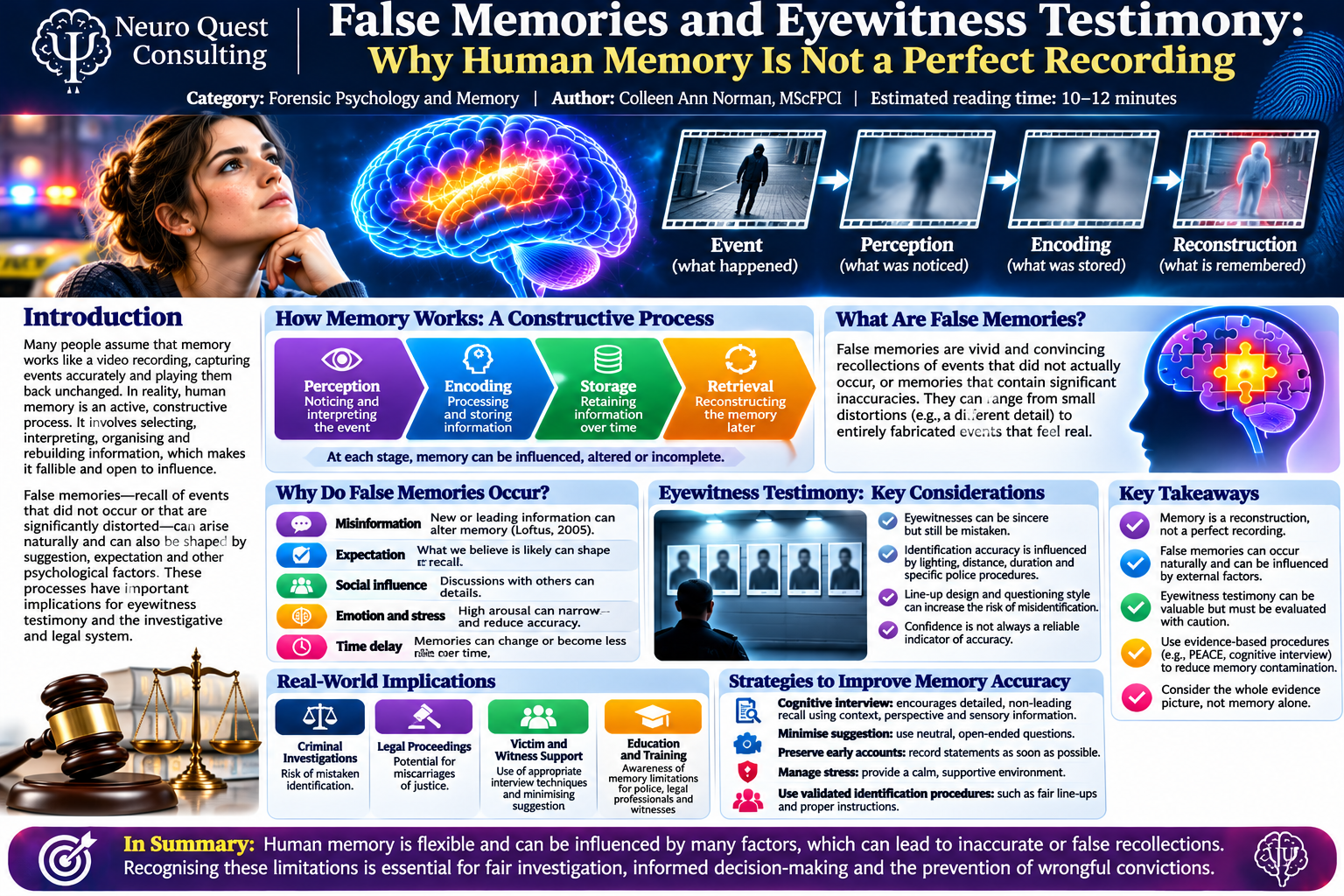
Introduction
Imagine witnessing a robbery outside a busy shopping centre. The incident lasts approximately thirty seconds. You notice the offender's clothing, hear shouting and briefly see the person's face before they disappear.
Several weeks later, police ask you to identify the offender.
You feel confident that you remember what happened. But how reliable is that confidence?
For decades, psychological research has demonstrated that human memory is not an exact recording of past events. Instead, memory is a reconstructive process influenced by attention, perception, prior knowledge, emotional responses and information encountered after an event.
One of the most significant contributions to this field comes from research on eyewitness testimony and false memories.
The findings have important implications for criminal investigations, police interviewing, courtroom evidence and the prevention of wrongful convictions.
How Does Human Memory Work?
Memory involves several interconnected processes, commonly described as encoding, storage and retrieval.
Encoding refers to the initial processing of information.
Storage concerns the retention of information over time.
Retrieval involves accessing information that has previously been encoded.
Although these processes are often described separately, they interact in complex ways.
When individuals remember an event, they do not necessarily retrieve a complete, unchanged representation of what occurred.
Instead, recollection may involve reconstructing information from fragments of memory, contextual knowledge and expectations.
Bartlett (1932) demonstrated that remembering is influenced by existing knowledge structures, sometimes called schemas.
These schemas help people organise information but can also contribute to errors when details are reconstructed according to what seems familiar or plausible.
What Is a False Memory?
A false memory is a recollection that contains inaccurate information or represents an event that did not occur.
False memories can range from relatively minor errors to more substantial distortions.
For example, a person may accurately remember attending a birthday celebration but incorrectly recall who was present.
In other circumstances, someone may develop a recollection of an event that never occurred.
False memories do not necessarily involve deliberate deception.
An individual may sincerely believe that their recollection is accurate.
This distinction is particularly important in forensic psychology because honesty and accuracy are not equivalent.
A witness may be truthful about what they believe they remember while nevertheless providing inaccurate information.
The Misinformation Effect
One of the most influential findings in memory research concerns the misinformation effect.
This occurs when information encountered after an event influences later recollection.
Loftus and Palmer (1974) conducted a landmark experiment examining how the wording of questions affected participants' estimates of vehicle speed.
Participants watched films of traffic accidents and were asked questions using different verbs.
For example, some were asked how fast the vehicles were travelling when they smashed into each other, while others received less forceful wording.
The wording influenced participants' estimates.
In a subsequent experiment, participants exposed to the more forceful wording were also more likely to report seeing broken glass, even though no broken glass appeared in the film.
The findings demonstrated that questioning can influence later reports of an event.
However, researchers continue to investigate the precise mechanisms underlying misinformation effects, including changes in memory, source confusion and response processes.
Why Leading Questions Matter
A leading question introduces information or implies a particular answer.
Consider the difference between these questions:
Neutral question: "What did you see the person carrying?"
Leading question: "Did you see the knife the person was carrying?"
The second question introduces the possibility that a knife was present.
If no knife was observed, repeated exposure to such suggestions may nevertheless influence a witness's later report.
Leading questions can be particularly problematic when witnesses are uncertain or when investigators unintentionally communicate their expectations.
This is why evidence-based interviewing procedures emphasise open-ended questions and avoiding unnecessary suggestion.
Source Monitoring Errors
Remembering an event involves more than recalling information. Individuals must also determine where that information originated.
This process is called source monitoring.
Johnson et al. (1993) described how people distinguish among memories arising from direct experience, imagination, conversation and other sources.
Source monitoring errors occur when information is attributed to the wrong origin.
For example, a witness may remember a detail mentioned in a news report but later believe they observed it personally.
Similarly, someone may confuse an imagined scenario with an actual experience.
These errors can be difficult to recognise because the remembered information may feel familiar and convincing.
The Influence of Social Discussion
Witnesses sometimes discuss events with other people before providing formal statements.
Such discussions may introduce details that were not independently observed.
Gabbert et al. (2003) investigated memory conformity and demonstrated that discussions between witnesses could influence subsequent accounts.
This raises important concerns when multiple witnesses discuss an incident before being interviewed separately.
A detail reported by several witnesses may appear to provide independent corroboration.
However, if the witnesses exchanged information beforehand, their accounts may no longer be independent.
Investigators should therefore consider the possibility of post-event information sharing when evaluating witness evidence.
Eyewitness Confidence and Accuracy
Eyewitness confidence is often persuasive in court.
A witness who states that they are completely certain may appear more credible than someone who expresses uncertainty.
However, confidence is not a straightforward measure of accuracy.
Research has demonstrated that confidence can be influenced by feedback, repeated identification procedures and other post-identification experiences.
Wells and Bradfield (1998) showed that confirming feedback following an identification could inflate witnesses' retrospective confidence and reports about their original viewing conditions.
More recent research has clarified that confidence recorded immediately after an initial, properly administered identification procedure can be informative about accuracy under suitable conditions (Wixted & Wells, 2017).
The important distinction is between an initial, uncontaminated confidence statement and confidence expressed after potentially suggestive influences.
Stress and Eyewitness Memory
Criminal incidents may involve fear, confusion and intense emotional arousal.
Stress can affect attention and memory, but its effects are not uniform.
A person experiencing a threatening situation may focus strongly on particular aspects of the event while processing other details less effectively.
For example, attention may be directed towards a weapon or an immediate escape route rather than the offender's clothing.
Research has examined the relationship between stress and eyewitness identification, with findings suggesting that high stress can impair certain aspects of performance (Deffenbacher et al., 2004).
However, the effects of stress depend on multiple factors, including timing, intensity and the type of information being remembered.
It would therefore be inaccurate to claim that all stressful memories are unreliable or that emotionally intense experiences are always remembered accurately.
The Weapon Focus Effect
The weapon focus effect refers to the possibility that the presence of a weapon draws attention away from other information, including the appearance of the person holding it.
This phenomenon has been investigated in experimental eyewitness research.
A meta-analysis by Fawcett et al. (2013) found evidence that weapons can negatively affect memory for certain event details.
However, the magnitude of the effect varies according to the experimental circumstances.
Weapon presence is one consideration among many when evaluating identification evidence.
It should not be used automatically to dismiss a witness's account.
Cross-Race Eyewitness Identification
Research has identified a phenomenon commonly called the own-race bias or cross-race effect in face recognition.
On average, people may demonstrate greater accuracy when recognising faces from racial groups with which they have greater perceptual familiarity.
Meissner and Brigham (2001) conducted a meta-analysis examining this effect in eyewitness identification.
The findings have implications for the evaluation of identification evidence.
However, group-level findings do not determine whether a particular witness's identification is accurate.
Investigators must consider the individual circumstances, identification procedure and other relevant evidence.
Why Identification Procedures Matter
Police identification procedures can influence the reliability of eyewitness evidence.
A lineup should be designed to test the witness's memory rather than suggest which individual investigators believe is responsible.
Important safeguards may include:
- Using appropriate lineup fillers.
- Providing instructions that the offender may not be present.
- Avoiding suggestive comments or feedback.
- Recording the witness's confidence at the time of the initial identification.
- Using procedures that prevent the administrator from unintentionally influencing the witness.
The National Research Council (2014) reviewed scientific evidence concerning eyewitness identification and recommended improvements to identification practices.
These safeguards are particularly important because identification errors can have serious consequences.
The Cognitive Interview
The cognitive interview is an evidence-based interviewing approach designed to improve the retrieval of information from cooperative witnesses.
It was developed through research by Geiselman, Fisher and colleagues.
The approach draws on principles of memory retrieval and encourages witnesses to report information without unnecessary interruption or suggestion.
Techniques may include mental reinstatement of the original context and comprehensive reporting of remembered details.
Fisher and Geiselman (1992) described the cognitive interview and its practical applications.
However, effective use requires appropriate training.
The goal is to improve the quantity and quality of information obtained without introducing misleading details.
The PEACE Interviewing Framework
In England and Wales, investigative interviewing is commonly informed by the PEACE framework.
PEACE refers to:
P — Planning and Preparation
E — Engage and Explain
A — Account, Clarification and Challenge
C — Closure
E — Evaluation
The framework emphasises structured, ethical and information-gathering approaches to interviewing.
Its principles encourage investigators to obtain accurate accounts while avoiding coercive or unnecessarily suggestive methods.
The framework is relevant to investigative practice, although different interviewing techniques may be appropriate for witnesses, victims and suspects.
Can Entirely False Autobiographical Memories Be Created?
Research has investigated whether suggestion can influence memories of personally experienced events.
Loftus and Pickrell (1995) conducted an influential study examining whether participants could develop memories of a childhood event involving becoming lost in a shopping mall.
Some participants reported recollections associated with the suggested event.
However, findings from false-memory implantation studies require careful interpretation.
Researchers distinguish among accepting a suggestion, developing a belief that an event occurred and experiencing a detailed recollective memory.
These are not identical outcomes.
The findings demonstrate the potential influence of suggestion under particular circumstances, not that every memory can be fabricated or that all recovered memories are false.
Trauma and Memory
Traumatic experiences raise particularly important questions about memory.
Trauma can influence attention, encoding, retrieval and the organisation of autobiographical information.
Some individuals remember central details of traumatic events vividly while having difficulty recalling peripheral information.
Others may experience fragmented or inconsistent recollections.
However, no single memory pattern establishes whether trauma occurred.
Inconsistency alone does not prove deception, and emotional intensity does not guarantee accuracy.
Clinical and forensic professionals should avoid making unsupported conclusions based solely on how a person recalls an experience.
False Memories and Wrongful Convictions
Eyewitness misidentification has contributed to documented wrongful convictions.
The consequences can be profound.
An innocent individual may be convicted, while the actual offender remains unidentified.
The possibility of error does not mean eyewitness testimony has no value.
Rather, eyewitness evidence should be evaluated alongside forensic findings, documentary evidence, behavioural information and other relevant sources.
Scientific research supports procedures designed to reduce contamination and improve the quality of identification evidence.
The objective is not to distrust every witness but to recognise that sincere recollection can be fallible.
Implications for Forensic Psychology
Forensic psychologists may be asked to examine factors relevant to memory, identification and interviewing.
Their role is not to determine automatically whether a witness is truthful.
Instead, psychological expertise may help explain how particular conditions could influence memory accuracy.
Relevant considerations may include:
- Opportunities to observe the original event.
- Exposure duration and environmental conditions.
- Stress and attentional demands.
- Delays between the event and recall.
- Exposure to post-event information.
- Interviewing and identification procedures.
- Confidence statements and possible feedback effects.
These factors must be considered in relation to the specific case.
Psychological research provides evidence about memory processes, but it cannot reconstruct an event with certainty.
What Can Investigators Do to Reduce Memory Errors?
Evidence-informed investigative practice can reduce avoidable risks of memory contamination.
Investigators should obtain witness accounts as promptly as practical, use open-ended questioning and avoid communicating expectations about what happened.
Witnesses should be encouraged to distinguish between what they directly observed and what they learned subsequently.
Where appropriate, initial confidence statements should be documented before feedback is provided.
Investigators should also preserve independent evidence that can corroborate or challenge eyewitness accounts.
A scientifically informed investigation recognises that memory evidence is valuable but imperfect.
Conclusion
Human memory is an extraordinary cognitive ability, but it is not an infallible recording system.
Research on false memories, misinformation, source monitoring and eyewitness identification has demonstrated that recollection can be influenced by numerous psychological and situational factors.
Individuals may sincerely remember details inaccurately, and confidence can sometimes be altered by experiences occurring after an event.
These findings are especially important in criminal investigations, where errors may have life-changing consequences.
At Neuro Quest Consulting, forensic psychology is approached through evidence-based analysis and careful consideration of the limitations of human cognition.
Understanding how memory works is essential not only for evaluating eyewitness testimony but also for promoting fairer investigative procedures and more informed decision-making within the justice system.
References
Bartlett, F. C. (1932). Remembering: A study in experimental and social psychology. Cambridge University Press.
Deffenbacher, K. A., Bornstein, B. H., Penrod, S. D., & McGorty, E. K. (2004). A meta-analytic review of the effects of high stress on eyewitness memory. Law and Human Behavior, 28(6), 687–706. https://doi.org/10.1007/s10979-004-0565-x
Fawcett, J. M., Russell, E. J., Peace, K. A., & Christie, J. (2013). Of guns and geese: A meta-analytic review of the weapon focus literature. Psychology, Crime & Law, 19(1), 35–66. https://doi.org/10.1080/1068316X.2011.599325
Fisher, R. P., & Geiselman, R. E. (1992). Memory-enhancing techniques for investigative interviewing: The cognitive interview. Charles C Thomas.
Gabbert, F., Memon, A., & Allan, K. (2003). Memory conformity: Can eyewitnesses influence each other's memories for an event? Applied Cognitive Psychology, 17(5), 533–543. https://doi.org/10.1002/acp.885
Johnson, M. K., Hashtroudi, S., & Lindsay, D. S. (1993). Source monitoring. Psychological Bulletin, 114(1), 3–28. https://doi.org/10.1037/0033-2909.114.1.3
Loftus, E. F., & Palmer, J. C. (1974). Reconstruction of automobile destruction: An example of the interaction between language and memory. Journal of Verbal Learning and Verbal Behavior, 13(5), 585–589. https://doi.org/10.1016/S0022-5371(74)80011-3
Loftus, E. F., & Pickrell, J. E. (1995). The formation of false memories. Psychiatric Annals, 25(12), 720–725. https://doi.org/10.3928/0048-5713-19951201-07
Meissner, C. A., & Brigham, J. C. (2001). Thirty years of investigating the own-race bias in memory for faces: A meta-analytic review. Psychology, Public Policy, and Law, 7(1), 3–35. https://doi.org/10.1037/1076-8971.7.1.3
National Research Council. (2014). Identifying the culprit: Assessing eyewitness identification. National Academies Press. https://doi.org/10.17226/18891
Wells, G. L., & Bradfield, A. L. (1998). “Good, you identified the suspect”: Feedback to eyewitnesses distorts their reports of the witnessing experience. Journal of Applied Psychology, 83(3), 360–376. https://doi.org/10.1037/0021-9010.83.3.360
Wixted, J. T., & Wells, G. L. (2017). The relationship between eyewitness confidence and identification accuracy: A new synthesis. Psychological Science in the Public Interest, 18(1), 10–65. https://doi.org/10.1177/1529100616686966
Editorial note: This article provides general scientific information rather than an assessment of any individual witness or criminal case. References should receive a final bibliographic check before publication.