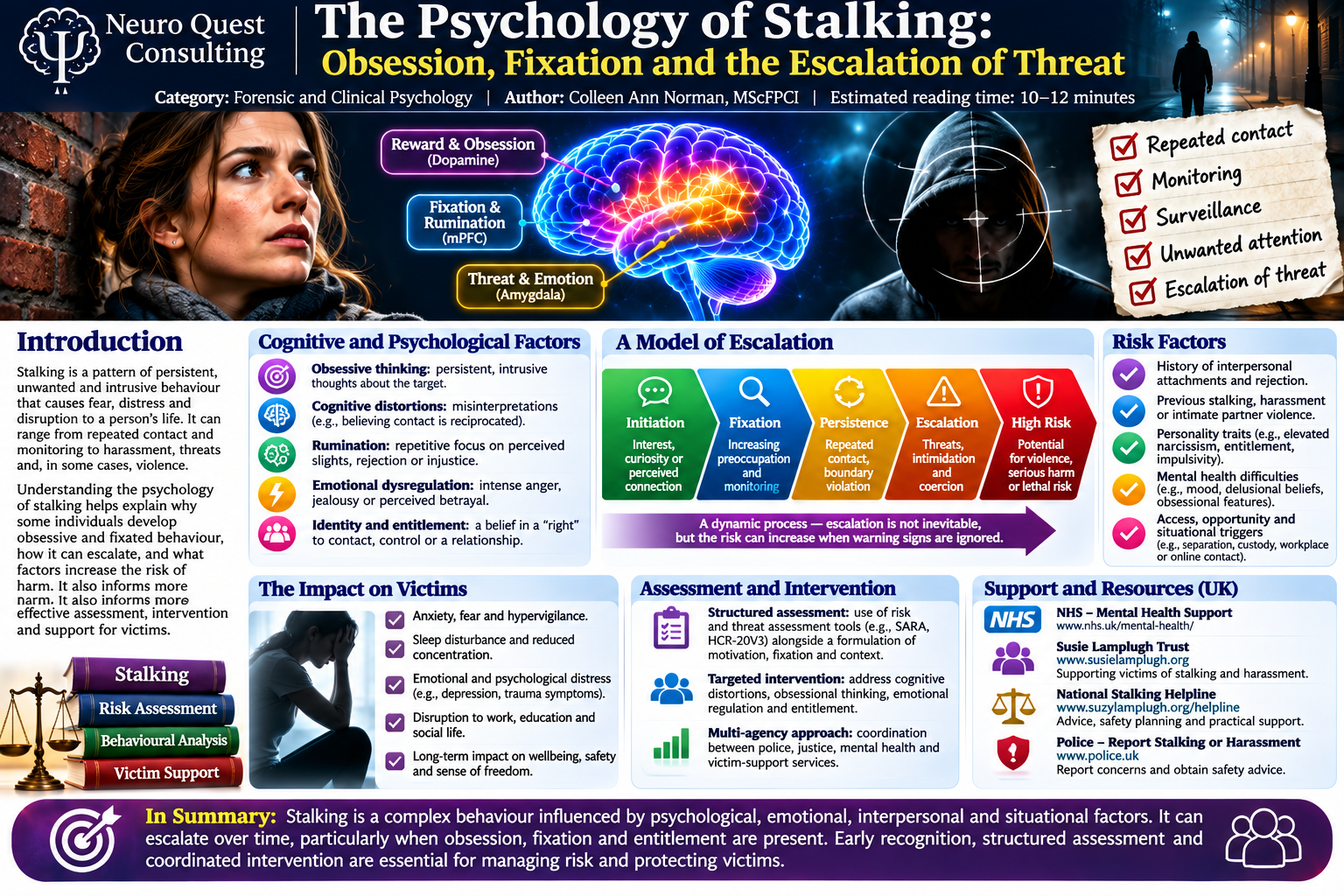
Introduction
Stalking is a serious pattern of unwanted, intrusive behaviour that can undermine an individual's safety, independence and psychological wellbeing.
Although stalking is sometimes portrayed as excessive romantic attention, its manifestations extend far beyond unwanted expressions of affection. Behaviour may involve repeated contact, following, surveillance, threats, interference with relationships, workplace intrusion or persistent digital harassment.
The psychological mechanisms associated with stalking are complex. Some individuals become preoccupied with perceived rejection, humiliation, betrayal or injustice. Others demonstrate persistent entitlement, hostility or attempts to control another person's behaviour.
However, no single personality type, mental health condition or motivational explanation accounts for all stalking.
Forensic psychology therefore examines stalking through a combination of behavioural evidence, individual circumstances, interpersonal history and changes over time.
What Constitutes Stalking?
Stalking generally involves a course of unwanted conduct directed towards another person.
The specific legal definition varies by jurisdiction.
In England and Wales, the Protection from Harassment Act 1997, as amended, provides the principal statutory framework for stalking offences.
Relevant behaviours may include following someone, contacting them repeatedly, monitoring their activities, interfering with property or watching and spying on them.
Individual acts may appear relatively minor when considered separately. Their cumulative impact, however, can be substantial.
For example, repeated unwanted messages, unexpected appearances at someone's workplace and persistent attempts to obtain personal information may collectively create a threatening pattern.
Stalking assessment must therefore examine the course of conduct rather than evaluating every incident in isolation.
The Psychology of Fixation
Fixation refers to persistent and disproportionate preoccupation with a person, grievance, relationship or perceived injustice.
In stalking cases, fixation may involve repeated thinking about the target, attempts to interpret their behaviour or efforts to restore an imagined or previous relationship.
An individual may repeatedly revisit an interpersonal event and attribute increasing significance to it.
For example, the end of a relationship may be interpreted not simply as a painful experience but as an intolerable humiliation or betrayal.
The person may then devote considerable attention to attempting reconciliation, obtaining explanations or asserting control.
Importantly, fixation does not necessarily lead to stalking or violence.
Many people experience intense emotional preoccupation without engaging in intrusive behaviour.
The relevant concern arises when preoccupation is accompanied by persistent boundary violations, intimidation, coercion or other harmful actions.
Rejection, Attachment and Perceived Loss
Relationship breakdown is an important context for some stalking cases.
Research by Mullen et al. (1999) identified several motivational patterns among stalkers, including individuals who persisted after rejection.
Rejection can be experienced as emotionally painful, particularly when a relationship has become central to someone's sense of identity.
However, the psychological response to rejection varies substantially.
Some individuals experience sadness and eventually disengage.
Others may engage in repeated attempts to restore contact.
A smaller proportion may develop persistent patterns of intrusive behaviour.
Factors such as entitlement, previous violence, hostility, behavioural regulation and the individual's interpretation of the relationship may influence subsequent conduct.
The experience of rejection itself does not excuse harassment or coercion.
The Role of Rumination
Rumination involves repetitive thinking about emotionally significant experiences, particularly their causes, consequences or perceived meaning.
Research has associated rumination with several forms of psychological distress (Nolen-Hoeksema et al., 2008).
In some stalking contexts, repetitive thinking may maintain attention on a perceived grievance or relationship.
For example, an individual may repeatedly review messages, conversations or imagined explanations for another person's behaviour.
This process may reinforce emotional distress and make disengagement more difficult.
Nevertheless, rumination is common across many psychological conditions and everyday experiences.
It is not a diagnostic indicator of stalking and cannot independently establish future risk.
Entitlement and Control
Some stalking behaviours involve beliefs about entitlement to another person's attention, affection, explanations or compliance.
An individual may regard rejection as unacceptable or believe that a previous relationship creates an ongoing right to contact.
Such beliefs may contribute to persistent boundary violations.
Stalking can also occur within broader patterns of coercive control.
In these circumstances, intrusive conduct may be intended to monitor, intimidate or restrict another person's independence.
The relevant assessment should focus on observable behaviour, the relationship history and evidence of coercion.
It is inappropriate to assume that every stalker is motivated by romantic obsession.
Different Motivational Patterns
Mullen et al. (1999) proposed a typology of stalking motivations that remains influential in forensic discussions.
The categories include:
Rejected stalkers: Individuals whose behaviour occurs in the context of a relationship breakdown.
Intimacy seekers: Individuals who pursue a relationship they believe exists or could develop.
Incompetent suitors: Individuals whose unwanted approaches may involve poor understanding of interpersonal boundaries.
Resentful stalkers: Individuals whose behaviour is associated with grievance, retaliation or perceived mistreatment.
Predatory stalkers: Individuals whose stalking may involve preparation for sexual aggression.
These categories are descriptive formulations rather than diagnoses.
Individuals may demonstrate characteristics associated with more than one category, and motivation may change over time.
Typologies should assist investigation and formulation, not replace case-specific assessment.
Stalking and Mental Health
Mental health difficulties may be relevant in some stalking cases, but stalking should not be regarded as synonymous with mental illness.
Some individuals who engage in stalking have identifiable psychiatric conditions.
Others do not.
Psychotic beliefs may contribute to particular forms of unwanted pursuit, while other cases involve relationship conflict, grievance, entitlement or coercive control.
A mental health diagnosis alone does not establish that someone will stalk another person.
Likewise, the absence of a diagnosis does not eliminate the possibility of harmful conduct.
Forensic assessment must distinguish clinical symptoms from the specific behavioural pattern under investigation.
Cyberstalking and Digital Intrusion
Technology has created additional opportunities for persistent unwanted contact and monitoring.
Cyberstalking may involve repeated threatening messages, unwanted contact through multiple accounts, impersonation, publication of private information or unauthorised monitoring.
Digital conduct may occur alongside physical stalking or independently.
For example, a person may repeatedly contact someone after being blocked, use new accounts to bypass boundaries or attempt to obtain information about their movements.
The psychological impact can be considerable because digital communication may make unwanted intrusion feel continuous.
Victims may experience reduced privacy, uncertainty and difficulty identifying when contact will occur.
Evidence preservation and appropriate specialist advice can be important components of responding to digital stalking.
Does Stalking Escalate?
Some stalking cases involve escalation in frequency, intrusiveness, intimidation or violence.
However, stalking does not follow a universal sequence of escalation.
Some patterns remain persistent without physical violence. Others involve threats or violence relatively early.
Risk may also fluctuate as circumstances change.
Relevant developments can include renewed access to the victim, relationship transitions, previous threats, breaches of protective orders or changes in the person's behaviour.
Assessment should therefore be dynamic rather than based on an assumed progression from harmless contact to serious violence.
An absence of explicit threats does not automatically indicate safety.
Equally, persistent unwanted contact does not mean that violence is inevitable.
What Does Research Say About Violence Risk?
Research has identified associations between stalking-related violence and factors such as prior intimate relationships, threats and previous violence.
Rosenfeld (2004) conducted a meta-analysis examining violence in stalking cases.
The findings highlighted the importance of considering relationship context and behavioural history.
However, associations identified across research populations cannot determine what any particular individual will do.
Professional assessment must consider the specific evidence, relevant risk factors, protective circumstances and uncertainty.
Risk evaluation should also distinguish the likelihood of continued stalking from the likelihood of physical violence, since these are different outcomes.
Assessing Stalking Behaviour
Specialist stalking assessment may involve structured professional judgment, behavioural analysis and a detailed examination of the case history.
One relevant framework is the Stalking Risk Profile, developed by MacKenzie and colleagues (2009).
Such approaches encourage consideration of motivation, persistence, escalation, violence and intervention needs.
Assessment may examine:
- The nature, frequency and duration of unwanted behaviour.
- Previous relationships and relevant interpersonal history.
- Threats, intimidation and past violence.
- Access to the victim and changes in circumstances.
- Responses to boundaries or legal intervention.
- Evidence of grievance, fixation or coercive control.
- Relevant clinical, social and protective factors.
No single factor should be interpreted in isolation.
A comprehensive formulation considers how the available information fits together and where uncertainty remains.
The Psychological Impact on Victims
Stalking can produce substantial psychological and practical consequences.
Victims may experience fear, anxiety, sleep disturbance, hypervigilance, reduced concentration and difficulties maintaining ordinary routines.
Some report changing employment, moving home, restricting social activities or avoiding familiar locations.
Research by Pathé and Mullen (1997) documented significant psychological and social consequences among stalking victims.
These effects can persist even when individual incidents appear minor to outsiders.
The unpredictability and cumulative nature of stalking may contribute to a continuing sense of insecurity.
Importantly, a victim's emotional response should not be used as the sole measure of whether the conduct is serious.
Some individuals minimise their distress, while others may experience substantial harm.
Why Victim-Centred Responses Matter
Effective responses require attention to the individual's safety, autonomy and circumstances.
Victims should not be expected to establish a stalker's diagnosis or psychological motivation before their concerns are taken seriously.
Professionals should examine the reported behaviour, available evidence and relevant safeguarding considerations.
Where appropriate, support may include safety planning, specialist advocacy, legal advice, psychological support and coordination with relevant agencies.
The responsibility for stopping stalking lies with the person engaging in the behaviour.
Victims should not be blamed for another person's persistent boundary violations.
Prevention and Intervention
Intervention depends on the circumstances of the case.
Possible responses may include criminal justice measures, specialist behavioural interventions, mental health treatment where clinically indicated and coordinated risk management.
The objectives may include stopping unwanted conduct, addressing relevant psychological processes and protecting the person targeted.
Interventions should be informed by the individual's actual behaviour and assessed needs.
For example, treatment addressing a psychotic disorder may be relevant where delusional beliefs contribute to stalking.
In another case, intervention may need to address coercive behaviour, entitlement or persistent interpersonal grievance.
There is no single treatment appropriate for every stalking presentation.
The Importance of Behavioural Evidence
Psychological theories can contribute to understanding stalking, but they must not replace evidence.
A person may experience rejection, jealousy or intense emotional distress without engaging in stalking.
Similarly, someone may engage in repeated intimidation without displaying an obvious psychiatric disorder.
The most defensible approach is to distinguish among:
- Documented behaviour: What the person has actually done.
- Psychological formulation: The possible processes contributing to the behaviour.
- Risk assessment: The evidence-informed evaluation of potential future outcomes.
These are related but separate tasks.
A psychological explanation is not proof of intent, and a risk formulation is not a certainty about the future.
UK Support and Information
People experiencing stalking in the United Kingdom can seek specialist advice and information through established services.
Suzy Lamplugh Trust: Provides information, advocacy and access to the National Stalking Helpline.
https://www.suzylamplugh.org/
National Stalking Helpline: Information and support for people affected by stalking.
https://www.suzylamplugh.org/helpline
Police.uk: Information about reporting stalking and harassment.
https://www.police.uk/
NHS: Information about mental health support and accessing healthcare services.
https://www.nhs.uk/mental-health/
If someone is in immediate danger in the UK, they should call 999.
These resources provide general starting points. The appropriate response will depend on individual circumstances and local services.
Conclusion
Stalking is a complex pattern of intrusive behaviour that can cause substantial psychological, social and practical harm.
Research has identified several potentially relevant processes, including fixation, perceived rejection, grievance, entitlement and difficulties disengaging from emotionally significant experiences.
However, stalking cannot be explained through a single personality type, diagnosis or universal escalation pathway.
The most effective forensic approach combines careful behavioural analysis, evidence-informed psychological formulation, dynamic risk assessment and victim-centred safeguarding.
At Neuro Quest Consulting, forensic psychology is approached through the systematic examination of behaviour, psychological processes and contextual evidence.
Understanding why harmful behaviour develops is important, but protecting those affected and recognising the limitations of psychological inference are equally essential.
References
MacKenzie, R. D., McEwan, T. E., Pathé, M. T., James, D. V., Ogloff, J. R. P., & Mullen, P. E. (2009). Stalking risk profile: Guidelines for the assessment and management of stalkers. StalkInc.
Mullen, P. E., Pathé, M., Purcell, R., & Stuart, G. W. (1999). Study of stalkers. American Journal of Psychiatry, 156(8), 1244–1249. https://doi.org/10.1176/ajp.156.8.1244
Nolen-Hoeksema, S., Wisco, B. E., & Lyubomirsky, S. (2008). Rethinking rumination. Perspectives on Psychological Science, 3(5), 400–424. https://doi.org/10.1111/j.1745-6924.2008.00088.x
Pathé, M., & Mullen, P. E. (1997). The impact of stalkers on their victims. British Journal of Psychiatry, 170(1), 12–17. https://doi.org/10.1192/bjp.170.1.12
Protection from Harassment Act 1997, c. 40 (UK). https://www.legislation.gov.uk/ukpga/1997/40/contents
Rosenfeld, B. (2004). Violence risk factors in stalking and obsessional harassment: A review and preliminary meta-analysis. Criminal Justice and Behavior, 31(1), 9–36. https://doi.org/10.1177/0093854803259241
Editorial note: This article is intended for educational purposes and does not constitute an individual threat assessment or legal advice. References and external resource links should undergo final verification before publication.