Introduction
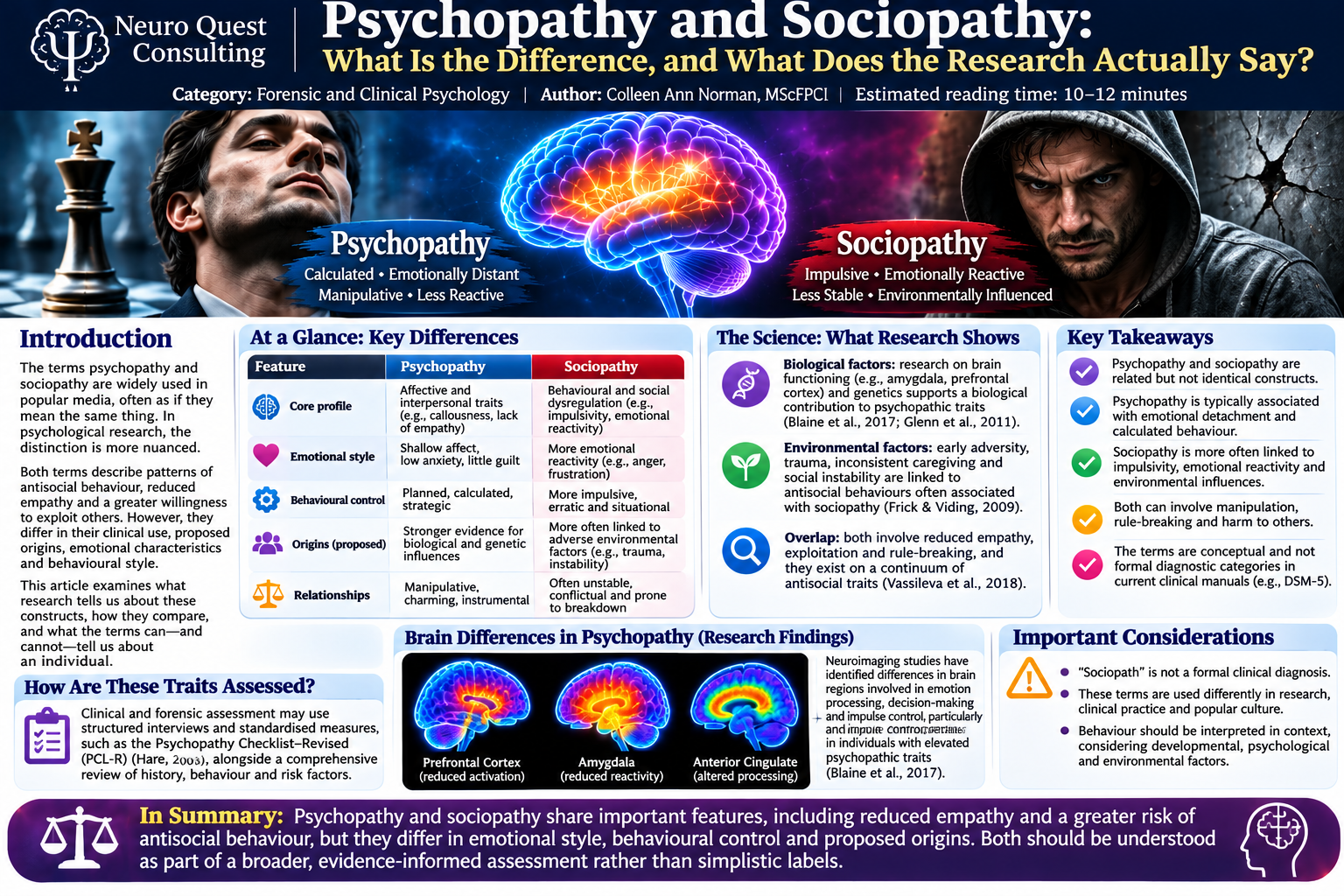
The terms psychopath and sociopath are frequently used to describe individuals perceived as manipulative, callous, aggressive or lacking remorse.
Popular culture often portrays psychopaths as calculating and emotionally detached, while sociopaths are depicted as impulsive, volatile and unable to maintain stable relationships.
Although these distinctions appear regularly in crime documentaries and popular psychology, they do not represent two clearly established diagnostic categories.
Psychopathy is a recognised research construct involving interpersonal, affective and behavioural characteristics. Sociopathy is a historically used term whose meaning varies across authors and contexts.
Neither is a separate formal diagnosis in the Diagnostic and Statistical Manual of Mental Disorders, Fifth Edition, Text Revision (DSM-5-TR; American Psychiatric Association, 2022).
Understanding the scientific evidence requires distinguishing these constructs from antisocial personality disorder and examining how personality, development and environmental circumstances interact.
What Is Psychopathy?
Psychopathy is a multidimensional personality construct involving characteristics such as interpersonal manipulation, callousness, reduced remorse, emotional detachment and, in some conceptualisations, impulsive or antisocial behaviour.
The modern scientific understanding of psychopathy was strongly influenced by psychiatrist Hervey Cleckley, whose book The Mask of Sanity described individuals who appeared socially competent while demonstrating profound disturbances in emotional and interpersonal functioning (Cleckley, 1941/1988).
Subsequent research developed more systematic approaches to defining and measuring psychopathic characteristics.
Robert Hare's Psychopathy Checklist–Revised (PCL-R) became particularly influential in forensic assessment and research (Hare, 2003).
However, psychopathy remains a psychological construct rather than a standalone DSM-5-TR diagnosis.
What Is Sociopathy?
Sociopathy is a less precisely defined term.
Historically, it has been used to describe persistent antisocial behaviour and difficulties conforming to social expectations.
Some writers distinguish sociopathy from psychopathy by suggesting that sociopathic characteristics arise primarily from adverse environmental experiences, while psychopathy has stronger biological foundations.
Others associate sociopathy with emotional volatility and impulsivity.
These distinctions are not consistently supported by standardised diagnostic definitions.
There is no universally accepted sociopathy assessment instrument equivalent to the established research measures of psychopathy.
Consequently, claims that psychopaths are always calculating while sociopaths are always impulsive oversimplify the evidence.
Antisocial Personality Disorder
Antisocial personality disorder (ASPD) is a recognised clinical diagnosis.
It involves a pervasive pattern of disregard for and violation of the rights of others, with diagnostic requirements concerning behaviour, developmental history and age.
Characteristics may include deceitfulness, impulsivity, aggression, irresponsibility and lack of remorse.
However, ASPD and psychopathy are not identical constructs.
ASPD places substantial emphasis on behavioural patterns, whereas many psychopathy models additionally emphasise interpersonal and emotional characteristics.
An individual may meet diagnostic criteria for ASPD without demonstrating the full range of characteristics associated with psychopathy.
Similarly, some individuals may show elevated psychopathic personality traits without meeting the criteria for ASPD.
This distinction is important in both clinical and forensic settings.
The Development of Psychopathic Characteristics
Psychopathic traits are understood to emerge through complex developmental processes.
Research has investigated genetic influences, temperament, neurodevelopment, family experiences, social environments and interactions among these factors.
It is inaccurate to attribute psychopathy exclusively to genetics or exclusively to childhood adversity.
Developmental research has also examined callous-unemotional traits in children and adolescents.
These characteristics may include reduced expressions of guilt, limited concern about performance and diminished responsiveness to other people's distress.
Frick and White (2008) reviewed evidence concerning the importance of callous-unemotional traits in understanding antisocial behaviour among young people.
Nevertheless, identifying such characteristics in childhood does not establish that a child will become an adult with psychopathy.
Developmental trajectories are variable, and early difficulties do not determine inevitable outcomes.
The Neuroscience of Psychopathy
Neuroscientific research has investigated brain systems involved in emotion, decision-making, learning and behavioural regulation.
Two regions frequently discussed are the amygdala and prefrontal cortex.
The Amygdala
The amygdala contributes to emotional learning, threat processing and responses to socially significant information.
Some research has identified differences in amygdala structure or functioning among groups with elevated psychopathic characteristics.
Blair (2013) discussed the potential importance of altered emotional learning and responsiveness in understanding psychopathy.
However, findings vary across studies and depend on the particular traits, populations and tasks examined.
The Prefrontal Cortex
The prefrontal cortex contributes to decision-making, behavioural regulation and the evaluation of consequences.
Research has investigated whether differences in prefrontal functioning are associated with particular psychopathic characteristics.
These findings do not demonstrate that every individual with psychopathic traits has a specific brain abnormality.
Nor can brain imaging establish whether an individual is a psychopath.
Neuroscience provides evidence about group-level associations and possible mechanisms, not a definitive diagnostic signature.
Empathy and Emotional Functioning
Psychopathy is often described as involving reduced empathy.
However, empathy includes several distinguishable processes.
Cognitive empathy involves understanding another person's perspective or emotional state.
Affective empathy involves sharing or responding emotionally to another person's experience.
Research suggests that some individuals with elevated psychopathic traits may demonstrate difficulties in particular affective processes while retaining aspects of cognitive understanding.
This distinction may help explain how someone can recognise another person's vulnerability without necessarily experiencing corresponding emotional concern.
Nevertheless, empathy varies considerably among individuals, and psychopathy should not be reduced to a complete absence of emotional experience.
Psychopathy and Impulsivity
A common misconception is that psychopathy always involves careful planning and exceptional self-control.
In reality, several influential models include impulsivity and behavioural disinhibition as important components.
Patrick et al. (2009) proposed the triarchic model of psychopathy, comprising:
- Boldness: Social confidence, emotional resilience and reduced fearfulness.
- Meanness: Callousness, antagonism and reduced concern for others.
- Disinhibition: Impulsivity, poor behavioural regulation and difficulties restraining immediate responses.
These dimensions can occur in different combinations.
Consequently, psychopathic characteristics may be associated with varied behavioural presentations rather than one stereotypical personality type.
Psychopathy and Criminal Behaviour
Psychopathy has received substantial attention in forensic psychology because certain psychopathic characteristics are associated with antisocial behaviour and recidivism.
However, psychopathy does not inevitably lead to criminal offending.
Likewise, most people who commit offences should not automatically be described as psychopaths.
Criminal behaviour is influenced by numerous factors, including opportunity, social circumstances, developmental experiences, substance use, behavioural history and situational pressures.
A comprehensive forensic assessment must examine the relevant evidence rather than assuming that a personality label explains an individual's actions.
Can Psychopathy Predict Violence?
Research has examined associations between psychopathy measures and future violence or offending.
Some studies have identified predictive relationships, particularly in forensic populations.
However, predictive accuracy varies across measures, outcomes and populations.
A meta-analysis by Yang et al. (2010) examined the predictive validity of several violence-risk assessment instruments, illustrating the importance of evaluating predictive performance rather than relying on broad assumptions.
A psychopathy score should not be treated as a deterministic prediction of violence.
Risk assessment requires consideration of historical, clinical, situational and potentially protective factors.
It is also important to distinguish predicting statistical risk across groups from explaining why a particular individual behaves in a particular way.
How Is Psychopathy Assessed?
Psychopathy assessment may involve structured interviews, collateral information, behavioural history and specialised instruments.
The PCL-R is among the best-known forensic measures.
Its administration and interpretation require appropriate professional training and access to relevant information.
The instrument should not be used casually to label colleagues, family members or public figures.
Research also uses self-report instruments designed to measure psychopathic traits in community or other populations.
Different instruments operationalise the construct differently, meaning that scores are not necessarily interchangeable.
The selection of an instrument should reflect the assessment purpose, population and available validity evidence.
Why Popular Psychology Gets the Distinction Wrong
Popular descriptions frequently present psychopathy and sociopathy as two entirely different personality types.
One is portrayed as intelligent, charming and calculating.
The other is described as impulsive, emotionally unstable and shaped by childhood adversity.
Although these descriptions may reflect certain historical interpretations, they are not established diagnostic distinctions.
They also risk reinforcing inaccurate stereotypes.
Psychopathy is not synonymous with intelligence, and sociopathy cannot be reliably diagnosed through the presence of emotional volatility.
Scientific interpretation requires more precise terminology and evidence-based assessment.
Personality Traits Versus Behaviour
An important principle in forensic psychology is that personality characteristics and actual behaviour must be distinguished.
Two individuals may demonstrate similar levels of antagonism, impulsivity or emotional detachment yet behave differently.
One may engage in repeated exploitation or offending, while another may not.
Understanding these differences requires attention to situational circumstances, personal meaning, social relationships, behavioural regulation and other relevant processes.
This is one reason psychological formulation should extend beyond assigning personality labels.
Can Psychopathic Traits Change?
The treatment of individuals with elevated psychopathic characteristics remains an important area of research.
Historically, psychopathy has sometimes been portrayed as untreatable.
However, categorical claims that change is impossible are not scientifically justified.
Evidence concerning treatment effectiveness is complex and varies according to the population, intervention, outcomes measured and methodological quality.
Research on younger populations suggests that interventions addressing behavioural difficulties and family functioning can be beneficial, although findings should not be interpreted as demonstrating that psychopathic traits can always be eliminated.
A realistic clinical approach focuses on specific treatment targets, behavioural outcomes and individual needs.
Ethical and Professional Considerations
The terms psychopath and sociopath can carry substantial stigma.
Using them without adequate evidence may lead to unfair judgments and misunderstanding.
Forensic practitioners should distinguish between established diagnoses, research constructs, psychometric findings and documented behaviour.
Assessment results must be interpreted within the limits of the evidence.
The Standards for Educational and Psychological Testing emphasise the importance of supporting test interpretations and uses with appropriate validity evidence (American Educational Research Association et al., 2014).
Responsible practice also requires consideration of fairness, confidentiality and the consequences of assessment decisions.
Conclusion
Psychopathy and sociopathy are frequently treated as interchangeable terms, but their scientific status differs.
Psychopathy is a well-established research construct involving interpersonal, affective and behavioural characteristics.
Sociopathy is a less precisely defined historical and popular term without a separate formal diagnostic classification.
Neither should be confused automatically with antisocial personality disorder.
Research indicates that psychopathic characteristics arise through complex interactions involving biological, psychological, developmental and environmental influences.
Most importantly, personality traits do not determine an individual's behaviour with certainty.
At Neuro Quest Consulting, evidence-informed psychological assessment emphasises careful interpretation, recognition of individual differences and the importance of understanding behaviour within its broader context.
Accurate psychological terminology is essential for scientific credibility, ethical assessment and responsible public education.
References
American Educational Research Association, American Psychological Association, & National Council on Measurement in Education. (2014). Standards for educational and psychological testing. American Educational Research Association.
American Psychiatric Association. (2022). Diagnostic and statistical manual of mental disorders (5th ed., text rev.). https://doi.org/10.1176/appi.books.9780890425787
Blair, R. J. R. (2013). The neurobiology of psychopathic traits in youths. Nature Reviews Neuroscience, 14, 786–799. https://doi.org/10.1038/nrn3577
Cleckley, H. (1988). The mask of sanity (5th ed.). Emily S. Cleckley. (Original work published 1941)
Frick, P. J., & White, S. F. (2008). Research review: The importance of callous-unemotional traits for developmental models of aggressive and antisocial behavior. Journal of Child Psychology and Psychiatry, 49(4), 359–375. https://doi.org/10.1111/j.1469-7610.2007.01862.x
Hare, R. D. (2003). The Hare Psychopathy Checklist–Revised (2nd ed.). Multi-Health Systems.
Patrick, C. J., Fowles, D. C., & Krueger, R. F. (2009). Triarchic conceptualization of psychopathy: Developmental origins of disinhibition, boldness, and meanness. Development and Psychopathology, 21(3), 913–938. https://doi.org/10.1017/S0954579409000492
Yang, M., Wong, S. C. P., & Coid, J. (2010). The efficacy of violence prediction: A meta-analytic comparison of nine risk assessment tools. Psychological Bulletin, 136(5), 740–767. https://doi.org/10.1037/a0020473
Editorial note: This article is intended for educational purposes. It does not provide a basis for diagnosing individuals or predicting their behaviour. References should undergo final bibliographic verification before publication.