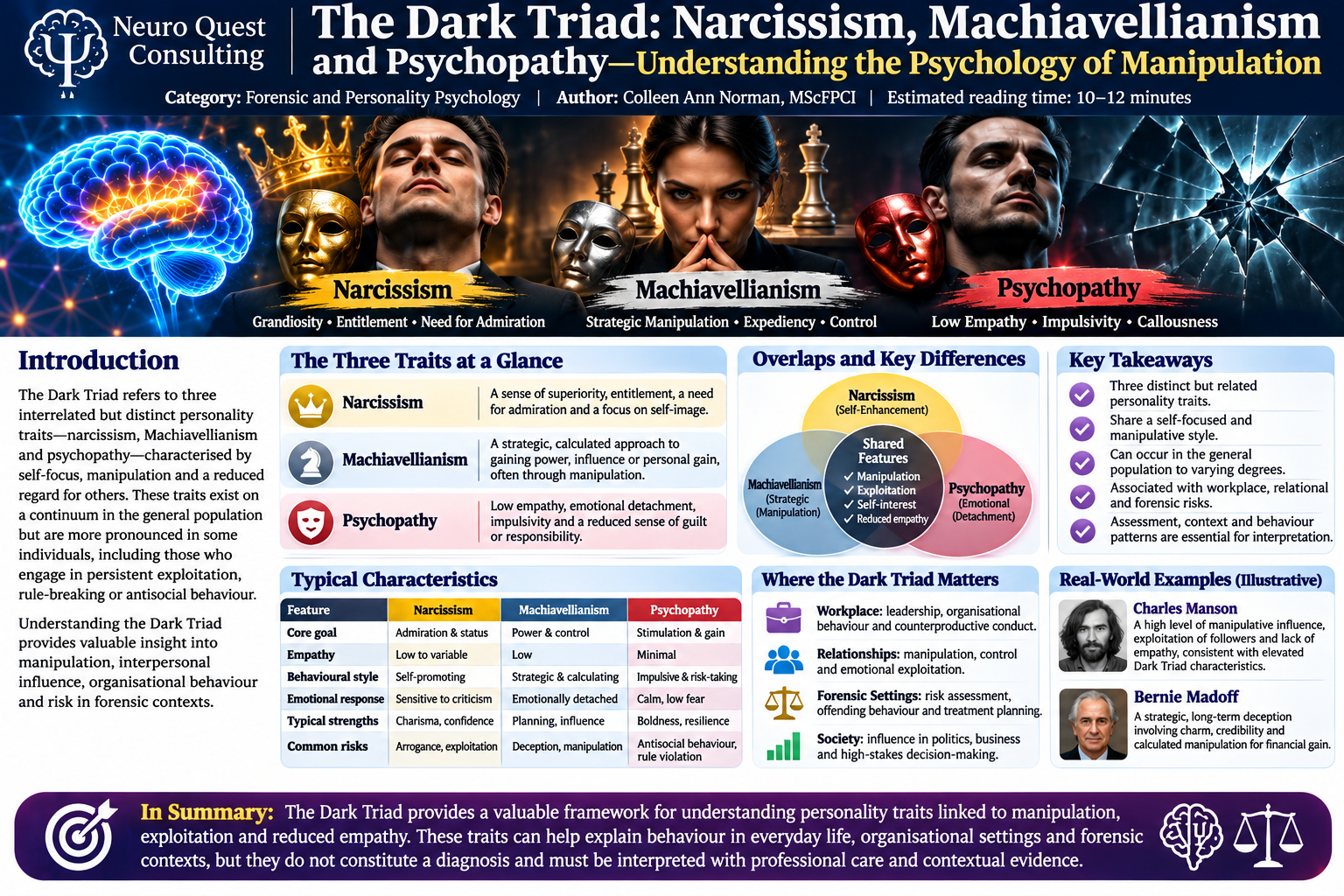
Introduction
Why do some people repeatedly exploit others for personal advantage? Why might an individual appear charming and persuasive while demonstrating little concern for the consequences of their actions? And why do certain people pursue status, influence or control at the expense of interpersonal relationships?
Personality psychologists have investigated these questions through the study of antagonistic personality traits.
One influential framework is the Dark Triad, introduced by Paulhus and Williams (2002). It describes three related but distinguishable personality constructs: narcissism, Machiavellianism and psychopathy.
These traits are associated with different patterns of self-interest, interpersonal behaviour and emotional functioning. They can be studied in general populations and are not confined to individuals with psychiatric diagnoses or criminal histories.
Understanding the Dark Triad can contribute to research on personality, organisational behaviour, interpersonal exploitation and forensic psychology. However, the framework must be interpreted carefully: elevated traits do not automatically establish a personality disorder, criminal intent or future dangerousness.
What Is the Dark Triad?
The Dark Triad describes three personality constructs that share certain antagonistic characteristics while differing in their underlying motivations and behavioural expressions.
Narcissism generally involves elevated self-importance, entitlement, admiration-seeking and sensitivity to threats to self-image.
Machiavellianism involves a cynical interpersonal orientation, strategic manipulation and willingness to use others to achieve personal goals.
Psychopathy, as examined in nonclinical Dark Triad research, involves characteristics such as callousness, reduced empathy, impulsivity and interpersonal exploitation.
Although these constructs overlap, they should not be treated as interchangeable.
A person may demonstrate elevated narcissistic characteristics without displaying substantial impulsivity. Another may use calculated manipulation without seeking public admiration.
These distinctions are important for understanding the different motivations and behavioural tendencies associated with each construct.
Narcissism: The Pursuit of Admiration and Status
Narcissism is frequently misunderstood because the term is often used casually to describe arrogance or selfishness.
In personality research, narcissism is a multidimensional construct.
Grandiose narcissistic traits may involve exaggerated self-importance, entitlement, dominance and a strong desire for admiration.
Vulnerable narcissistic characteristics may involve insecurity, hypersensitivity to criticism and fluctuations in self-esteem.
Research suggests that grandiose and vulnerable narcissism have partly distinct psychological profiles (Miller et al., 2011).
Individuals with elevated grandiose narcissistic traits may seek leadership positions, social recognition or opportunities to demonstrate superiority.
However, confidence and ambition are not inherently pathological.
The significance of narcissistic traits depends on their intensity, associated impairment and expression in actual behaviour.
Narcissism and Interpersonal Relationships
Some narcissistic characteristics may contribute to difficulties with criticism, reciprocity and recognising other people's perspectives.
For example, an individual who places considerable importance on maintaining a superior self-image may react defensively when challenged.
In some circumstances, entitlement may contribute to exploitative behaviour.
Nevertheless, narcissism does not automatically indicate abusive conduct.
It is essential to distinguish between a personality trait, a pattern of harmful behaviour and a clinically diagnosed personality disorder.
Machiavellianism: Strategic Manipulation
Machiavellianism takes its name from Niccolò Machiavelli, whose writings examined political power and strategy.
In modern personality psychology, the construct refers to a tendency towards calculated self-interest, interpersonal cynicism and manipulative approaches to achieving goals.
Individuals with elevated Machiavellian traits may place relatively little importance on interpersonal trust or conventional moral expectations when pursuing desired outcomes.
They may prefer strategic planning, information management and indirect influence.
Unlike the impulsive characteristics sometimes associated with psychopathy, Machiavellianism is often conceptualised as more deliberate and calculating.
However, empirical research indicates substantial overlap between Machiavellianism and psychopathy, raising questions about how distinctly they can be measured (Miller et al., 2017).
Machiavellianism in Organisations
Organisational settings provide opportunities to investigate how strategic manipulation may influence professional relationships.
For example, an employee might selectively share information, take credit for colleagues' contributions or exploit interpersonal disagreements to advance their position.
Such behaviour can damage trust and cooperation.
However, ordinary strategic thinking, negotiation and political awareness should not automatically be classified as Machiavellianism.
The distinction lies partly in the broader pattern of cynical, exploitative and self-serving interpersonal tendencies.
Psychopathy: Callousness, Disinhibition and Antisocial Tendencies
Psychopathy is a complex construct studied extensively in forensic and clinical psychology.
Research has examined characteristics involving interpersonal manipulation, emotional detachment, callousness, impulsivity and antisocial behaviour.
Importantly, the psychopathy measures used in general personality research are not equivalent to comprehensive forensic assessments.
The term psychopathy is also not interchangeable with antisocial personality disorder, although the constructs overlap.
Some theoretical models distinguish between interpersonal-affective characteristics and behavioural or lifestyle characteristics.
For example, the triarchic model describes psychopathy through three broad dimensions: boldness, meanness and disinhibition (Patrick et al., 2009).
Psychopathy and Empathy
Research has investigated differences in emotional responsiveness and empathy associated with psychopathic traits.
However, empathy is not a single ability.
It may involve recognising another person's emotional state, understanding their perspective and experiencing an emotional response to their circumstances.
Some individuals may demonstrate relatively preserved understanding of others' intentions while showing reduced emotional concern.
It would nevertheless be inaccurate to claim that every person with elevated psychopathic traits entirely lacks empathy.
Psychopathy and Criminal Behaviour
Psychopathy has received considerable attention in forensic research because certain characteristics are associated with antisocial behaviour and offending.
However, psychopathic traits do not inevitably lead to criminal activity.
Likewise, criminal behaviour cannot be explained solely through personality traits.
Environmental conditions, developmental experiences, situational opportunities and other psychological processes may influence behaviour.
Forensic assessment therefore requires evidence-based evaluation rather than reliance on personality labels.
What Do the Three Traits Have in Common?
The Dark Triad constructs share elements of interpersonal antagonism.
These may include self-interest, reduced concern for others, manipulative tendencies and willingness to prioritise personal goals over interpersonal obligations.
Research has investigated whether these shared characteristics reflect a broader underlying disposition.
Moshagen et al. (2018) proposed the Dark Factor of Personality, or D, as a general tendency to maximise personal utility while disregarding or accepting negative consequences for others, accompanied by beliefs that justify such behaviour.
This framework is one theoretical account of the common features of socially aversive traits.
It does not mean that all individuals with elevated Dark Triad scores have identical personalities or motivations.
How Do the Three Traits Differ?
| Dimension | Narcissism | Machiavellianism | Psychopathy |
|---|---|---|---|
| Characteristic emphasis | Status and self-image | Strategic self-interest | Callousness and disinhibition |
| Interpersonal tendency | Admiration-seeking or entitlement | Calculated manipulation | Exploitation or reduced concern |
| Emotional characteristics | May be sensitive to criticism | Often associated with cynicism | May involve reduced emotional responsiveness |
| Behavioural expression | Self-promotion and dominance | Strategic influence | May involve impulsivity and rule-breaking |
These are broad research tendencies rather than diagnostic criteria or descriptions applicable to every individual.
How Is the Dark Triad Measured?
Researchers commonly investigate Dark Triad traits using self-report personality questionnaires.
Two widely discussed instruments are the Short Dark Triad (SD3) and the Dirty Dozen.
Jones and Paulhus (2014) developed the SD3 as a brief measure of narcissism, Machiavellianism and psychopathy.
Jonason and Webster (2010) introduced the Dirty Dozen as an even shorter measure.
Although brief instruments can be useful for research, their limitations must be considered.
Self-report questionnaires depend on respondents' understanding of questions, willingness to disclose information and interpretation of their own behaviour.
A person may deliberately present themselves favourably or may have limited awareness of how others experience their conduct.
Psychometric evaluation is therefore essential.
Scores should not be interpreted as definitive evidence of deception, abuse or criminal intent.
The Dark Triad in the Workplace
Research has investigated associations between Dark Triad traits and workplace behaviour.
O'Boyle et al. (2012) conducted a meta-analysis examining relationships among Dark Triad traits, job performance and counterproductive workplace behaviour.
The findings supported associations between these traits and certain undesirable workplace outcomes, although relationships varied across constructs and circumstances.
Potentially relevant behaviours include interpersonal conflict, exploitation, dishonesty and disregard for organisational responsibilities.
However, an employee's personality questionnaire should not be used as a substitute for evidence of actual misconduct.
Organisations must evaluate behaviour fairly and avoid discriminatory or unsupported psychological labelling.
The Dark Triad and Leadership
Some Dark Triad characteristics may influence leadership emergence, interpersonal influence and organisational decision-making.
Confidence, assertiveness and willingness to take risks can sometimes be perceived positively in leadership contexts.
However, these characteristics are not equivalent to effective leadership.
A leader who pursues personal recognition at the expense of organisational wellbeing may undermine trust.
Similarly, manipulative decision-making may produce short-term advantages while damaging long-term relationships and organisational stability.
Effective leadership assessment must consider integrity, competence, accountability and actual performance rather than assuming that charisma reflects good judgment.
Manipulation in Personal Relationships
Manipulation involves attempts to influence another person's behaviour through methods that may include deception, coercion or exploitation.
Some Dark Triad traits are associated with greater willingness to use manipulative interpersonal strategies.
However, identifying manipulation requires attention to specific behaviour and context.
A disagreement, an insensitive remark or an isolated selfish decision does not establish that someone possesses a Dark Triad personality profile.
Persistent patterns of coercive control, intimidation or exploitation should be evaluated according to their actual effects and relevant safeguarding considerations.
Individuals do not need to establish another person's personality type before seeking support for harmful behaviour.
Can Dark Triad Traits Change?
Personality traits demonstrate relative stability, but they are not entirely fixed.
Research on personality development indicates that meaningful trait changes can occur across adulthood (Roberts et al., 2006).
Nevertheless, evidence concerning interventions specifically targeting Dark Triad traits is more limited.
It would therefore be inappropriate to promise that a particular psychological intervention can reliably eliminate narcissistic, Machiavellian or psychopathic characteristics.
Clinical work should focus on clearly identified problems, individual circumstances and interventions supported by relevant evidence.
The Dark Triad and Forensic Assessment
The Dark Triad can contribute to theoretical discussions about interpersonal exploitation, moral decision-making and antisocial behaviour.
However, its research measures are not substitutes for validated forensic assessment instruments.
A forensic evaluation may require examination of behavioural history, situational factors, psychological functioning and other evidence relevant to the referral question.
Risk assessment should not be reduced to identifying supposedly dangerous personality types.
Individuals with similar personality characteristics may follow very different behavioural pathways.
Some may engage in harmful conduct, while others do not.
This distinction highlights the importance of examining psychological processes, environmental influences and actual behaviour rather than relying on static personality labels.
Ethical Considerations
Personality terminology can be misused when applied to individuals without appropriate evidence.
Words such as narcissist and psychopath are frequently used in public discussions as insults or explanations for disliked behaviour.
Such labelling can obscure the complexity of psychological assessment.
Professionals should distinguish between measured traits, clinical diagnoses and documented behaviour.
Psychometric findings must be interpreted in accordance with the intended purpose of the instrument and its supporting evidence.
The Standards for Educational and Psychological Testing emphasise the importance of validity evidence for test-score interpretations and uses (American Educational Research Association et al., 2014).
Conclusion
The Dark Triad provides a useful framework for examining three related personality constructs: narcissism, Machiavellianism and psychopathy.
These traits can help researchers investigate individual differences in self-interest, interpersonal manipulation, emotional functioning and socially aversive behaviour.
However, they do not provide a complete explanation of personality, nor do they establish that an individual has a mental disorder or will engage in harmful conduct.
Understanding human behaviour requires consideration of individual characteristics, situational influences, developmental experiences and observable actions.
At Neuro Quest Consulting, evidence-informed personality assessment emphasises the careful interpretation of psychological characteristics within their appropriate clinical, educational or forensic context.
The objective of assessment is to improve understanding—not to reduce individuals to labels or make unsupported predictions about their behaviour.
References
American Educational Research Association, American Psychological Association, & National Council on Measurement in Education. (2014). Standards for educational and psychological testing. American Educational Research Association.
Jonason, P. K., & Webster, G. D. (2010). The dirty dozen: A concise measure of the Dark Triad. Psychological Assessment, 22(2), 420–432. https://doi.org/10.1037/a0019265
Jones, D. N., & Paulhus, D. L. (2014). Introducing the Short Dark Triad (SD3): A brief measure of dark personality traits. Assessment, 21(1), 28–41. https://doi.org/10.1177/1073191113514105
Miller, J. D., Hoffman, B. J., Gaughan, E. T., Gentile, B., Maples, J., & Campbell, W. K. (2011). Grandiose and vulnerable narcissism: A nomological network analysis. Journal of Personality, 79(5), 1013–1042. https://doi.org/10.1111/j.1467-6494.2010.00711.x
Miller, J. D., Vize, C., Crowe, M. L., & Lynam, D. R. (2017). A critical appraisal of the Dark Triad literature and suggestions for moving forward. Current Directions in Psychological Science, 26(4), 353–360. https://doi.org/10.1177/0963721417700459
Moshagen, M., Hilbig, B. E., & Zettler, I. (2018). The dark core of personality. Psychological Review, 125(5), 656–688. https://doi.org/10.1037/rev0000111
O'Boyle, E. H., Jr., Forsyth, D. R., Banks, G. C., & McDaniel, M. A. (2012). A meta-analysis of the Dark Triad and work behavior: A social exchange perspective. Journal of Applied Psychology, 97(3), 557–579. https://doi.org/10.1037/a0025679
Patrick, C. J., Fowles, D. C., & Krueger, R. F. (2009). Triarchic conceptualization of psychopathy: Developmental origins of disinhibition, boldness, and meanness. Development and Psychopathology, 21(3), 913–938. https://doi.org/10.1017/S0954579409000492
Paulhus, D. L., & Williams, K. M. (2002). The Dark Triad of personality: Narcissism, Machiavellianism, and psychopathy. Journal of Research in Personality, 36(6), 556–563. https://doi.org/10.1016/S0092-6566(02)00505-6
Roberts, B. W., Walton, K. E., & Viechtbauer, W. (2006). Patterns of mean-level change in personality traits across the life course: A meta-analysis of longitudinal studies. Psychological Bulletin, 132(1), 1–25. https://doi.org/10.1037/0033-2909.132.1.1
Editorial note: This article is for general educational purposes. It does not provide a method for diagnosing individuals or determining their dangerousness. References should receive final bibliographic verification before publication.