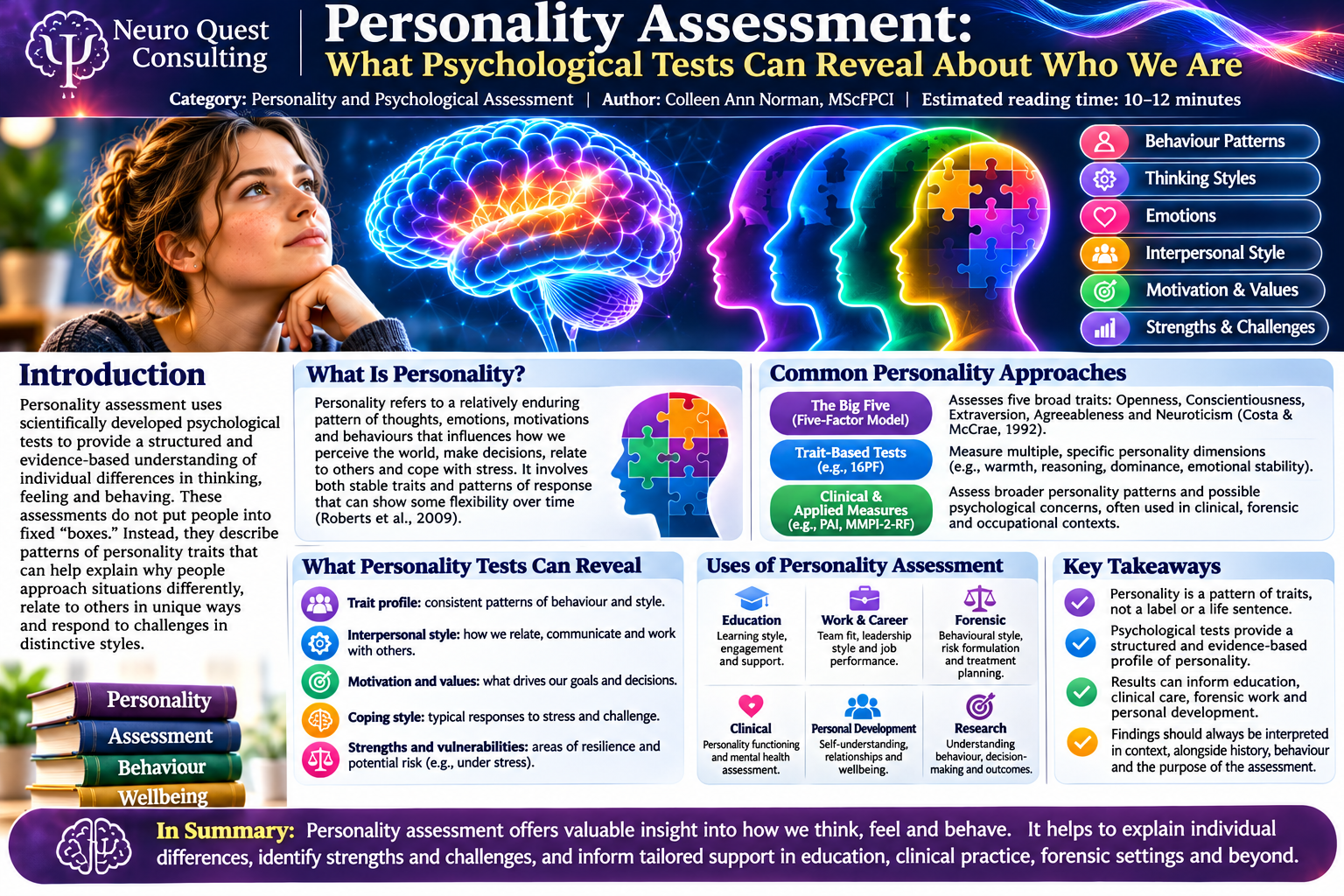
Introduction
Why do people respond differently to the same circumstances? One individual may enjoy public speaking, while another experiences considerable discomfort. Some people prefer predictable routines, while others actively seek novelty and change.
Personality psychology investigates the patterns of thoughts, feelings and behaviours that contribute to these differences.
Personality assessment uses structured methods to investigate individual characteristics and understand how they may influence behaviour across situations.
When appropriately selected and interpreted, psychometric instruments can provide useful information for clinical practice, education, occupational settings and forensic assessment.
However, personality tests are not instruments for reading minds. Their findings must be interpreted within the context of an individual's experiences, circumstances and the specific purpose of assessment.
What Is Personality?
Personality refers to relatively enduring patterns of thinking, feeling, motivation and behaviour.
These patterns influence how individuals approach relationships, respond to challenges, make decisions and interact with their environment.
Personality is neither completely fixed nor infinitely changeable.
Research suggests that personality traits demonstrate substantial continuity while also showing meaningful changes across adulthood (Roberts et al., 2006).
For example, an individual who is generally conscientious may become less organised during a period of considerable stress.
Similarly, someone who typically avoids unfamiliar social situations may develop greater confidence through experience.
Personality traits describe tendencies rather than absolute rules governing behaviour.
The Five-Factor Model of Personality
One of the most extensively researched approaches to personality is the Five-Factor Model, often called the Big Five.
The model describes personality using five broad dimensions (McCrae & Costa, 1997).
1. Openness to Experience
Openness concerns intellectual curiosity, imagination, appreciation of new ideas and willingness to explore unfamiliar experiences.
Individuals scoring relatively high on openness may enjoy abstract thinking, artistic activities or exploring alternative perspectives.
Those scoring lower may prefer familiar methods, practical approaches and established routines.
Neither end of the dimension automatically indicates superior functioning.
2. Conscientiousness
Conscientiousness involves organisation, dependability, persistence and goal-directed behaviour.
Highly conscientious individuals often prefer planning and structured approaches to responsibilities.
Lower conscientiousness may be associated with greater spontaneity but can also involve difficulties maintaining organisation or following through on plans.
Conscientiousness is associated with several important life outcomes, although its effects depend on circumstances and the specific behaviour being examined.
3. Extraversion
Extraversion concerns sociability, assertiveness, activity and the tendency to experience positive emotions.
Individuals scoring high on extraversion may enjoy frequent social interaction and stimulating environments.
More introverted individuals may prefer quieter activities, smaller social groups or extended periods of independent work.
Introversion should not be confused with shyness or social anxiety.
4. Agreeableness
Agreeableness concerns cooperation, compassion, trust and interpersonal consideration.
Individuals high in agreeableness may place considerable value on maintaining harmonious relationships.
Those scoring lower may be more sceptical, competitive or willing to challenge others.
The expression of these traits depends partly on social and occupational circumstances.
5. Neuroticism
Neuroticism describes individual differences in the tendency to experience negative emotions such as anxiety, worry, irritability and emotional vulnerability.
Higher scores may indicate greater sensitivity to stressful circumstances.
Lower scores generally reflect greater emotional stability.
Importantly, a high neuroticism score is not equivalent to a psychiatric diagnosis.
How Are Personality Traits Measured?
Personality assessments commonly use standardised self-report questionnaires.
Respondents indicate how accurately particular statements describe their typical thoughts, feelings or behaviour.
Responses are scored according to established procedures and may be compared with appropriate normative samples.
Other approaches include informant reports, structured interviews and behavioural observations.
Each method provides different information.
Self-report questionnaires can be efficient, but responses may be influenced by self-awareness, interpretation of questions and willingness to disclose personal information.
Informant reports may provide additional perspectives but are also affected by the observer's relationship with the individual.
A comprehensive assessment considers these limitations rather than assuming that any single method provides a complete account of personality.
What Can Personality Assessments Reveal?
A well-designed personality assessment may provide insight into several aspects of psychological functioning.
Behavioural tendencies: How someone generally approaches tasks, responsibilities and interpersonal situations.
Emotional patterns: Typical responses to stress, uncertainty and emotionally demanding circumstances.
Interpersonal style: Tendencies involving sociability, cooperation, assertiveness and communication.
Motivation and self-regulation: Patterns related to persistence, organisation and goal-directed behaviour.
Potential vulnerabilities: Characteristics that may become relevant under particular environmental or psychological pressures.
These findings are probabilistic rather than deterministic.
A personality profile cannot establish precisely how someone will behave in every future situation.
Personality and the Workplace
Personality assessment has applications in occupational psychology, including research on work behaviour, leadership and organisational functioning.
Barrick and Mount (1991) demonstrated relationships between Big Five personality dimensions and job performance across occupational groups.
Conscientiousness, in particular, has been associated with performance across several work contexts.
However, personality is only one influence on occupational outcomes.
Knowledge, experience, cognitive abilities, motivation, organisational culture and working conditions also contribute.
Personality assessments used for employment decisions should have evidence supporting their suitability for the intended purpose.
They should not be used to make unsupported assumptions about an individual's competence or character.
Personality and Leadership
Leadership involves complex interactions among individual characteristics, behaviour, organisational structures and situational demands.
Some personality traits are associated with leadership emergence and effectiveness.
For example, research has identified associations between extraversion and leadership-related outcomes (Judge et al., 2002).
Nevertheless, no single personality profile guarantees effective leadership.
A highly assertive individual may communicate confidently but still lack the judgment, empathy or technical knowledge required for a particular role.
Effective leadership assessment therefore requires consideration of actual behaviour and relevant competencies alongside personality characteristics.
Personality in Clinical Psychology
Personality assessment may contribute to understanding an individual's emotional functioning, interpersonal experiences and characteristic responses to stress.
Clinical instruments sometimes examine broader psychological symptoms and patterns of personality functioning.
However, measures designed for general personality research are not interchangeable with clinical instruments intended to investigate psychopathology.
For example, the Minnesota Multiphasic Personality Inventory family of instruments includes measures designed to support clinical assessment, with interpretation requiring specific professional competence.
A personality questionnaire cannot independently establish a mental health diagnosis unless the assessment process meets the relevant clinical requirements.
Results must be integrated with clinical history, interviews and other appropriate evidence.
Personality in Forensic Psychology
Personality assessment may also contribute to forensic psychological formulations.
In appropriate circumstances, clinicians may investigate enduring interpersonal characteristics, emotional regulation, impulsivity and patterns of behaviour relevant to a referral question.
However, forensic assessment requires particular caution.
A personality score does not establish criminal intent, dangerousness or the likelihood of committing a particular offence.
Risk assessment, when indicated, requires purpose-specific methods, relevant evidence and consideration of contextual and dynamic factors.
Personality information may contribute to a broader formulation but should not replace validated procedures or professional judgment.
The Difference Between Personality Traits and Personality Disorders
Personality traits are normal dimensions of human variation.
Everyone demonstrates characteristic patterns of behaviour and emotional response.
A personality disorder, by contrast, involves a clinically significant pattern of difficulties in personality functioning that meets established diagnostic criteria.
Having high or low scores on a particular personality trait does not automatically indicate a personality disorder.
Clinical diagnosis requires assessment of the relevant criteria, persistence, impairment and alternative explanations.
This distinction is important because personality terminology is sometimes used casually to label individuals without adequate evidence.
Can Personality Change?
Although personality demonstrates considerable stability, research indicates that traits can change over time.
A meta-analysis by Roberts et al. (2006) identified patterns of personality trait development across the life course.
Changes may occur through maturation, experiences, social roles and other developmental influences.
Psychological interventions may also be associated with changes in personality trait measures, although findings depend on the intervention and population studied (Roberts et al., 2017).
Personality assessment should therefore be viewed as an examination of characteristics at a particular point in time, not an irreversible judgment about an individual's future.
Are Online Personality Tests Reliable?
The internet contains numerous personality quizzes promising to identify a person's psychological type within minutes.
Some are designed primarily for entertainment.
Others may draw on psychological terminology without demonstrating adequate scientific evidence.
A credible personality assessment should provide information about its reliability, validity, normative sample and intended use.
Tests that divide everyone into rigid personality categories may oversimplify characteristics that are better understood as continuous dimensions.
Popular personality typologies can be interesting conversation tools, but their scientific properties should not be assumed to match those of well-validated trait assessments.
Why Professional Interpretation Matters
Psychometric assessment involves considerably more than administering a questionnaire and producing a score.
Qualified practitioners must consider the purpose of testing, the suitability of the instrument, its measurement properties and the context in which results will be used.
Interpretation should also consider language, culture, developmental history and possible response biases.
A person completing an assessment during a period of acute stress may respond differently from how they would under more typical circumstances.
Similarly, respondents may consciously or unconsciously present themselves favourably.
Professional interpretation involves recognising these possibilities and avoiding conclusions that exceed the available evidence.
Ethical Considerations
Personality assessment raises important ethical questions concerning privacy, informed consent and the appropriate use of psychological information.
Individuals should understand why they are being assessed, how their information will be used and who may receive the results.
Assessment findings should be communicated accurately and respectfully.
They should not be used to stereotype individuals, justify discrimination or make unsupported predictions.
The Standards for Educational and Psychological Testing emphasise the importance of evidence supporting the intended interpretations and uses of test scores (American Educational Research Association et al., 2014).
Responsible practice requires recognising both the value and limitations of psychometric evidence.
Conclusion
Personality assessment offers a scientifically informed approach to understanding individual differences in thinking, feeling and behaviour.
Well-developed instruments can provide valuable insights into emotional tendencies, interpersonal style, organisation, motivation and other psychological characteristics.
Nevertheless, personality is complex.
A test score cannot reveal everything about an individual, and no personality profile determines precisely how someone will respond in every circumstance.
At Neuro Quest Consulting, personality assessment is understood as a means of developing an evidence-informed picture of individual characteristics, strengths and potential support needs.
When used appropriately, psychometric assessment can support self-understanding, professional development and more informed psychological formulation.
References
American Educational Research Association, American Psychological Association, & National Council on Measurement in Education. (2014). Standards for educational and psychological testing. American Educational Research Association.
Barrick, M. R., & Mount, M. K. (1991). The Big Five personality dimensions and job performance: A meta-analysis. Personnel Psychology, 44(1), 1–26. https://doi.org/10.1111/j.1744-6570.1991.tb00688.x
Judge, T. A., Bono, J. E., Ilies, R., & Gerhardt, M. W. (2002). Personality and leadership: A qualitative and quantitative review. Journal of Applied Psychology, 87(4), 765–780. https://doi.org/10.1037/0021-9010.87.4.765
McCrae, R. R., & Costa, P. T., Jr. (1997). Personality trait structure as a human universal. American Psychologist, 52(5), 509–516. https://doi.org/10.1037/0003-066X.52.5.509
Roberts, B. W., Luo, J., Briley, D. A., Chow, P. I., Su, R., & Hill, P. L. (2017). A systematic review of personality trait change through intervention. Psychological Bulletin, 143(2), 117–141. https://doi.org/10.1037/bul0000088
Roberts, B. W., Walton, K. E., & Viechtbauer, W. (2006). Patterns of mean-level change in personality traits across the life course: A meta-analysis of longitudinal studies. Psychological Bulletin, 132(1), 1–25. https://doi.org/10.1037/0033-2909.132.1.1
Editorial note: This article is intended for educational information rather than individual psychological diagnosis. References should undergo final bibliographic verification before publication.