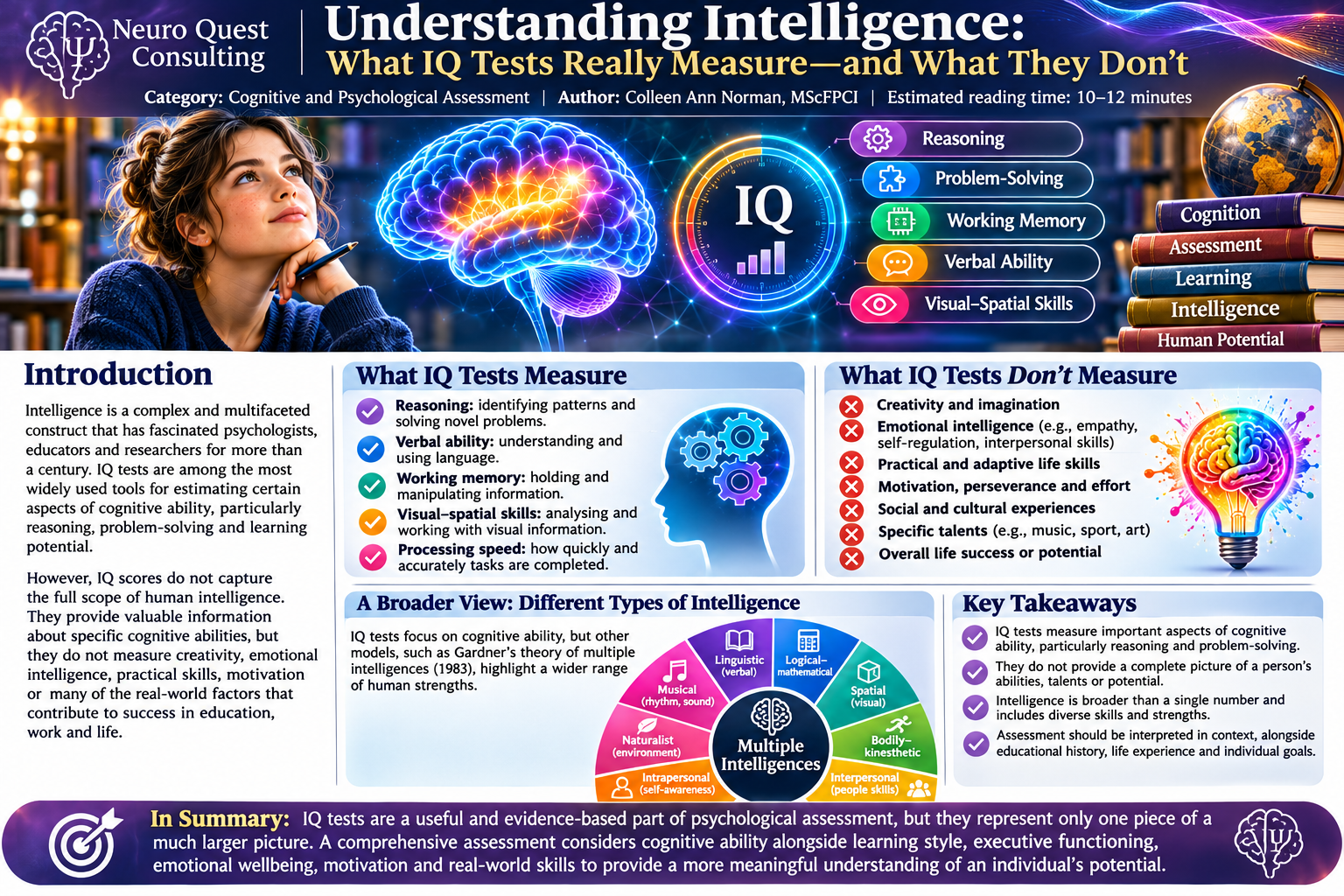
Introduction
What does it mean to be intelligent? Is intelligence the ability to solve complex mathematical problems, understand language, remember information or adapt successfully to unfamiliar situations?
For more than a century, psychologists have attempted to answer these questions through scientific research and the development of standardised intelligence assessments.
Intelligence quotient (IQ) tests are among the most widely researched instruments in psychological assessment. They provide useful information about cognitive abilities and can contribute to educational, clinical and occupational decision-making.
However, IQ scores are frequently misunderstood. A single score does not capture every aspect of an individual's intellectual functioning, nor does it establish their creativity, personality, motivation or overall potential.
Understanding the scientific foundations and limitations of intelligence assessment is essential for interpreting results responsibly.
What Is Intelligence?
Intelligence is generally understood as a broad capacity involving reasoning, learning, problem-solving and adaptation to cognitive demands.
Psychologists have proposed several theories to explain how intellectual abilities are organised.
Charles Spearman (1904) proposed the concept of general intelligence, commonly represented by the symbol g.
Spearman observed that individuals who performed well on one type of cognitive task often performed relatively well on others.
This pattern suggested that different cognitive abilities share an underlying general factor.
Subsequent researchers expanded intelligence theory to include both general cognitive ability and more specialised abilities.
One influential contemporary framework is the Cattell–Horn–Carroll (CHC) model, which describes intelligence through a hierarchy of broad and narrow cognitive abilities (Schneider & McGrew, 2018).
These theories have influenced the development and interpretation of modern psychometric assessments.
What Does an IQ Test Measure?
Modern intelligence tests generally assess several cognitive domains.
The exact abilities measured depend on the instrument, its theoretical foundations and the age of the individual being assessed.
Verbal Comprehension
Verbal comprehension involves understanding language, reasoning with verbal information and expressing conceptual knowledge.
Tasks may require individuals to explain relationships between concepts, define words or answer questions involving acquired knowledge.
Performance can be influenced by language development, educational opportunities and cultural experiences.
Fluid Reasoning
Fluid reasoning involves solving unfamiliar problems without relying exclusively on previously learned information.
For example, an individual may be asked to identify patterns or determine which element completes a visual sequence.
Fluid reasoning is particularly relevant when people encounter novel problems.
Visual-Spatial Ability
Visual-spatial abilities support the interpretation and manipulation of visual information.
They may involve understanding spatial relationships, mentally rotating shapes or reproducing geometric patterns.
These abilities contribute to many everyday and professional activities, although performance on a particular test should not be equated with overall practical competence.
Working Memory
Working memory allows individuals to temporarily retain and manipulate information.
Examples include remembering a sequence of numbers, following multistep instructions or mentally reorganising information.
Working memory plays an important role in learning and complex cognitive activity.
Processing Speed
Processing speed concerns the efficiency with which individuals perform certain simple cognitive tasks.
Some tests assess how quickly and accurately a person identifies, discriminates or records visual information.
Processing-speed performance can be influenced by several factors, including attention, motor demands, familiarity with the task and testing conditions.
A slower processing-speed score does not necessarily indicate lower reasoning ability.
How Are IQ Scores Calculated?
Modern IQ scores are generally derived by comparing an individual's performance with that of a representative standardisation sample.
Many widely used IQ scales have a mean of 100 and a standard deviation of 15.
This means that approximately 68% of scores in a normally distributed reference population fall between 85 and 115.
| IQ score | Approximate percentile |
|---|---|
| 70 | 2nd |
| 85 | 16th |
| 100 | 50th |
| 115 | 84th |
| 130 | 98th |
These values are approximate and assume a normal distribution with a mean of 100 and standard deviation of 15.
An IQ score is therefore a relative indicator of performance on the abilities measured by the test.
It is not a percentage of intelligence, and a score of 120 does not mean that someone is 20% more intelligent than a person scoring 100.
Why the Full-Scale IQ Is Not Always the Whole Story
Many intelligence assessments provide an overall score alongside separate index scores.
The overall score can be useful because general cognitive ability has demonstrated predictive value for several educational and occupational outcomes.
However, individuals may display substantial variation across cognitive domains.
Consider a student who demonstrates strong verbal reasoning but comparatively weaker working memory and processing speed.
The overall IQ score may obscure important differences in how that student approaches learning.
The student might understand complex ideas yet struggle to complete timed assignments or retain lengthy verbal instructions.
A qualified assessor must consider whether the overall score provides an appropriate summary and how individual index scores should be interpreted.
This requires attention to the test's technical manual, reliability, confidence intervals and the individual's broader assessment history.
Intelligence and Academic Achievement
Intelligence and academic achievement are related but distinct constructs.
Intelligence tests assess cognitive abilities, while achievement tests measure acquired academic skills such as reading, spelling and mathematics.
A student may demonstrate average or above-average reasoning ability while experiencing significant difficulties with reading.
This pattern can occur in dyslexia.
Similarly, a student with ADHD may possess strong intellectual abilities but struggle with task initiation, organisation or sustained attention.
The presence of learning or attention difficulties does not automatically indicate reduced intelligence.
Educational assessment can help distinguish among cognitive abilities, academic attainment and factors that interfere with performance.
Can Intelligence Change?
Intellectual development is influenced by biological, developmental and environmental factors.
Research indicates that cognitive abilities show both stability and change across the lifespan.
Educational experiences, health, opportunities for learning and developmental circumstances can influence cognitive performance.
Ritchie and Tucker-Drob (2018) found evidence that education has a beneficial effect on performance on intelligence tests.
However, this does not mean that every intervention claiming to increase IQ has scientific support.
Claims about brain-training programmes, supplements or rapid intelligence enhancement should be evaluated critically.
It is also important to distinguish genuine cognitive development from practice effects or increased familiarity with a particular test.
Intelligence and Genetics
Research has demonstrated that genetic factors contribute to individual differences in intelligence.
However, heritability estimates are population-specific statistical measures.
They do not indicate that an individual's intelligence is fixed or that environmental influences are unimportant.
Genetic influences operate within developmental and environmental contexts.
Education, nutrition, health and social opportunity remain relevant to cognitive development.
The relationship between genetic and environmental influences is complex, and findings about population variation should not be used to make deterministic judgments about individuals.
What IQ Tests Do Not Measure
Despite their scientific value, conventional IQ tests do not provide comprehensive measurements of every human ability.
Creativity
Creativity involves generating ideas or solutions that are both original and useful.
Although some aspects of creativity relate to cognitive ability, standard IQ tests are not designed to provide a comprehensive assessment of creative potential.
An individual may demonstrate exceptional artistic originality without obtaining an unusually high IQ score.
Emotional Intelligence
Emotional intelligence concerns abilities or characteristics associated with recognising, understanding and managing emotions.
Different theoretical models define and measure emotional intelligence in different ways.
Conventional IQ tests do not directly measure empathy, emotional regulation or interpersonal sensitivity.
Motivation and Perseverance
Motivation, persistence and self-discipline can influence how individuals pursue goals.
These characteristics may contribute to educational and occupational outcomes but are not comprehensively captured by IQ scores.
Practical and Adaptive Skills
Practical functioning includes managing everyday responsibilities, communicating effectively, navigating social environments and applying knowledge in real-world circumstances.
An individual may perform well on cognitive tests while experiencing substantial difficulties with adaptive functioning.
Conversely, someone with lower measured cognitive abilities may demonstrate well-developed practical skills.
These differences are particularly important in clinical assessment.
The Theory of Multiple Intelligences
Howard Gardner (1983) proposed that human abilities could be understood through several forms of intelligence, including linguistic, logical-mathematical, spatial, musical, bodily-kinaesthetic, interpersonal and intrapersonal capacities.
Gardner's theory has influenced educational discussions by encouraging recognition of varied human abilities.
However, it is important to distinguish its educational appeal from its psychometric evidence.
The theory has not received the same level of empirical support as hierarchical models of cognitive ability, and its proposed intelligences are not established as independent cognitive factors in the same way as abilities measured by conventional intelligence tests.
Consequently, multiple intelligences should not be presented as a scientifically validated replacement for standardised intelligence assessment.
Intelligence, Culture and Fairness
Psychometric assessment must account for cultural, linguistic and educational factors.
Test performance can be affected by language proficiency, familiarity with testing conventions and access to educational opportunities.
An assessment developed and standardised for one population may not be equally appropriate for every individual.
Qualified assessors should consider the suitability of the instrument, the available normative data and any relevant limitations.
Fair interpretation requires more than simply administering a standardised test.
It involves understanding the individual and recognising the boundaries of what the results can establish.
Why Reliability and Validity Matter
Psychometric tests should be evaluated according to their reliability and validity.
Reliability concerns the consistency or precision of measurement.
Validity concerns the extent to which evidence supports the interpretations and uses of test scores.
A test may produce highly consistent results without measuring the intended construct adequately.
Similarly, a measure may be appropriate for one purpose but unsuitable for another.
Professional assessment requires selecting instruments supported by appropriate evidence and interpreting them according to their intended use.
The Standards for Educational and Psychological Testing provide an important framework for responsible test development and use (American Educational Research Association et al., 2014).
Intelligence Assessment in Children
For children, cognitive assessment may contribute to understanding learning strengths, developmental concerns and educational support needs.
Assessment findings can help identify areas where a child may benefit from additional instruction, accommodations or further investigation.
However, results should be considered alongside academic achievement, developmental history, classroom observations and relevant contextual information.
An intelligence test alone does not diagnose dyslexia, ADHD or autism.
Nor should a single score be used to place unnecessary limits on a child's educational opportunities.
The purpose of assessment should be to improve understanding and support informed decision-making.
Intelligence Assessment in Adults
Adults may seek cognitive assessment for educational, occupational or clinical reasons.
Assessment can provide information about reasoning, memory, processing efficiency and other cognitive abilities.
Depending on the referral question, results may help clarify learning needs or inform further evaluation.
However, different referral purposes require different instruments and professional competencies.
For example, an assessment of intellectual functioning is not interchangeable with a comprehensive neuropsychological evaluation following a neurological injury.
The assessment process should therefore begin with a clearly defined question.
Interpreting Intelligence Responsibly
An IQ score should never be treated as a complete description of a person.
A meaningful assessment considers the individual's abilities, developmental history, educational experiences, cultural and linguistic background, and the specific purpose of testing.
Psychologists must also recognise measurement uncertainty.
Standardised scores are estimates, not perfectly precise quantities.
Confidence intervals and relevant sources of measurement error should be considered when interpreting results.
The most useful assessment is one that translates findings into an accurate, balanced and practical understanding of the individual.
Conclusion
Intelligence testing has made substantial contributions to psychology, education and clinical assessment.
Modern IQ tests provide scientifically grounded information about important cognitive abilities, including reasoning, verbal comprehension, working memory, visual-spatial processing and processing speed.
However, intelligence is not synonymous with a single numerical score.
Creativity, motivation, emotional functioning, practical abilities and individual experiences also contribute to how people learn, work and navigate the world.
At Neuro Quest Consulting, psychometric assessment is approached as a means of understanding individual cognitive profiles rather than reducing people to a single test result.
When interpreted responsibly, intelligence assessment can contribute to better educational planning, greater self-understanding and more informed decisions about support.
References
American Educational Research Association, American Psychological Association, & National Council on Measurement in Education. (2014). Standards for educational and psychological testing. American Educational Research Association.
Gardner, H. (1983). Frames of mind: The theory of multiple intelligences. Basic Books.
Ritchie, S. J., & Tucker-Drob, E. M. (2018). How much does education improve intelligence? A meta-analysis. Psychological Science, 29(8), 1358–1369. https://doi.org/10.1177/0956797618774253
Schneider, W. J., & McGrew, K. S. (2018). The Cattell–Horn–Carroll theory of cognitive abilities. In D. P. Flanagan & E. M. McDonough (Eds.), Contemporary intellectual assessment: Theories, tests, and issues (4th ed., pp. 73–163). Guilford Press.
Spearman, C. (1904). “General intelligence,” objectively determined and measured. The American Journal of Psychology, 15(2), 201–292. https://doi.org/10.2307/1412107
Editorial note: This article is intended for general educational information and does not replace individual psychological assessment. References should be checked against the final publication records before posting.