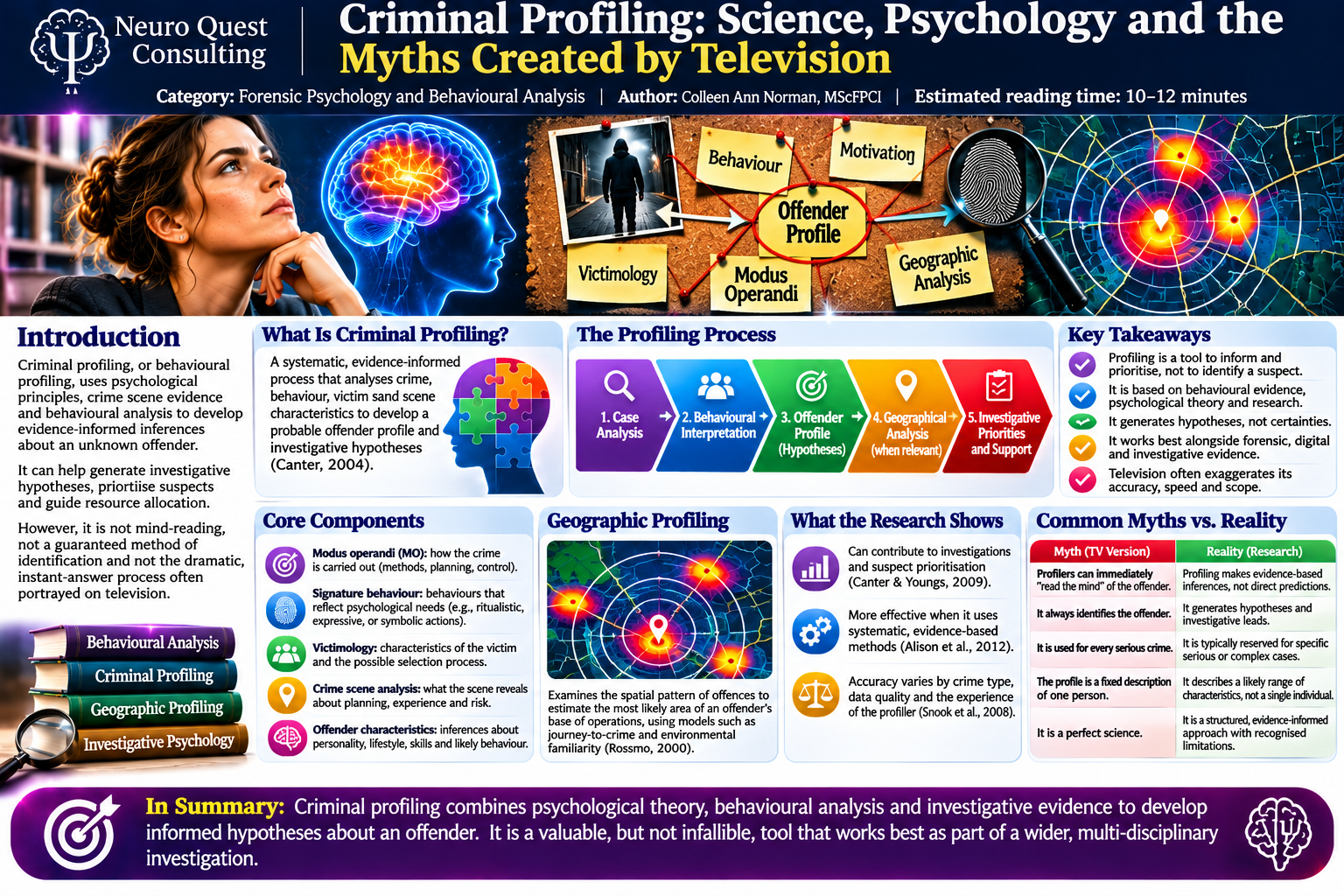
Introduction
Criminal profiling has captured the public imagination for decades. Television programmes frequently portray profilers as extraordinary investigators capable of identifying an unknown offender's personality, childhood experiences and future behaviour after examining only a few crime-scene photographs.
These portrayals make compelling entertainment, but they often misrepresent the scientific foundations and practical limitations of criminal profiling.
In professional contexts, behavioural investigative advice involves the systematic examination of offence-related information to develop hypotheses that may assist investigators.
The approach may draw upon psychology, criminology, behavioural analysis, crime-scene evidence, victimology and geographic information.
However, criminal profiling is not mind-reading. It does not provide a scientifically guaranteed method of identifying an offender, and its effectiveness depends on the quality of evidence, the methods employed and the circumstances of the investigation.
Understanding its potential contribution requires separating established research findings from popular assumptions.
What Is Criminal Profiling?
Criminal profiling involves drawing inferences about an unknown offender from information associated with one or more offences.
These inferences may concern behavioural tendencies, offence patterns, possible investigative priorities or relationships between crimes.
Canter (2004) described offender profiling as an area requiring greater attention to scientific principles and empirically supported inference.
A central challenge is determining whether characteristics observed during an offence can reliably support conclusions about characteristics of the person responsible.
For example, investigators may identify repeated patterns in how an offender approaches victims.
However, establishing that the same behavioural pattern occurred across several offences does not automatically reveal the offender's occupation, personality or personal history.
The strength of any inference depends on the evidence supporting the relationship between the observed behaviour and the proposed conclusion.
The Origins of Criminal Profiling
Attempts to infer offender characteristics from criminal behaviour have a long history.
Modern criminal profiling developed through several traditions, including clinical interpretation, police investigative experience and empirical behavioural research.
In the United States, the FBI's Behavioural Science Unit contributed to the development and popularisation of criminal investigative analysis.
Researchers and practitioners subsequently proposed different approaches to interpreting crime-scene behaviour.
In the United Kingdom, investigative psychology developed as an empirical approach emphasising systematic analysis of offender behaviour and psychological principles.
David Canter played an influential role in establishing this research tradition.
These approaches share an interest in behavioural evidence but differ in their theoretical assumptions, methods and levels of empirical support.
The Difference Between Criminal Profiling and Investigative Psychology
Criminal profiling is a broad term encompassing several approaches.
Some methods rely heavily on professional experience and case-based interpretation.
Investigative psychology places particular emphasis on developing and testing psychological principles relevant to criminal investigations.
Canter and Youngs (2009) described investigative psychology as the application of psychological research and systematic analysis to investigative questions.
This may involve examining behavioural consistency, offender differentiation, geographic patterns, investigative decision-making and the relationships between crime-related actions.
The distinction matters because not all profiling techniques have been evaluated to the same scientific standard.
A conclusion based on a systematic statistical analysis should not automatically be treated as equivalent to an intuition-based interpretation.
Behavioural Evidence and Crime-Scene Analysis
Crime-scene behaviour can provide information about how an offence occurred.
Relevant evidence may include the sequence of actions, methods of approach, interactions with victims and apparent attempts to avoid detection.
Investigators may also consider whether particular behaviours appear across multiple offences.
However, behavioural interpretation requires caution.
The same action may have several explanations.
For example, an offender may enter a property through an unlocked door because of opportunity rather than careful planning.
Similarly, an absence of physical evidence does not necessarily demonstrate sophisticated forensic knowledge.
The investigator must distinguish between what the evidence establishes and what remains hypothetical.
Modus Operandi and Signature Behaviour
Two concepts frequently discussed in criminal profiling are modus operandi and signature behaviour.
Modus Operandi
Modus operandi, often abbreviated as MO, refers to the methods used to commit an offence.
Examples may include methods of entry, approaches to victims or techniques used to obtain property.
These methods can change as offenders gain experience, encounter different circumstances or adapt to obstacles.
Signature Behaviour
Signature behaviour is commonly used to describe actions interpreted as expressing psychological needs beyond those strictly necessary to commit an offence.
However, determining whether behaviour represents a psychological signature can involve considerable interpretive uncertainty.
Investigators should avoid assuming that an unusual action necessarily reveals a stable psychological motivation.
Behavioural similarities may assist linkage analysis, but their significance must be evaluated against alternative explanations and relevant evidence.
Victimology: Understanding Victim Selection
Victimology involves the systematic study of victims and the circumstances surrounding victimisation.
In criminal investigations, victimological information may help clarify opportunities, offender-victim interactions and possible patterns of selection.
Relevant questions may include where the victim encountered the offender, whether a prior relationship existed and what circumstances created an opportunity for the offence.
However, victimology must not become victim-blaming.
The objective is to understand the circumstances of an offence, not to transfer responsibility from the offender to the person harmed.
Victim characteristics may be relevant to investigative hypotheses, but they do not independently establish offender motivation.
Geographic Profiling
Geographic profiling examines the spatial distribution of offences and related locations.
The objective may be to identify geographic areas that warrant investigative attention.
For example, repeated offences occurring within a particular region may provide information about an offender's activity patterns.
Researchers have examined relationships between offenders' home locations, travel behaviour and crime sites.
Rossmo (2000) developed an influential approach to geographic profiling based on spatial analysis.
However, geographic profiling does not reveal an offender's address with certainty.
Its usefulness depends on factors such as the number and distribution of relevant offences, the accuracy of location information and the assumptions of the analytical method.
A geographic profile should be interpreted as an investigative aid rather than a definitive identification.
Behavioural Consistency and Offender Linkage
One important research question is whether offenders behave consistently across different crimes.
If certain behaviours remain relatively stable, investigators may be able to use them when examining whether offences were committed by the same person.
However, behavioural consistency is not absolute.
Offenders may change methods because of circumstances, opportunities, victim responses or attempts to avoid detection.
Research on behavioural linkage therefore examines both consistency and distinctiveness.
A behaviour must not only recur; it must also be sufficiently informative to distinguish among possible offenders or offence series.
Woodhams et al. (2007) reviewed the use of behavioural consistency in linking serial offences.
The research supports careful empirical evaluation rather than assuming that every offender has a unique and unchanging behavioural signature.
Can Criminal Profiling Identify an Offender?
One of the most persistent myths is that a profiler can determine an offender's identity from psychological characteristics alone.
In reality, profiling generally produces hypotheses rather than identification evidence.
A profile may suggest investigative priorities or identify patterns worth examining.
It may also help investigators reconsider assumptions or organise complex information.
However, the profile must be tested against independent evidence.
DNA, fingerprints, digital records, witness information and other investigative findings may provide more direct links between a suspect and an offence.
Profiling should complement such evidence rather than replace it.
How Accurate Is Criminal Profiling?
The accuracy of profiling has been debated for decades.
Snook et al. (2007) critically examined claims concerning the scientific foundations of criminal profiling.
Their review identified important limitations in the available evidence and questioned whether popular confidence in profiling was justified.
One difficulty is that profiling studies use different methods, definitions and outcome measures.
Another is that profiles may contain statements that are difficult to falsify.
For example, describing an offender as someone who may appear socially ordinary but experience private emotional difficulties is too broad to provide strong investigative discrimination.
Scientific evaluation requires clear predictions, appropriate comparison groups and measurable outcomes.
The Barnum Effect and Vague Profiles
The Barnum effect describes the tendency for individuals to perceive broad or general personality statements as personally accurate.
This phenomenon is relevant to criminal profiling because vague descriptions may appear insightful even when they apply to many people.
For example, a profile might describe an offender as experiencing internal conflict while maintaining an outwardly normal appearance.
Without additional evidence, such a statement may have limited investigative value.
The critical question is not whether a profile sounds plausible.
It is whether the information distinguishes among competing hypotheses and improves investigative decisions.
Confirmation Bias in Criminal Investigations
Confirmation bias occurs when individuals preferentially seek, interpret or remember information supporting an existing belief.
In criminal investigations, an early hypothesis may influence how subsequent evidence is evaluated.
For example, investigators may become convinced that an offender possesses particular personality characteristics.
They may then interpret ambiguous behaviour as supporting that conclusion while overlooking inconsistent evidence.
A psychological profile can unintentionally reinforce this process if its assumptions are not critically examined.
Good investigative practice requires considering alternative explanations and actively seeking evidence capable of disproving preferred hypotheses.
Criminal Profiling and Mental Health
Television programmes sometimes imply that unusual criminal behaviour must indicate a psychiatric disorder.
This is not scientifically justified.
A criminal act cannot establish a mental health diagnosis.
Similarly, most individuals experiencing mental illness do not engage in serious violence.
Psychological symptoms may be relevant in particular investigations, but diagnostic conclusions require appropriate clinical evidence.
Profilers should avoid inferring psychiatric conditions solely from unusual or disturbing crime-scene characteristics.
Profiling Serial Offences
Criminal profiling is often associated with serial homicide and sexual offending.
These cases may involve complex behavioural patterns and substantial investigative information.
However, serial offences are not necessarily committed according to a fixed psychological script.
The same offender may demonstrate different behaviours across incidents.
Conversely, unrelated offenders may use similar methods because they encounter comparable opportunities.
Linkage analysis must therefore examine whether observed similarities are statistically and behaviourally meaningful.
Investigators should avoid relying on dramatic assumptions about ritual, symbolism or offender personality without adequate supporting evidence.
Criminal Profiling Versus Threat Assessment
Criminal profiling and behavioural threat assessment are related but distinct activities.
Criminal profiling often examines offences that have already occurred and seeks to generate investigative hypotheses.
Behavioural threat assessment generally focuses on evaluating concerning behaviour and circumstances relevant to potential future harm.
Threat assessment may involve patterns of communication, behavioural changes, access to potential targets and other contextual information.
Neither discipline can predict human behaviour with certainty.
Both require careful evidence evaluation, appropriate methods and recognition of uncertainty.
The Influence of Television and Popular Culture
Television has contributed significantly to public fascination with profiling.
Fictional investigators frequently identify offenders through sudden psychological insights.
These portrayals may exaggerate the speed, accuracy and scope of behavioural analysis.
In real investigations, relevant information is often incomplete, contradictory or uncertain.
Analysts may spend considerable time reviewing records, constructing timelines, comparing incidents and evaluating competing explanations.
Their conclusions may be modest rather than dramatic.
The scientific value of behavioural analysis depends on disciplined reasoning, not theatrical certainty.
What Makes Profiling Scientifically Defensible?
A scientifically defensible profiling approach should demonstrate several characteristics.
Clear definitions: The behaviours and characteristics under examination should be defined precisely.
Transparent reasoning: Investigators should be able to explain how conclusions were reached.
Empirical support: Inferences should be grounded in relevant research wherever possible.
Alternative hypotheses: Competing explanations should be considered.
Testability: Predictions should be specific enough to evaluate against evidence.
Acknowledgment of uncertainty: Conclusions should distinguish established facts from tentative interpretations.
These principles help prevent speculative reasoning from being presented as scientific certainty.
The Role of Forensic Psychology
Forensic psychology can contribute to criminal investigations by applying psychological research to relevant behavioural questions.
Potential contributions include analysing decision-making, evaluating behavioural patterns, examining memory and interviewing issues, and considering psychological processes associated with offending.
However, the appropriate role depends on the practitioner's expertise, the referral question and the available evidence.
Psychological expertise does not confer an ability to determine guilt.
Criminal responsibility and guilt are legal questions requiring appropriate evidential and judicial processes.
Ethical Considerations
Profiling can have serious consequences when it influences investigative decisions.
An unsupported profile may divert resources, reinforce stereotypes or contribute to unjustified suspicion.
Practitioners should therefore avoid making claims that exceed their evidence.
Particular caution is necessary when drawing conclusions about ethnicity, mental illness, personality disorders or other sensitive characteristics.
The objective is to improve investigative reasoning, not to construct a persuasive narrative unsupported by facts.
Ethical practice requires transparency, accountability and recognition of professional limitations.
The Future of Criminal Profiling
Advances in behavioural research, statistical modelling and data analysis may improve certain aspects of investigative decision-making.
Computational approaches can assist with identifying patterns across large datasets.
Geographic analysis, behavioural linkage and evidence integration may also benefit from improved analytical methods.
However, technological sophistication does not automatically establish validity.
Algorithms and statistical models must be evaluated for accuracy, bias, generalisability and practical usefulness.
Future progress will depend on rigorous research and transparent evaluation rather than increasingly elaborate claims about predicting offender characteristics.
Conclusion
Criminal profiling occupies an important but frequently misunderstood position within forensic psychology and criminal investigation.
Its potential value lies in organising behavioural evidence, developing testable hypotheses and supporting investigative decisions.
However, profiling is not a scientifically guaranteed method of identifying offenders.
Its limitations include uncertain behavioural inferences, inconsistent empirical support and the potential for cognitive bias.
The most defensible approach combines psychological knowledge with systematic evidence analysis, alternative hypotheses and clear recognition of uncertainty.
At Neuro Quest Consulting, forensic psychological analysis emphasises evidence-informed reasoning, behavioural interpretation and the importance of distinguishing investigative hypotheses from established facts.
Understanding criminal behaviour requires scientific discipline—not the illusion of certainty portrayed on television.
References
Canter, D. (2004). Offender profiling and investigative psychology. Journal of Investigative Psychology and Offender Profiling, 1(1), 1–15. https://doi.org/10.1002/jip.7
Canter, D., & Youngs, D. (2009). Investigative psychology: Offender profiling and the analysis of criminal action. Wiley.
Rossmo, D. K. (2000). Geographic profiling. CRC Press.
Snook, B., Eastwood, J., Gendreau, P., Goggin, C., & Cullen, R. M. (2007). Taking stock of criminal profiling: A narrative review and meta-analysis. Criminal Justice and Behavior, 34(4), 437–453. https://doi.org/10.1177/0093854806296925
Woodhams, J., Hollin, C. R., & Bull, R. (2007). The psychology of linking crimes: A review of the evidence. Legal and Criminological Psychology, 12(2), 233–249. https://doi.org/10.1348/135532506X118631
Editorial note: This article provides general educational information. It does not constitute an investigative profile, psychological diagnosis or opinion concerning any specific criminal case. References should be verified before publication.