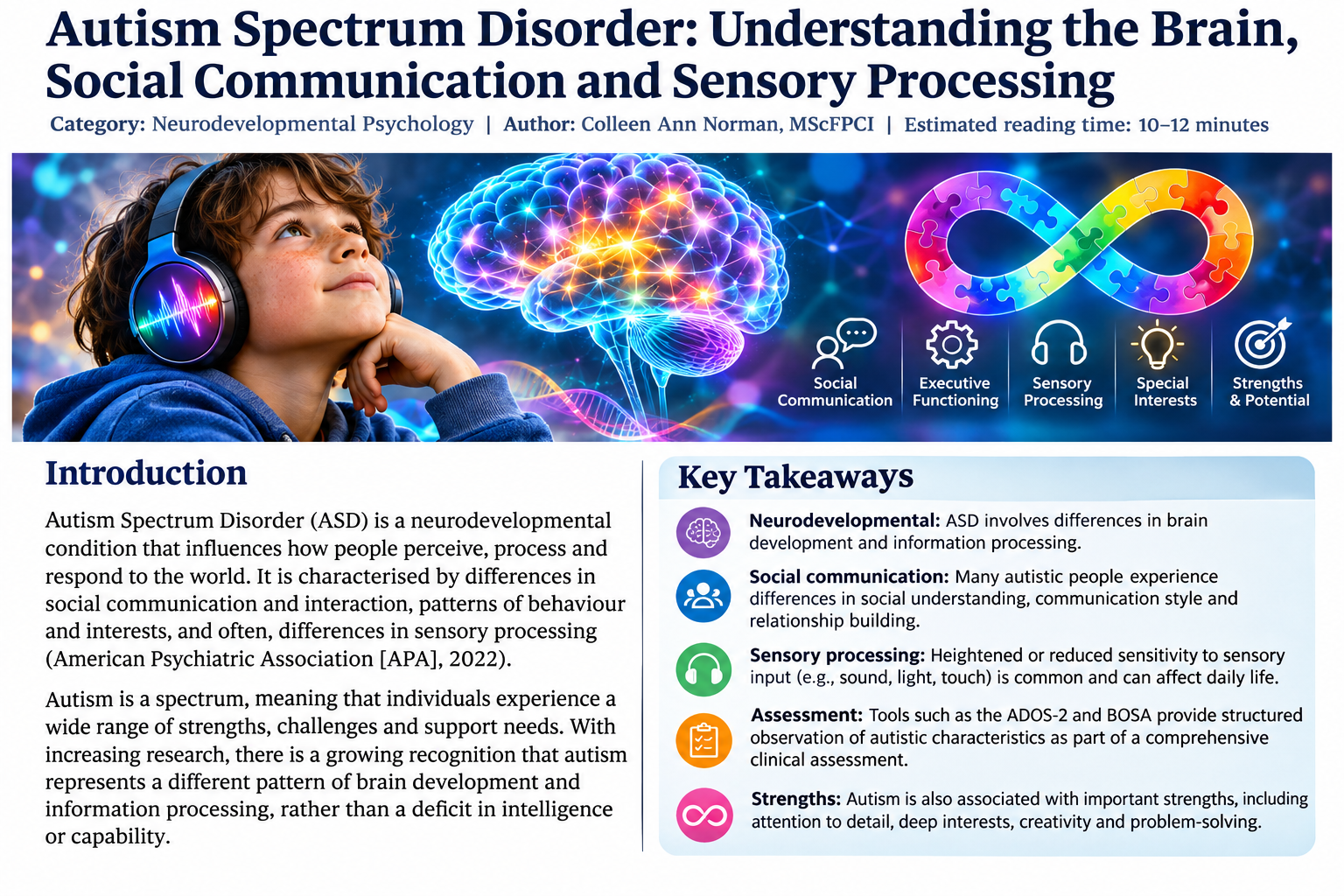
Understanding Autism
Autism spectrum disorder (ASD) is a neurodevelopmental condition characterised by persistent differences in social communication and interaction, together with restricted or repetitive patterns of behaviour, interests or activities. These characteristics emerge during development, although they may not become fully apparent until social demands increase (American Psychiatric Association [APA], 2022).
Autism is described as a spectrum because individuals vary considerably in their abilities, experiences and support needs.
Some autistic people communicate fluently and live independently, while others have substantial communication, intellectual, sensory or daily-living support needs. These differences cannot be adequately represented by a simple distinction between mild and severe autism.
A person may demonstrate advanced verbal abilities while experiencing significant sensory distress or difficulty managing everyday activities.
Understanding autism therefore requires examining an individual's complete developmental and functional profile.
The Neuroscience of Autism
Neuroscientific research suggests that autism involves differences in brain development, connectivity and information processing.
However, no single neurological characteristic explains every autistic presentation.
Research has examined the development of brain networks involved in social cognition, sensory processing, attention and behavioural flexibility (Ecker et al., 2015).
Brain Connectivity
Neural connectivity refers to the structural and functional relationships among brain regions.
Studies have investigated whether patterns of connectivity differ between autistic and non-autistic populations.
Some findings suggest differences in the coordination of networks involved in social communication, sensory integration and cognitive control.
Nevertheless, results vary across studies, and autism cannot be reliably identified through a particular connectivity pattern.
Social Cognition Networks
Social cognition involves interpreting social information, understanding intentions and responding to interpersonal situations.
Relevant brain regions include the medial prefrontal cortex, temporoparietal junction and superior temporal sulcus.
Research has explored differences in how these regions respond during social tasks in autistic and non-autistic groups (Pelphrey et al., 2011).
Such findings should not be interpreted as evidence that autistic individuals lack empathy or the capacity to form meaningful relationships.
Social understanding is complex, and communication difficulties can arise when people with different interaction styles misunderstand one another.
Sensory Processing Networks
Sensory processing involves detecting, interpreting and regulating information from the environment.
Autistic individuals may experience heightened or reduced responses to sounds, lighting, textures, smells or other sensations.
Research suggests that sensory differences are an important component of many autistic experiences (Robertson & Baron-Cohen, 2017).
These experiences can influence learning, emotional wellbeing and participation in everyday activities.
Social Communication and Interaction
Social communication involves verbal language, non-verbal communication, conversational reciprocity and understanding social context.
Autistic individuals may communicate differently in several ways.
Some prefer direct and literal language, while others may find implied meanings, sarcasm or ambiguous social expectations difficult to interpret.
Eye contact also varies. For some individuals, maintaining eye contact may be uncomfortable or distracting rather than a sign of attentiveness.
It is therefore important not to interpret reduced eye contact automatically as dishonesty, disinterest or disrespect.
Communication differences may also involve conversational timing, turn-taking and understanding unwritten social conventions.
The double-empathy perspective proposes that misunderstandings between autistic and non-autistic people may reflect differences in reciprocal understanding rather than difficulties located exclusively within the autistic individual (Milton, 2012).
This perspective encourages greater attention to mutual communication and environmental adaptation.
Restricted and Repetitive Patterns of Behaviour
Autism is also associated with patterns of behaviour, interests or activities that may include repetition, preference for predictability, intense interests and sensory-related responses.
Repetitive movements, sometimes described as stimming, may include rocking, hand movements or manipulating objects.
These behaviours can serve regulatory, communicative or pleasurable functions.
A strong preference for routine may help individuals manage uncertainty and anticipate what will happen next.
Unexpected changes can sometimes create considerable distress, particularly when combined with sensory or social demands.
Intense interests may provide enjoyment, expertise and opportunities for social connection.
They should not automatically be regarded as problematic. Their significance depends on the individual's experience and whether they interfere with wellbeing or necessary activities.
Sensory Processing and Everyday Life
Sensory differences are particularly important because they may be invisible to other people.
Consider a student entering a crowded classroom.
Fluorescent lighting, overlapping conversations, scraping chairs and movement may create an overwhelming sensory environment.
The student's difficulty concentrating may reflect the combined effects of sensory demands rather than unwillingness to participate.
Similarly, an adult may find busy shopping centres exhausting or experience discomfort from clothing textures.
Sensory responses can vary across individuals and situations.
Practical adjustments may include quieter environments, reduced visual clutter, alternative lighting, predictable routines and opportunities for sensory breaks.
The objective is to support participation without assuming that every autistic person requires identical adjustments.
Autism and Executive Functioning
Executive functioning refers to the cognitive processes supporting planning, organisation, inhibition, working memory and flexible behaviour.
Some autistic individuals experience difficulty switching between tasks, adapting to unexpected changes or organising complex activities.
For example, a student may understand an assignment but struggle to determine where to begin or how to divide it into manageable stages.
Executive-function differences are not exclusive to autism and may also occur in ADHD and other conditions.
Assessment should therefore consider the individual's particular cognitive profile rather than attributing every difficulty to autism.
Autism in Girls and Women
Autism has historically been recognised more frequently in boys than girls.
Researchers have investigated whether differences in presentation, social expectations and assessment practices contribute to under-recognition in some girls and women (Lai et al., 2015).
Some individuals consciously or unconsciously modify their behaviour to fit social expectations.
This process is often called camouflaging or masking.
Examples may include rehearsing conversations, imitating social behaviour or suppressing visible repetitive movements.
Although these strategies may facilitate participation in certain situations, sustained camouflaging can be exhausting.
However, masking is not unique to women, and not every autistic person uses these strategies.
Assessment should be sensitive to individual presentation rather than relying exclusively on stereotypical behavioural descriptions.
Autism in Adulthood
Some individuals reach adulthood without receiving an autism diagnosis.
They may have developed coping strategies or lived in environments that accommodated their particular needs.
Difficulties may become more apparent during transitions involving increased social, occupational or organisational demands.
Adults seeking assessment may describe longstanding experiences of social misunderstanding, sensory sensitivity, preference for predictability or exhaustion following demanding interactions.
A developmental history remains important because autism is a neurodevelopmental condition.
Assessment must also consider other possible explanations and co-occurring conditions.
How Is Autism Assessed?
Autism assessment requires a comprehensive examination of developmental history, social communication, behavioural characteristics, functional needs and relevant contextual information.
Clinical guidelines recommend using information from multiple sources rather than relying on a single observation or questionnaire (National Institute for Health and Care Excellence [NICE], 2011, 2012).
Two assessment tools frequently discussed in specialist practice are the Autism Diagnostic Observation Schedule, Second Edition (ADOS-2), and the Brief Observation of Symptoms of Autism (BOSA).
The ADOS-2
The ADOS-2 is a standardised, semi-structured observational assessment designed to examine communication, social interaction, play or imaginative use of materials, and restricted or repetitive behaviours.
Different modules are selected according to an individual's language and developmental characteristics.
The assessment creates opportunities for a trained examiner to observe behaviours relevant to autism.
Although the ADOS-2 is widely used, its results must be interpreted alongside developmental history, clinical information and other assessment findings.
An ADOS-2 classification is not, by itself, equivalent to a comprehensive clinical diagnosis.
The BOSA
The Brief Observation of Symptoms of Autism was developed to provide a structured, brief observation of autism-related behaviours, particularly in circumstances where a conventional ADOS-2 administration was not feasible.
The BOSA uses activities designed to elicit behaviours relevant to autism and requires appropriately trained professionals to interpret observations within a broader assessment process.
Its development and initial psychometric evaluation were described by Dow et al. (2022).
Like the ADOS-2, the BOSA is not intended to replace comprehensive diagnostic evaluation.
The selection of assessment procedures depends on clinical circumstances, the individual's needs and the qualifications of the professionals involved.
Autism and Co-occurring Conditions
Autism may co-occur with ADHD, anxiety disorders, intellectual disability, language difficulties, sleep disturbances and other developmental or mental health conditions.
Recognising co-occurring conditions is essential because an individual's difficulties may have multiple contributing factors.
For example, a child experiencing autism, ADHD and dyslexia may require distinct forms of educational and psychological support.
A comprehensive formulation considers how these characteristics interact rather than assuming that one diagnosis explains every aspect of functioning.
Strengths and Individual Differences
Autistic individuals may demonstrate strong attention to detail, extensive knowledge in areas of interest, originality, persistence or distinctive approaches to problem-solving.
However, these characteristics are not universal, and autism should not be portrayed as automatically conferring exceptional abilities.
A strengths-based approach involves identifying the person's actual abilities, preferences and goals.
It also recognises genuine difficulties and the importance of appropriate support.
Respecting neurodiversity does not mean overlooking disability or support needs. Rather, it involves understanding differences without reducing individuals to diagnostic labels.
Supporting Autistic Individuals
Effective support should be individualised, respectful and informed by the person's communication style, sensory needs and priorities.
In educational settings, useful adjustments may include predictable schedules, clear instructions, sensory accommodations and structured transitions.
In employment, support might involve written communication, quiet workspaces, explicit expectations or flexibility in how tasks are completed.
Families and professionals can also benefit from understanding that behaviours sometimes interpreted as defiance may reflect distress, communication difficulties or overwhelming environmental demands.
Support should promote autonomy, wellbeing and meaningful participation.
Conclusion
Autism is a complex neurodevelopmental condition characterised by substantial variation in communication, behaviour, sensory experience and support needs.
Neuroscience has contributed important insights into associated differences in brain development and information processing, although no single neurological marker defines autism.
Comprehensive assessment, including appropriately selected observational instruments such as the ADOS-2 or BOSA, can contribute to understanding an individual's developmental and behavioural profile.
The central objective is not merely to identify diagnostic characteristics but to understand the individual, recognise strengths, clarify support needs and improve opportunities for participation and wellbeing.
References
American Psychiatric Association. (2022). Diagnostic and statistical manual of mental disorders (5th ed., text rev.). https://doi.org/10.1176/appi.books.9780890425787
Dow, D., Guthrie, W., Stronach, S. T., & Wetherby, A. M. (2022). Psychometric analysis of the Brief Observation of Symptoms of Autism (BOSA). Journal of Autism and Developmental Disorders, 52, 1–14. [Bibliographic details to be verified before publication.]
Ecker, C., Bookheimer, S. Y., & Murphy, D. G. M. (2015). Neuroimaging in autism spectrum disorder: Brain structure and function across the lifespan. The Lancet Neurology, 14(11), 1121–1134. https://doi.org/10.1016/S1474-4422(15)00050-2
Lai, M.-C., Lombardo, M. V., Auyeung, B., Chakrabarti, B., & Baron-Cohen, S. (2015). Sex/gender differences and autism: Setting the scene for future research. Journal of the American Academy of Child & Adolescent Psychiatry, 54(1), 11–24. https://doi.org/10.1016/j.jaac.2014.10.003
Milton, D. E. M. (2012). On the ontological status of autism: The 'double empathy problem'. Disability & Society, 27(6), 883–887. https://doi.org/10.1080/09687599.2012.710008
National Institute for Health and Care Excellence. (2011). Autism spectrum disorder in under 19s: Recognition, referral and diagnosis (Clinical Guideline CG128). https://www.nice.org.uk/guidance/cg128
National Institute for Health and Care Excellence. (2012). Autism spectrum disorder in adults: Diagnosis and management (Clinical Guideline CG142). https://www.nice.org.uk/guidance/cg142
Pelphrey, K. A., Shultz, S., Hudac, C. M., & Vander Wyk, B. C. (2011). Research review: Constraining heterogeneity: The social brain and its development in autism spectrum disorder. Journal of Child Psychology and Psychiatry, 52(6), 631–644. https://doi.org/10.1111/j.1469-7610.2010.02349.x
Robertson, C. E., & Baron-Cohen, S. (2017). Sensory perception in autism. Nature Reviews Neuroscience, 18, 671–684. https://doi.org/10.1038/nrn.2017.112
Editorial note: This article is intended for educational purposes and does not constitute an individual diagnosis or clinical recommendation. References should receive a final bibliographic check before publication.