Introduction
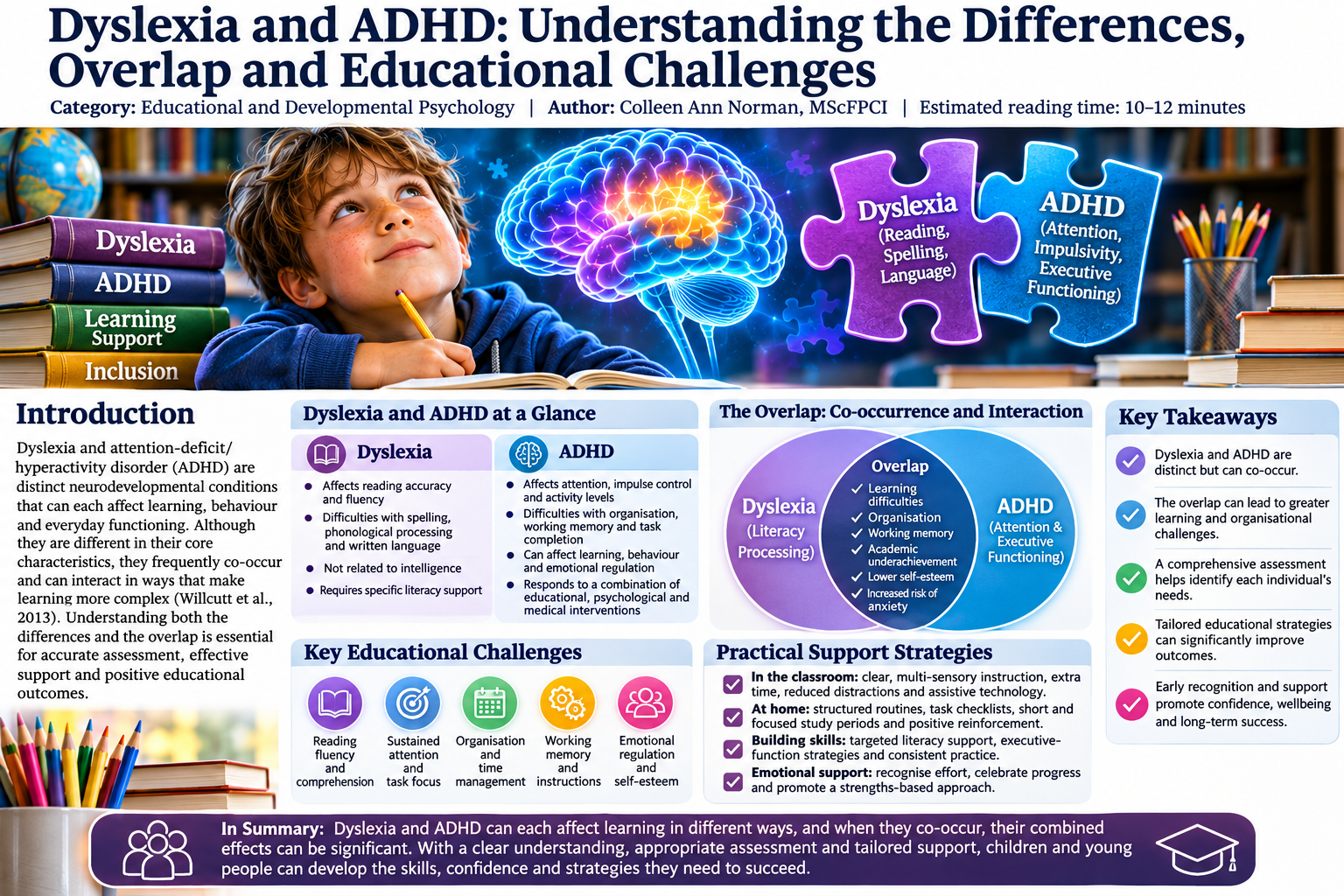
Dyslexia and attention-deficit/hyperactivity disorder (ADHD) are distinct neurodevelopmental conditions that can influence learning, behaviour and everyday functioning. Although their defining characteristics differ, they frequently co-occur, creating challenges that may be difficult to identify without comprehensive assessment.
A child who struggles with reading, spelling, organisation or classroom attention may be experiencing dyslexia, ADHD or both. Understanding the differences between these conditions is essential for identifying appropriate educational interventions and preventing unnecessary frustration.
Research has demonstrated that dyslexia and ADHD share some underlying cognitive and developmental influences, while retaining distinct characteristics (Willcutt et al., 2010).
The most effective approach is therefore not to assume that one diagnosis explains every difficulty but to investigate the individual's particular pattern of strengths and needs.
What Is Dyslexia?
Dyslexia is a learning difficulty primarily associated with the development of accurate and fluent word reading and spelling.
Individuals with dyslexia may experience difficulties with phonological processing, decoding unfamiliar words, recognising written words automatically and developing spelling accuracy.
These difficulties are not explained simply by low intelligence, poor motivation or inadequate effort.
Dyslexia can affect individuals across the full range of intellectual abilities.
For example, a child may demonstrate strong verbal reasoning and an excellent understanding of scientific concepts while experiencing persistent difficulty reading written instructions.
Without appropriate support, the child's academic performance may underestimate their actual understanding.
Dyslexia is commonly associated with difficulties in phonological processing, although its cognitive profile varies among individuals (Peterson & Pennington, 2015).
What Is ADHD?
ADHD is a neurodevelopmental condition characterised by persistent patterns of inattention and/or hyperactivity-impulsivity that interfere with functioning or development (American Psychiatric Association, 2022).
In educational settings, ADHD may affect sustained attention, task initiation, organisation, impulse control and the management of competing demands.
A student may understand an assignment but struggle to begin it, remain focused or complete it within the available time.
ADHD does not necessarily involve reading difficulties.
Some children with ADHD read fluently but experience difficulty sustaining attention during lengthy reading tasks.
Others may have both ADHD and dyslexia, creating a more complex educational profile.
How Do Dyslexia and ADHD Differ?
The distinction between dyslexia and ADHD is particularly important during educational assessment.
Dyslexia primarily concerns difficulties with acquiring fluent and accurate word-level literacy skills.
ADHD primarily concerns difficulties regulating attention and/or activity and impulses.
| Area | Dyslexia | ADHD |
|---|---|---|
| Primary difficulty | Word reading and spelling | Attention and/or hyperactivity-impulsivity |
| Reading | Decoding and fluency difficulties | May involve inconsistent attention during reading |
| Spelling | Frequently affected | May be affected by inattention or co-occurring dyslexia |
| Organisation | May be affected by task demands | Frequently challenging |
| Impulse control | Not a defining characteristic | May be affected |
| Intelligence | Not defined by IQ | Not defined by IQ |
These distinctions are general rather than absolute. An individual may experience additional difficulties that extend beyond the defining features of either condition.
Why Do Dyslexia and ADHD Frequently Co-occur?
Research suggests that dyslexia and ADHD share some genetic and cognitive risk factors.
Willcutt et al. (2010) examined the relationship between reading disability and ADHD and identified evidence of shared cognitive weaknesses alongside disorder-specific difficulties.
Twin research has also supported overlapping genetic influences on reading difficulties and ADHD symptoms (Willcutt et al., 2007).
However, co-occurrence does not mean that dyslexia causes ADHD or that ADHD causes dyslexia.
Both conditions may arise through partly shared and partly distinct developmental mechanisms.
This distinction is important because intervention targeting one condition does not necessarily resolve difficulties associated with the other.
The Role of Working Memory
Working memory enables individuals to temporarily retain and manipulate information.
It is involved in following instructions, performing mental calculations, understanding complex sentences and completing multistep activities.
Some children with dyslexia experience working-memory difficulties, particularly when tasks involve verbal or phonological information.
Working-memory difficulties are also commonly observed in ADHD, although they are not present in every individual (Martinussen et al., 2005).
When both conditions occur together, classroom demands may become particularly challenging.
For example, a teacher might ask a child to read a paragraph, identify the main argument and write a short summary.
The child may struggle to decode the words while also finding it difficult to maintain attention and remember the instructions.
The combined cognitive demands can make a relatively straightforward classroom activity exhausting.
Processing Speed and Academic Performance
Processing speed refers to how efficiently an individual performs certain relatively simple cognitive tasks.
Some children with dyslexia or ADHD demonstrate slower performance on particular processing-speed measures.
However, processing speed is not a single universal ability, and difficulties may differ according to the task.
A child may answer questions accurately when given sufficient time but perform poorly under strict time limits.
This can lead to misleading interpretations of ability.
Teachers and assessors should distinguish between the quality of understanding and the speed at which a student produces a response.
Appropriate adjustments may include additional time, reduced unnecessary copying and access to assistive technology where justified by individual assessment.
Reading Difficulties: Dyslexia or Inattention?
One of the most important questions in educational assessment is whether poor reading performance reflects difficulty recognising written words, difficulty sustaining attention or both.
Consider two children.
Child A reads slowly, struggles to decode unfamiliar words and makes persistent spelling errors. Their reading difficulties remain apparent even when attention is well supported.
This pattern may warrant investigation for dyslexia.
Child B can decode words accurately but frequently loses their place, skips sections and struggles to remain engaged with lengthy passages.
This pattern may suggest that attention regulation contributes to the reading difficulty.
A third child may demonstrate both patterns.
These examples are illustrative, not diagnostic. Comprehensive assessment is necessary to distinguish among possible explanations.
Emotional Wellbeing and Self-Esteem
Repeated academic difficulties can influence children's confidence and attitudes towards learning.
A child who consistently works harder than classmates but achieves lower marks may begin to believe that they lack ability.
When dyslexia and ADHD co-occur, difficulties with literacy, organisation and behavioural expectations may create additional frustration.
Some children experience anxiety about reading aloud, completing timed assignments or being criticised for forgotten homework.
The resulting distress may contribute to avoidance of educational activities.
A supportive environment should recognise effort, identify specific barriers and provide achievable opportunities for success.
Children benefit from understanding that learning differences do not define their intelligence, character or future potential.
Comprehensive Educational Assessment
When dyslexia and ADHD are both suspected, assessment should consider each condition separately while examining their interaction.
A specialist educational assessment may investigate:
- Reading accuracy, fluency and comprehension.
- Spelling and phonological processing.
- Working memory and relevant cognitive abilities.
- Processing speed and patterns of task performance.
- Educational history and classroom functioning.
- Attention-related concerns and the possibility of referral for clinical ADHD assessment.
ADHD diagnosis requires an appropriately qualified clinician and a comprehensive clinical assessment.
Psychometric testing can provide valuable information about learning and cognitive functioning, but it does not independently establish an ADHD diagnosis.
The objective is to develop a coherent understanding of why difficulties occur and what support is most appropriate.
Supporting Children in the Classroom
Children with dyslexia and ADHD may benefit from coordinated support addressing both literacy and attention-related needs.
For dyslexia, structured, explicit literacy instruction can help develop decoding, word recognition and spelling skills.
The International Dyslexia Association describes structured literacy approaches that systematically teach the relationships between sounds, letters, spelling patterns and language structures.
For ADHD, educational strategies may include clear instructions, predictable routines, task breakdown, reduced distractions and regular feedback.
A child experiencing both conditions may require literacy intervention alongside organisational and attentional support.
Neither approach should replace the other.
Practical Strategies for Parents
Parents can support learning by creating predictable routines and reducing unnecessary demands on memory and organisation.
Homework may be divided into shorter sessions with clearly defined goals.
Written checklists, visual schedules and consistent locations for school materials can help children manage responsibilities.
Reading activities should be appropriate to the child's skill level, with opportunities for encouragement rather than repeated experiences of failure.
Assistive technology, including text-to-speech and speech-to-text software, may improve access to learning while literacy instruction continues.
Positive reinforcement should focus on specific achievements and effort rather than comparing the child with siblings or classmates.
Importantly, support should be collaborative. Children can be involved in identifying which strategies help them most.
Educational Support in the United Kingdom
In England, children with special educational needs may receive SEN support through their school.
The school's Special Educational Needs Coordinator (SENCO) can help coordinate assessment information, adjustments and educational interventions.
Some children with more substantial needs may require consideration for an Education, Health and Care Plan (EHCP).
A diagnosis is not automatically required before educational support can begin, and support should be based on identified needs.
Parents can consult government SEND guidance and discuss concerns with their child's school.
For suspected ADHD, families may also seek advice through their GP or relevant specialist services.
The Importance of Early Recognition
Early identification can reduce the risk of prolonged academic difficulties and negative educational experiences.
However, support remains valuable for older children, adolescents and adults.
A person who receives an assessment later in life may gain a clearer understanding of longstanding difficulties and discover strategies that were previously unavailable.
Recognition should lead to practical action rather than merely attaching a diagnostic label.
The most meaningful outcome is an improved understanding of the individual's needs and the development of effective support.
Conclusion
Dyslexia and ADHD are distinct conditions with different defining characteristics, but they may co-occur and interact in ways that complicate learning.
Dyslexia primarily affects word-level literacy development, while ADHD involves difficulties regulating attention and/or hyperactivity-impulsivity.
Both may influence working memory, classroom performance, emotional wellbeing and educational participation.
Comprehensive assessment is particularly important when difficulties overlap because effective support must address the actual mechanisms contributing to the child's experiences.
With appropriate recognition and support, children experiencing dyslexia, ADHD or both can develop effective strategies and participate more confidently in education.
References
American Psychiatric Association. (2022). Diagnostic and statistical manual of mental disorders (5th ed., text rev.). https://doi.org/10.1176/appi.books.9780890425787
International Dyslexia Association. (n.d.). Structured literacy: Effective reading instruction for students with dyslexia and related reading difficulties. https://dyslexiaida.org/structured-literacy-effective-reading-instruction-for-students-with-dyslexia-and-related-reading-difficulties/
Martinussen, R., Hayden, J., Hogg-Johnson, S., & Tannock, R. (2005). A meta-analysis of working memory impairments in children with attention-deficit/hyperactivity disorder. Journal of the American Academy of Child & Adolescent Psychiatry, 44(4), 377–384. https://doi.org/10.1097/01.chi.0000153228.72591.73
National Institute for Health and Care Excellence. (2018). Attention deficit hyperactivity disorder: Diagnosis and management (NICE Guideline NG87). https://www.nice.org.uk/guidance/ng87
Peterson, R. L., & Pennington, B. F. (2015). Developmental dyslexia. Annual Review of Clinical Psychology, 11, 283–307. https://doi.org/10.1146/annurev-clinpsy-032814-112842
Willcutt, E. G., Betjemann, R. S., McGrath, L. M., Chhabildas, N. A., Olson, R. K., DeFries, J. C., & Pennington, B. F. (2010). Etiology and neuropsychology of comorbidity between RD and ADHD: The case for multiple-deficit models. Cortex, 46(10), 1345–1361. https://doi.org/10.1016/j.cortex.2010.06.009
Willcutt, E. G., Pennington, B. F., Olson, R. K., & DeFries, J. C. (2007). Understanding comorbidity: A twin study of reading disability and attention-deficit/hyperactivity disorder. American Journal of Medical Genetics Part B: Neuropsychiatric Genetics, 144B(6), 709–714. https://doi.org/10.1002/ajmg.b.30310
Editorial note: This article provides general educational information rather than individual diagnostic advice. Scientific references should undergo final verification before website publication.