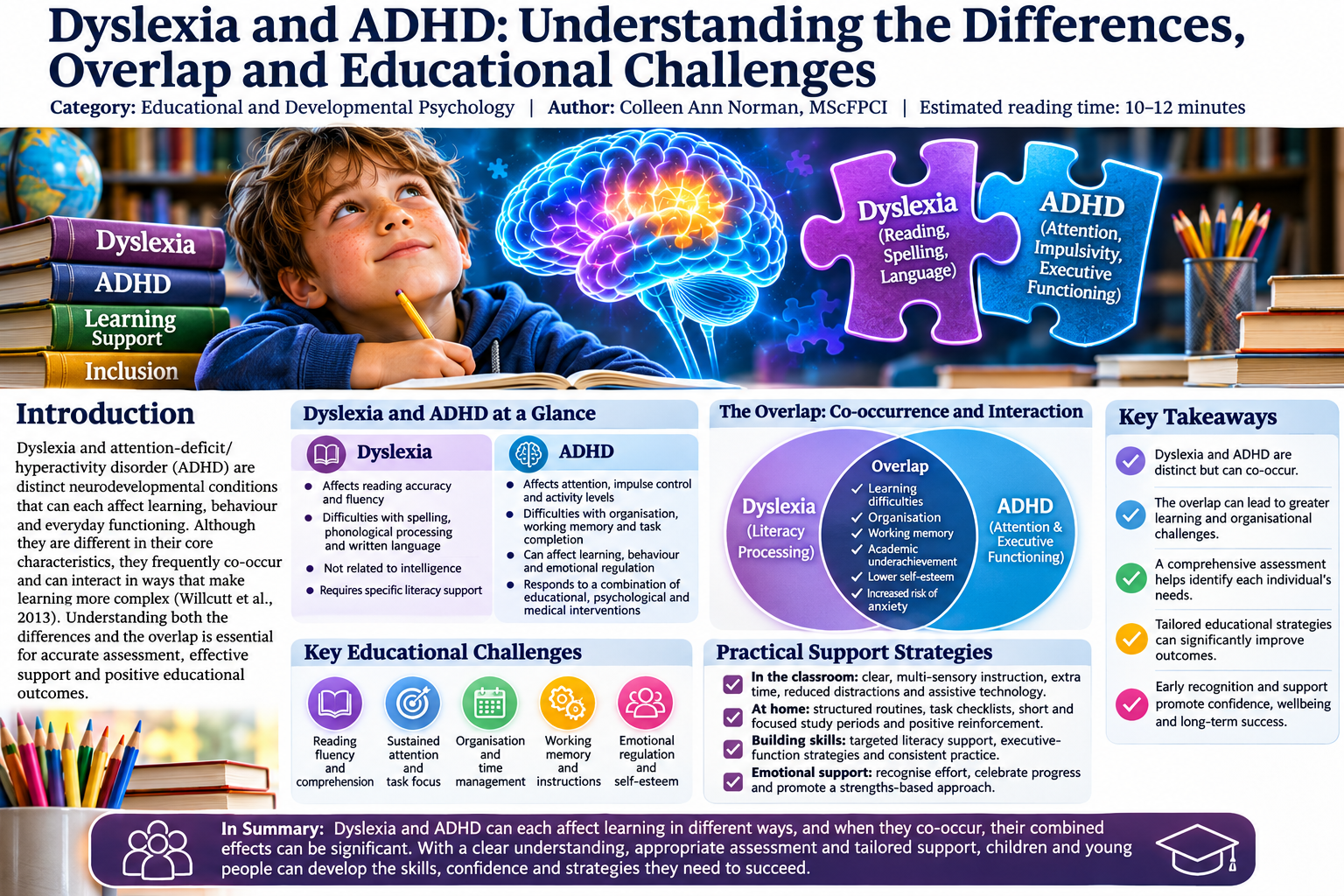
Why dyslexia is not a measure of intelligence, how it affects the brain, and why appropriate assessment and support can make a lasting difference.
Introduction: When Reading Becomes a Challenge
Imagine a bright, curious child who can explain complicated ideas, remember fascinating facts, and participate confidently in classroom discussions. Yet when asked to read a paragraph aloud, that same child hesitates, struggles to recognise familiar words, and becomes increasingly frustrated.
Now imagine an adult who has developed a successful career but continues to find reading lengthy documents, spelling unfamiliar words, or completing written tasks under time pressure exhausting.
These experiences may reflect dyslexia, a learning difficulty that affects the development of accurate and fluent reading and spelling.
For decades, dyslexia has been misunderstood. Children have sometimes been labelled careless or inattentive, while adults may have spent years questioning their academic abilities. However, research has established that dyslexia is a neurodevelopmental learning difficulty involving complex interactions between genetic, neurobiological, cognitive, and environmental influences (Peterson & Pennington, 2015).
Understanding dyslexia requires moving beyond assumptions about intelligence and examining the cognitive processes that make reading possible.
1. What Is Dyslexia?
Dyslexia is characterised primarily by persistent difficulties with accurate or fluent word reading and spelling.
In October 2025, the International Dyslexia Association adopted a revised definition reflecting advances in scientific understanding. The revision recognises that dyslexia varies in severity, may present differently across languages, and involves multiple interacting influences rather than a single universal cognitive deficit (Catts et al., 2026).
In the United Kingdom, the British Dyslexia Association adopted a definition developed through an expert Delphi consensus process in 2025. This definition emphasises processing difficulties affecting reading and spelling, with phonological processing, working memory, processing speed, and orthographic knowledge contributing to the individual's profile (British Dyslexia Association, 2025).
Dyslexia is not simply a difficulty with seeing letters correctly. It involves aspects of how written language is learned, recognised, processed, and retrieved.
Crucially, dyslexia is not an indication of low intelligence. Individuals with dyslexia demonstrate a wide range of intellectual abilities, just as individuals without dyslexia do.
The relationship between reading difficulties and general intelligence is particularly important when considering assessment. Contemporary approaches do not require a large discrepancy between intelligence and reading attainment before dyslexia can be identified (Catts et al., 2026).
2. What Happens in the Dyslexic Brain?
Reading is not an innate human ability in the same way that acquiring spoken language generally is. The brain must learn to coordinate visual recognition, speech sounds, language knowledge, attention, and memory to interpret written symbols.
Neuroimaging research has identified a network of predominantly left-hemisphere brain regions involved in skilled reading.
These include:
- Left temporoparietal regions: Involved in aspects of mapping written symbols to speech sounds and integrating language information.
- Left occipitotemporal regions: Important for rapid recognition of familiar written words and letter patterns.
- Left inferior frontal regions: Involved in language processing, articulation, and aspects of phonological analysis.
Research reviews have reported differences in the structure and functioning of reading-related networks among groups of individuals with dyslexia compared with typical readers (Peterson & Pennington, 2015).
However, these findings require careful interpretation.
Brain imaging cannot currently diagnose dyslexia reliably in an individual. Group-level neurological differences do not mean every person with dyslexia has an identical neurological profile.
Furthermore, the brain is adaptable. Reading instruction and experience can influence the functioning of reading networks, demonstrating the importance of effective educational intervention.
3. Phonological Processing: Why Sounds Matter
One of the most extensively researched cognitive characteristics associated with dyslexia is difficulty with phonological processing.
Phonological processing refers to the ability to recognise, remember, and manipulate the sounds of spoken language.
Consider the word cat. A child learning to read must understand that the spoken word contains three phonemes: /k/, /æ/, and /t/. The child must then learn how those sounds correspond to written letters.
For some individuals with dyslexia, these relationships are more difficult to establish and retrieve automatically.
Common difficulties may include recognising rhymes, identifying individual sounds within words, blending sounds into complete words, decoding unfamiliar words, and spelling words accurately.
Nevertheless, phonological processing difficulties are not universal among individuals with dyslexia. The condition is heterogeneous, meaning that different individuals may exhibit different combinations of cognitive strengths and difficulties (Catts et al., 2026).
This variability is one reason that individualised assessment is important.
4. Working Memory, Processing Speed, and Reading Fluency
Although phonological processing is central to many explanations of dyslexia, other cognitive functions can contribute to its presentation.
Working memory allows individuals to temporarily hold and manipulate information. For example, a reader may need to remember the beginning of a sentence while processing its ending.
Processing speed refers to the efficiency with which certain cognitive operations can be completed. Slower processing may make timed reading and written tasks particularly demanding.
Orthographic processing involves learning and recognising familiar spelling patterns and written word forms.
Some individuals with dyslexia experience difficulties in one or more of these areas. Others may have comparatively strong working memory or processing speed despite substantial reading difficulties.
The British Dyslexia Association (2025) recognises these processing differences as potentially relevant to the impact of dyslexia.
Importantly, no single working-memory score or processing-speed score is sufficient to establish dyslexia. These measures must be interpreted alongside direct assessments of reading and spelling.
5. Recognising Dyslexia in Children and Adults
Dyslexia may become apparent during the early years of literacy instruction, although some individuals are not identified until secondary school, university, or adulthood.
In younger children, possible indicators include difficulty learning letter–sound relationships, recognising familiar words, spelling simple words, or developing fluent reading.
Older students may read accurately but slowly, avoid reading aloud, struggle with lengthy written assignments, or require considerably more time to complete literacy tasks.
Adults may report persistent spelling difficulties, slow reading, problems with unfamiliar terminology, or fatigue when undertaking demanding written work.
However, these characteristics are not diagnostic on their own.
Reading difficulties can arise for numerous reasons, including limited educational opportunities, language differences, sensory impairments, or other developmental conditions.
A comprehensive assessment must consider these possibilities without automatically excluding dyslexia when another condition is present.
6. Why Professional Assessment Matters
An appropriate dyslexia assessment should do more than produce a single test score.
It should investigate the individual's literacy difficulties, developmental and educational history, relevant cognitive processes, and functional needs.
Depending on the assessment's purpose, relevant areas may include:
- Word-reading accuracy and fluency.
- Decoding of unfamiliar or nonwords.
- Spelling accuracy.
- Phonological awareness and processing.
- Rapid naming and aspects of processing efficiency.
- Relevant working-memory skills.
- Educational history and response to previous instruction.
The precise assessment battery depends on the individual's age, presenting difficulties, and professional assessment standards.
Standardised tests can provide valuable information about performance relative to appropriate comparison groups. However, results must be interpreted by a suitably qualified practitioner who understands psychometric reliability, validity, and the limitations of individual measures.
A thorough assessment should also identify strengths, educational needs, and practical recommendations.
As Catts et al. (2026) emphasise, identification should focus on persistent word-reading and spelling difficulties within a broader educational and developmental context.
7. Can Dyslexia Be Treated?
Dyslexia is generally understood as a persistent developmental learning difficulty rather than a temporary condition that can simply be cured.
Nevertheless, effective teaching and appropriate accommodations can substantially improve literacy skills and everyday functioning.
One influential approach is structured literacy, which emphasises explicit and systematic teaching of the relationships between sounds, letters, spelling patterns, word structure, vocabulary, and language comprehension (International Dyslexia Association, 2024).
Instruction may involve carefully sequenced phonics, guided decoding, spelling practice, repeated opportunities to develop fluency, and comprehension activities.
Interventions should be selected according to the individual's needs and monitored for effectiveness.
Not every programme marketed as a dyslexia intervention has strong empirical support. Educational decisions should therefore consider the quality of the available research rather than relying solely on testimonials or commercial claims.
The earlier that significant literacy difficulties are recognised, the sooner appropriate support can begin. However, adults can also benefit from targeted literacy instruction and assistive technology.
8. Dyslexia, Confidence, and Emotional Wellbeing
The psychological consequences of persistent reading difficulties should not be overlooked.
A child who repeatedly struggles with classroom reading may begin to anticipate failure, avoid written tasks, or become reluctant to participate.
Similarly, an adult may conceal literacy difficulties because of embarrassment or concerns about how colleagues will interpret them.
These responses do not mean dyslexia inevitably causes anxiety, depression, or low self-esteem. Rather, repeated negative educational experiences and inadequate support can contribute to emotional difficulties.
The revised international definition explicitly acknowledges that dyslexia may affect psychological wellbeing, academic achievement, and employment opportunities (Catts et al., 2026).
Appropriate support therefore involves more than improving reading scores.
It also requires recognising effort, reducing unnecessary barriers, providing realistic accommodations, and ensuring that individuals are not defined by their literacy difficulties.
9. Dyslexia and Individual Strengths
Public discussions frequently associate dyslexia with creativity, entrepreneurship, visual thinking, or exceptional problem-solving.
Although some individuals with dyslexia demonstrate outstanding abilities in these areas, it is important not to assume that dyslexia automatically produces particular talents.
The scientific evidence does not establish a universal dyslexic cognitive advantage.
Individuals with dyslexia differ considerably in their interests, abilities, personalities, educational experiences, and professional achievements.
A strengths-based approach should therefore focus on identifying the actual abilities of the individual rather than assigning characteristics based on a diagnostic label.
Recognising strengths is compatible with acknowledging genuine literacy-related difficulties and providing appropriate support.
10. The Importance of Early Identification and Appropriate Support
One of the most significant developments in contemporary dyslexia research is the increasing emphasis on early identification and intervention.
Waiting until a child experiences years of academic difficulty before providing additional support can create unnecessary educational and emotional disadvantages.
The Rose Report (Rose, 2009) highlighted the importance of identifying literacy difficulties and providing appropriate teaching in the UK educational system.
More recent international guidance continues to emphasise early language and literacy support while recognising that identification and intervention remain valuable throughout adulthood (Catts et al., 2026).
For parents, educators, and employers, the practical message is straightforward: persistent reading and spelling difficulties deserve careful attention.
Assessment should not be regarded merely as a process of assigning a label. Its purpose is to understand the individual's learning profile and identify interventions and adjustments that can improve participation, independence, and achievement.
Conclusion: Understanding the Individual, Not Just the Diagnosis
Dyslexia is a complex learning difficulty with important implications for education, employment, and psychological wellbeing.
Research has moved beyond simplistic explanations that attribute reading difficulties to low intelligence, lack of motivation, or visual confusion.
Contemporary evidence instead supports a multifactorial understanding involving language processing, neurodevelopment, genetics, educational experience, and individual differences.
The most effective response is neither to minimise dyslexia nor to define individuals entirely by it.
It is to identify genuine difficulties, recognise individual strengths, provide evidence-informed instruction, and remove unnecessary barriers to learning.
Understanding dyslexia begins with understanding the person.
References
British Dyslexia Association. (2025). Dyslexia factsheet. https://cdn.bdadyslexia.org.uk/uploads/documents/Downloadable-Resources/British-Dyslexia-Association-Dyslexia-Factsheet.pdf
Catts, H. W., Haynes, C. W., & Joshi, R. M. (2026). Defining dyslexia: 2025 revision. Annals of Dyslexia, 76, 409–437. https://doi.org/10.1007/s11881-026-00363-4
International Dyslexia Association. (2024). Structured literacy defined: An explanation and rationale. https://dyslexiaida.org/wp-content/uploads/2025/12/8_SL-Fact-Sheet.pdf
Peterson, R. L., & Pennington, B. F. (2015). Developmental dyslexia. Annual Review of Clinical Psychology, 11, 283–307. https://doi.org/10.1146/annurev-clinpsy-032814-112842
Rose, J. (2009). Identifying and teaching children and young people with dyslexia and literacy difficulties: An independent report. Department for Children, Schools and Families. https://dera.ioe.ac.uk/id/eprint/14790/
This article is provided for educational purposes and does not replace an individual assessment by a suitably qualified professional.
Show less